Getting found online isn’t luck, it’s about using the right HVAC SEO keywords. If customers can’t find you, they’ll call your competitors instead.
The challenge? 94% of keywords get fewer than 10 searches per month, meaning many businesses are targeting ineffective terms.
By strategically optimizing with high-impact HVAC keywords, you can rank higher, drive traffic, and turn searches into service calls.
This guide breaks down 101 high-impact HVAC keywords, along with local SEO keywords examples to help you optimize your website, blogs, and service pages. Whether you’re a seasoned pro or just starting with SEO, these keywords will put your HVAC company on the map.
Ready to get more clicks, calls, and conversions? Let’s dive in!
Want More HVAC Leads? It Starts with the Right Keywords!
Ever wonder why some HVAC businesses show up first on Google while others get buried?
The secret isn’t just great service—it’s using the right words in the right places! Keywords are the foundation of your online success. 46% of SEO experts say keyword management is the most effective SEO tactic.
When you use HVAC SEO keywords that match what people are searching for, you increase your chances of landing on page one—and businesses with a strong keyword strategy can, on average, rank 1.5 spots higher than their competitors.
Think of keywords as the GPS that guides customers straight to your website. Using HVAC keywords for SEO in your blogs, service pages, and even image descriptions helps search engines understand what you do.
The best HVAC keywords focus on the services you offer and the areas you serve, making it easier for local customers to find you.
Need an SEO keyword example?
If someone searches for “AC repair near me” and your site has HVAC marketing keywords like “air conditioning repair in [city],” you have a better shot at showing up.
That’s why choosing the best keywords for HVAC is crucial—they drive traffic, generate leads, and help your business grow.

The Keyword Showdown: Short-Tail vs. Long-Tail
Not all keywords are created equal, especially when it comes to HVAC SEO. You’ll hear a lot about short-tail and long-tail keywords, and while both are important, they serve different purposes.
- Short-tail keywords, like “HVAC repair” or “air conditioning,” are broad and competitive. They get a lot of search volume, but because every HVAC company is targeting them, they’re tough to rank for.
- Long-tail keywords are more specific. Think “best HVAC repair service in [city]” or “affordable furnace installation for small homes.” These are easier to rank for and usually bring in better-quality leads because they’re targeted to customers with a clear intent.
In fact, the top 10% of Google-ranked sites use keywords with an average length of 3.2–3.5 words, showing just how crucial long-tail keywords are for SEO success.
Where should you use them?
- Short-tail keywords are great for homepage content, your main service pages, and headlines.
- Long-tail keywords, on the other hand, really shine in blogs, FAQs, and detailed service descriptions, where you can get more specific and targeted.
🎯 The Keyword Sweet Spot: Mix, Match, and Rank Higher!
The key to a strong HVAC SEO strategy? A mix of both short-tail and long-tail keywords. The best HVAC websites balance both to boost rankings and bring in the right customers.
Want an SEO keyword example?
Here’s how you can do it: Optimize your homepage with HVAC marketing keywords that signal someone is ready to buy, like “HVAC services” or “AC contractor.” At the same time, show off your expertise by sprinkling in long-tail keywords like “energy-efficient furnace installation in [city]” throughout your blogs.
Ready to see how your keywords stack up? Your SEO strategy might be missing key opportunities! Get a free, comprehensive SEO audit for your HVAC website today and discover how you can optimize both short-tail and long-tail keywords to boost your rankings, drive more qualified leads, and improve your online presence. Request your audit now!
101 HVAC Keywords to Heat Up Leads & Cool Down the Competition
Choosing the right HVAC keywords is essential for driving traffic and growing your business. Whether you’re targeting local customers, seasonal services, or specific HVAC repairs, the right keywords help you rank higher and attract qualified leads.
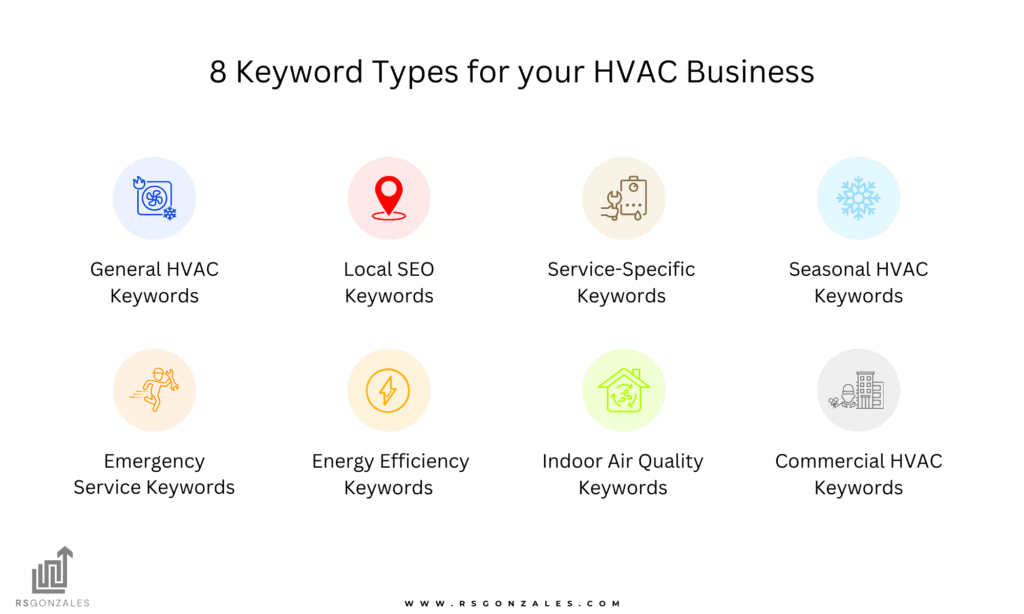
Here’s a breakdown of 101 powerful HVAC SEO keywords, covering everything from general services to emergency fixes, designed to boost your visibility and drive more conversions.
🛠️ 1. General HVAC Keywords
Broad industry terms are used to describe HVAC services. Ideal for homepages and your main service pages.
- HVAC services
- Heating and cooling repair
- Air conditioning installation
- Furnace maintenance
- HVAC system inspection
- Air conditioning repair
- HVAC replacement services
- Residential HVAC services
- HVAC tune-up
- HVAC troubleshooting
- Ductwork installation
- Commercial HVAC services
- HVAC system upgrades
- Heating system repair
- Cooling system maintenance
- Emergency HVAC repair
- Heat pump installation
- Indoor air quality solutions
- HVAC energy efficiency upgrades
- Ventilation system maintenance
- Smart thermostat installation
- Boiler repair services
📍 2. Local SEO Keywords (Geo-Targeted)
Helps rank for searches in specific cities, counties, and regions. Essential for Google Business Profile and service pages.
- HVAC repair [city]
- AC installation near me
- Furnace maintenance in [county]
- Heating and cooling services in [state]
- Emergency HVAC repair in [city]
- Best HVAC company in [county]
- Affordable AC Repair in [city]
- Licensed HVAC contractor near me
- Local heating and cooling specialists in [city]
- Top-rated HVAC services in [state]
- Best HVAC company near me
- Heating services in [city]
- AC replacement in [county]
- Same-day HVAC service in [city]
- HVAC installation in [state]
🔩 3. Service-Specific Keywords
Targets customers searching for specific HVAC services. Ideal for service pages and blog content.
- Heat pump repair
- Boiler replacement
- Ductless mini-split installation
- Smart thermostat setup
- Furnace replacement
- Central air conditioning installation
- HVAC system diagnostics
- Air handler repair
- Radiant heating system installation
- Ventilation system repair
- Thermostat replacement
❄️ 4. Seasonal HVAC Keywords
SEO-friendly terms based on weather-driven demand for heating and cooling services.
Winter
- Winter furnace tune-up
- AC unit freezing in winter
Spring
- Spring HVAC system inspection
- Best time to schedule AC maintenance
- HVAC maintenance for spring allergies
- Pre-summer AC tune-up
Summer
- Summer AC check-up
- Summer heatwave cooling solutions
- Emergency AC repair in summer
Fall
- HVAC winterization service
- Pre-winter heating system prep
- Fall HVAC maintenance
- Cold weather furnace check
⚠️ 5. Emergency Service Keywords
Used for urgent HVAC services that customers search for in critical situations. Perfect for Google Ads, service pages, and local SEO.
- 24/7 HVAC repair
- Emergency AC service
- Same-day furnace repair
- After-hours HVAC repair
- Urgent heating repair near me
- Immediate air conditioner fix
- Fast HVAC service in [city]
- Weekend furnace repair
- Rapid response HVAC technician
- Late-night emergency AC service
- Use emergency-related keywords.
- Be the first name they see.
- Dominate Google Maps rankings.

💡 6. Energy Efficiency Keywords
Appeals to eco-conscious and cost-saving homeowners. Great for blog posts, service pages, and lead magnets.
- Energy-efficient HVAC systems
- High-efficiency furnace installation
- Smart home HVAC upgrades
- SEER-rated AC units
- Energy-saving thermostat installation
- Green HVAC solutions
- Eco-friendly heating and cooling
- Best HVAC units for energy savings
- Reduce HVAC energy costs
- HVAC rebates and tax incentives
🌬️ 7. Indoor Air Quality Keywords
Ideal for targeting customers concerned about air quality, allergies, and home health.
- Air duct cleaning services
- UV light air purifiers
- HEPA filters for HVAC systems
- Whole-house dehumidifier installation
- Indoor air pollution solutions
- Air purifier for HVAC system
- Mold prevention with HVAC
- Ventilation system upgrades
- Carbon monoxide detector installation
- Best HVAC filters for allergies
🏢 8. Commercial HVAC Keywords
Targets businesses, offices, and industrial clients looking for HVAC services. Perfect for B2B service pages.
- Commercial HVAC contractors near me
- Industrial AC installation
- Office heating system repair
- Warehouse ventilation solutions
- Rooftop HVAC unit installation
- Restaurant HVAC maintenance
- HVAC solutions for office buildings
- Commercial ductwork installation
- Energy-efficient HVAC for businesses
- Retail store air conditioning services
Struggling to get your HVAC business noticed online? Don’t let your competitors steal your leads. Contact RS Gonzales today to optimize your HVAC website with the right SEO strategy and start bringing in more high-quality leads!
How To Match HVAC Keywords to Customer Intent
Don’t be surprised if not all keywords bring you new leads. Often, customers need to shop before they buy. Or, they’re looking for a DIY solution and may never become customers. That’s why it’s so important to understand the psychology behind each AC or heating keyword.
A healthy SEO strategy includes a mix of informational, navigational, and transactional keywords. In fact, Google wants to see that your HVAC offers informative content and isn’t just angling for the quick buck. Still, it’s important to understand the connection between keywords and customer intent.
Ask yourself: in spending my time writing a blog about this topic, am I attracting a browser or a buyer?
Where to (and Where NOT to) Add Keywords for HVAC SEO
When it comes to HVAC SEO keywords, placement is everything. Drop them in the right spots, and your site climbs the rankings. Overstuff them, and Google might push you down instead.
So, where should you add those HVAC marketing keywords—and where should you avoid them? Let’s break it down.
Where to Add Keywords for Maximum Impact ✅
- Optimizing website pages with HVAC keywords: Your homepage and service pages should naturally include HVAC keywords for SEO in the headlines, subheadings, and body text. This helps search engines (and potential customers) instantly understand what you offer.
- Writing SEO-friendly blog posts using long-tail keywords: Blogs are the perfect place for long-tail keywords. A well-written post using the best HVAC keywords like “how to fix a leaking AC unit” attracts homeowners actively searching for solutions.
- Creating location-specific service pages: If you serve multiple areas, create a dedicated page for each city or county. A page titled “AC Repair in [City]” with the right SEO keywords improves your local visibility.
- Using keywords in meta titles and meta descriptions: This is prime real estate for the best keywords for HVAC. When people search, Google highlights the meta title and description—so make sure they include your HVAC marketing keywords naturally.
- Leveraging Google Business Profile for local SEO: Your Google Business Profile needs strategic HVAC keywords for SEO in the business description, services, and posts to improve local rankings.
- Keyword placement in FAQs and customer testimonials: Many people search using questions, so adding HVAC SEO keywords in FAQs makes your website more discoverable. And if a happy customer says, “Kay’s Affordable HVAC&R provided the best furnace repair in [city],” that’s a natural and powerful keyword boost.
Where NOT to Add Keywords ❌
- **Overloading every sentence: “**Looking for HVAC services? Our HVAC services include the best HVAC services for all your HVAC service needs.” Yeah… don’t do this. Keyword stuffing makes your content unreadable and hurts your rankings.
- Forcing keywords in reviews: Google flags review stuffed with unnatural keywords. Keep testimonials authentic and organic. Keyword density is another important principle of HVAC SEO. Model the Goldilocks approach — not too many keywords, not too few.
- Image alt text cramming: Yes, the alt text should describe the image and include relevant HVAC SEO keywords, but don’t write: “HVAC services heating repair AC installation best HVAC company HVAC SEO.” Instead, say: “A technician performing AC installation for a homeowner.”
- Random keyword dumps: Throwing HVAC keywords for SEO at the bottom of a page in a list like “HVAC repair, heating services, AC tune-up, furnace replacement” won’t fool Google. In fact, it can hurt your rankings.
- Hidden or white text keywords: A shady old-school trick—hiding the best keywords for HVAC in white text on a white background—is a surefire way to get penalized. Google sees everything. The best SEO strategists abandoned this black hat SEO tactic a decade ago.

The DO’s & DONT’s of HVAC Marketing Keywords
The DO’s
- Write for humans first, search engines second: Your content should sound like a real person wrote it—not a robot. If your website feels overly optimized with HVAC keywords for SEO, but it’s unreadable, potential customers will bounce. Thanks to AI, Google can assess your content based on Natural Language Processing. That means search engine algorithms are getting better at recognizing and boosting content that reads well for bonafide humans.
- Make it locally relevant: People don’t just search for “AC repair.” They look for “AC repair near me” or “best HVAC company in [city].” Use keywords for HVAC that naturally fit your service areas—without overdoing it.
- Show real expertise and insights: Generic content won’t help you stand out. You’re not the only small business owner who is using ChatGPT. So, if you want to outperform AI-generated content, add personal insights, case studies, or real-world experiences. Show that your HVAC company actually knows what it’s talking about.
- Use keywords naturally in headlines, meta descriptions, and body text: The best places for HVAC marketing keywords are H1 and H2 headers, service pages, blog introductions, and Google Business Profile descriptions.
- Focus on long-tail keywords for better ranking chances: Instead of “HVAC services,” try SEO keyword examples like “best HVAC services for older homes in [city]” or “affordable furnace repair near me.”
- Add keywords in URLs for better search visibility: A clean, keyword-rich URL like /hvac-repair-near-me or /best-ac-installation helps Google understand your page’s focus and improves rankings. Posts with target keywords in their URL have a 45% higher click-through rate. But remember to keep your URLs short and relevant!
The DONT’s
- Don’t rely on AI-generated content and expect rankings: AI can help with ideas, but copy-pasting AI-generated content won’t rank well. Google prioritizes original, valuable insights—so edit, refine, and add real expertise. As a matter of fact, 46.08% of clicks in Google Search Console go to hidden terms, making manual keyword inclusion even more critical than ever.
- Don’t overstuff keywords: Cramming “HVAC repair in Chicago” into every sentence won’t help—it’ll actually hurt your rankings. Google understands that “furnace repair” and “Chicago” are semantically related, so there’s no need to repeat it awkwardly.
- Don’t forget about user experience: A page overloaded with HVAC keywords for SEO will feel unnatural and forced. Instead, keep the flow conversational, like you’re explaining services to a customer.
- Don’t ignore search intent: HVAC keywords randomly won’t help if they don’t match what your customers are actually looking for. Anyone searching for “HVAC installation financing” doesn’t need a blog about furnace maintenance.
- Don’t forget mobile users: Visitors will leave fast if your site is cluttered with excessive keywords and difficult to read on a phone. Mobile-friendliness is part of SEO now.
Case Study: How to Use HVAC SEO Keywords the Right Way?
Let’s say you’re creating a service page for Seattle HVAC repair. In that case, how do you write your content while ensuring there are enough keywords, but you are not stuffing keywords?
There are two ways to go about it: the wrong approach and the right approach. Confused? Let us simplify it for you!
Wrong Approach (Overstuffed, AI-Generated, Unnatural)
“Looking for furnace repair in Seattle? Our Seattle furnace repair experts offer the best furnace repair in Seattle. Contact our Seattle HVAC repair team today for the best Seattle heating services.”
What’s wrong?
- Repeats the same keyword unnaturally
- Doesn’t provide useful information
- Sounds robotic instead of engaging
Right Approach (Natural, User-Friendly, Local SEO Optimized)
“Need reliable furnace repair in Seattle? Our experienced HVAC technicians have been serving the Seattle area for over a decade. Whether your heater won’t start or your energy bills are skyrocketing, we provide fast, expert service. Call today for a free estimate!”
What’s right?
- Keeps it natural and conversational
- Includes local relevance without stuffing keywords
- Uses engaging, customer-focused language
Remember: AI is Transforming Keyword Research—But Google is Smarter!
With Google’s natural language processing (NLP) advancements, the algorithm now understands context better than ever. That means:
- You don’t need to force keywords if your content naturally covers the topic.
- Google recognizes synonyms and related terms, so mix up how you phrase HVAC services.
- Focusing on useful, high-quality content will always win over keyword stuffing.
Tools & Resources for HVAC Keyword Research
Want more calls and clicks? It all begins with choosing the right HVAC SEO keywords. But how do you find the best keywords for HVAC—the ones that attract real customers?
The key is simple: use smart research tools, track what’s working, and keep an eye on your competitors.
🔍 Free & Paid Keyword Research Tools
Free Tools:
- Google Keyword Planner – A solid start for finding keyword ideas.
- Google Trends – Shows which HVAC services are trending.
- AnswerThePublic – Great for question-based keywords like “Why is my AC leaking?”
- Ubersuggest – Offers limited free searches with volume and competition data.
Paid Tools:
- SEMrush & Ahrefs – Find SEO keywords examples and analyze competitors.
- Moz Keyword Explorer – Helps with ranking difficulty and long-tail keywords.
- Surfer SEO – Gives you real-time keyword optimization tips.
- Search Atlas – Uses heat maps to help you visualize how your keywords are ranking in “near me” searches on Google maps.
💡 Pro Tip: Even if you don’t use a paid tool, Google’s “People Also Ask” and autocomplete suggestions can uncover valuable HVAC marketing keywords.
📊 How to Track Keyword Performance
Once you’ve added the best HVAC keywords to your site, it’s crucial to track their performance to see what’s working and what needs improvement. Regular monitoring ensures your SEO strategy is effective and you’re staying ahead of the competition.
Easy ways to track your rankings:
- Google Search Console – Tracks clicks, impressions, and keyword rankings.
- Google Analytics – Shows which HVAC pages bring in traffic and which keywords are most effective.
- SEMrush or Ahrefs – Provides ranking updates, keyword insights, and competitive analysis.
Watch out for:
- Keyword movement: Are you climbing or dropping in rankings? Monitor regularly to catch any issues early.
- Click-through rates (CTR): Are people actually clicking on your site from search results? Low CTR could indicate your title tags or meta descriptions need optimization.
- Bounce rate: If visitors leave your site quickly, your page might not be meeting expectations. Check your page’s relevance and load time, or consider refining your content to better match user intent.
⚡ Competitor Analysis: Finding New Keyword Opportunities
Want to outperform other HVAC businesses? Look at what they’re ranking for! Competitor analysis can help you find gaps in their strategy and uncover valuable keyword opportunities for your own SEO success.
How to analyze competitors:
- Google your top services (e.g., “AC installation near me”) and see who ranks first.
- Check their keywords using tools like Ahrefs, SEMrush, or Ubersuggest to understand which terms drive their traffic.
- Look at their content—what FAQs, blogs, and service pages do they have that you don’t? Identify content opportunities to cover gaps in your strategy.
- Find gaps—are they missing HVAC keywords for SEO that you can target to rank higher? Use these gaps to outsmart the competition with more targeted content.
💡 Pro Tip: If a competitor is ranking for “furnace repair in [city]”, create an even better page with more details, FAQs, customer-focused content, and local SEO optimization to outperform them.
Need Help Implementing These HVAC SEO Strategies? RS Gonzales Has You Covered!
Optimizing your HVAC website with the right keywords takes time, effort, and expertise. 39% of marketers say keyword research is the toughest SEO task, but with RS Gonzales, we make it simple and effective.
As a leading digital marketing agency specializing in HVAC SEO, we know exactly how to help you:
✅ Identify the most profitable HVAC keywords for your market and goals
✅ Optimize your website, blogs, and service pages to rank higher and attract more local traffic
✅ Craft high-quality, strategic content that boosts your Google rankings
✅ Implement targeted local SEO strategies that drive more calls, leads, and conversions
Stop wasting time with guesswork and start seeing results! Partner with RS Gonzales today to supercharge your HVAC SEO strategy and dominate your local market!

What are HVAC keywords?
HVAC keywords are specific terms and phrases related to heating, ventilation, and air conditioning that users search for online. They help businesses optimize content to attract relevant traffic.
Why are HVAC keywords important for SEO?
HVAC keywords improve a websites visibility on search engines, helping businesses rank higher in search results, attract more visitors, and ultimately generate leads or sales.
Further Reading
How can I find popular HVAC keywords?
You can use tools like Google Keyword Planner, SEMrush, Ubersuggest, Search Atlas or Ahrefs to identify popular HVAC-related keywords by analyzing search volume and competition levels.
What role does Google Trends play in keyword research for HVAC contractors?
Google Trends helps track the popularity of specific HVAC keywords over time, allowing marketers to identify seasonal trends and adjust their strategies accordingly. It's a great free tool that HVAC contractors who want to DIY their marketing and don't want to hire an HVAC SEO agency.
Should I focus on long-tail or short-tail HVAC keywords for better SEO results?
Focusing on long-tail HVAC keywords is often more effective as they tend to have lower competition and attract more targeted traffic looking for specific services. You can tailor your website service pages, blogs, videos or other content to exactly what the customer is searching for -- and that increases both Google rankings and click-through-rates.