
fbpx ...
Google Ads logo with dollar signs in the background, representing marketing strategies for HVAC companies in 2026.

How Much Should HVAC Companies Really Spend on Google Ads

If you’re an HVAC contractor thinking about Google Ads, one of the first questions you probably have is simple:

“How much is this actually going to cost me?”

That’s a fair question.

And honestly, it’s one we get all the time.

In this post, I want to walk through:

  • The two types of Google ads HVAC companies should be using
  • What you can realistically expect to pay per lead
  • Why Google Ads don’t work instantly
  • How to set a budget without wasting money

The Two Types of Google Ads HVAC Companies Need

When most contractors say “Google Ads,” they are usually talking about two different platforms without realizing it.

1. Google Local Service Ads (LSAs)

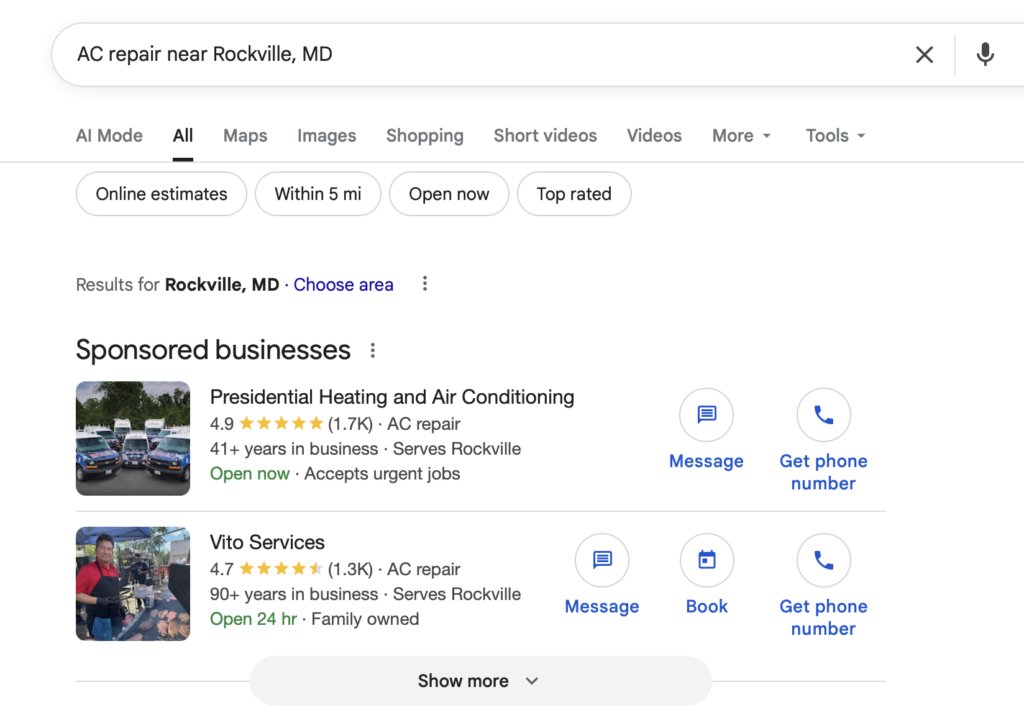
Google Local Service Ads show up at the very top of Google, above everything else.

Sponsored Google search results for AC repair services in Rockville, MD, featuring business listings for Presidential Heating and Air Conditioning and Vito Services, including ratings and contact options.

These are the ads with:

  • A blue “Google Verified” badge
  • Your company name
  • Reviews
  • A “Call” button

LSAs are pay-per-lead, not pay-per-click.

That means:

  • You only pay when someone contacts you—either a call or a message
  • Google doesn’t charge you for spam, job seekers, and unrelated calls
  • You can dispute irrelevant leads if you don’t offer that service
  • Cost Per Lead is set by supply and demand and outside your control

This makes LSAs one of the lowest-risk ad options for HVAC companies. It’s also possible for HVAC contractors

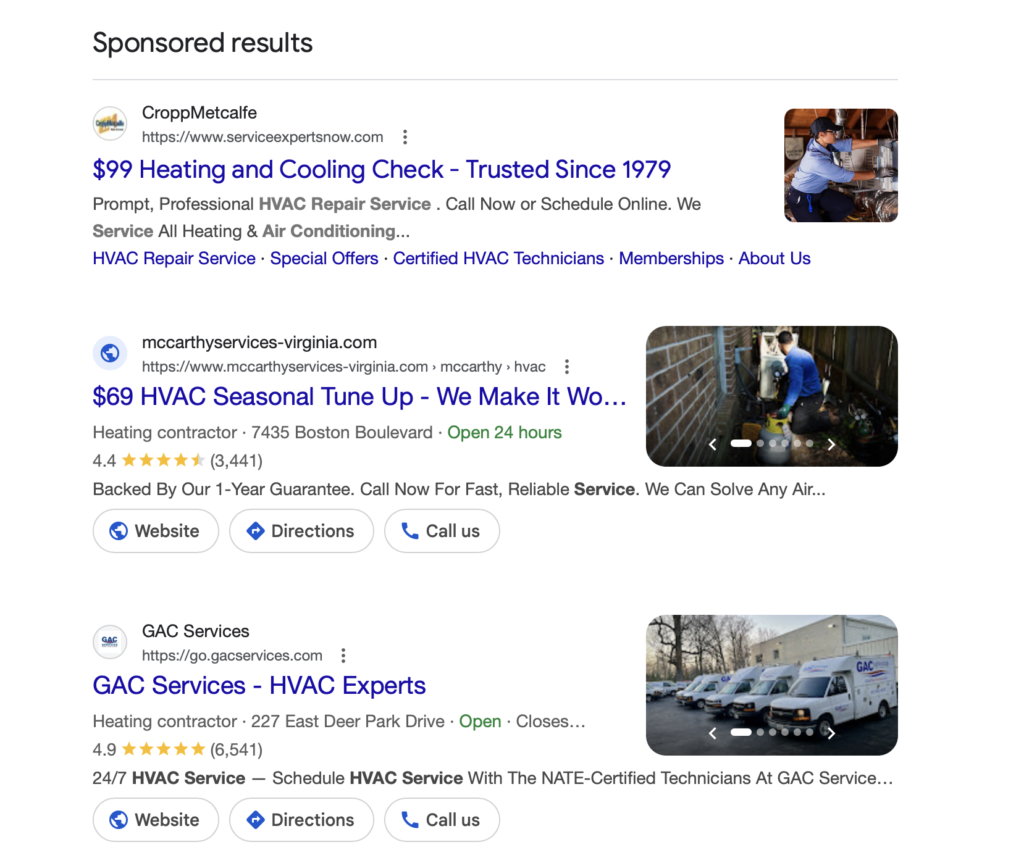
2. Google Pay Per Click Ads

These are the ads that appear below Local Service Ads, at the top of the search results.

With Google Search Ads:

  • You pay per click
  • Traffic goes to a landing page or website
  • Conversions depend on your site and offer

This is higher risk, higher reward.

You might:

  • Get more volume
  • Pay for clicks that don’t convert
  • Convert 1 out of 5, or even 1 out of 10 visitors
  • Cost per lead will vary depending on the quality of your offer, your landing page, and your keyword tracking

That’s why landing pages, tracking, and strategy matter so much here.

Google Local Services Ads vs. Google Pay-Per-Click (PPC)

Factor
Google Local Service Ads (LSAs)
Google Pay-Per-Clcik (PPC)
Where Ads Appear
Very top of Google search results
Below LSAs, at top of search results
How You Pay
Pay per qualified lead
Pay per click
High intent, service-ready calls
Varies, depends on landing page and offer
Spam / Job Seekers
Filtered by Google (disputable leads)
You pay for every click, qualified or not
Setup Difficulty
Low
Medium to High
Website Required
No (But Recommended)
Yes
Control Over Messaging
Limited
High
Cost Per Lead
Usually lower and more stable
Can be higher and more variable
Volume Potential
Limited and steady
Higher volume potential
Best For
Consistent, low-risk lead flow
Scaling lead volume and growth
Learning Curve
Short
Longer
Seasonal Impact
Moderate increases in peak seasons
Can scale aggressively in peak seasons
Risk Level
Low
Medium to High
Long-Term Growth
Supportive
Strong when paired with SEO

Why Local Service Ads Are a Great Starting Point

For most HVAC companies, Local Service Ads should come first.

Here’s why:

  • Lower cost per lead
  • Less setup required
  • Google pre-qualifies leads
  • Strong intent (people are actively looking for service)

We often recommend LSAs for HVAC companies with the following qualities:

  • Startup to $300,000 per year revenue
  • 1 truck or a solo operator with no Customer Service Rep answering the phones
  • Looking for steady, predictable leads
  • Understands that growth will be slow and steady

Think of LSAs as steady fuel, not a growth rocket. You won’t get hundreds of leads overnight. But you can enjoy consistent, high-quality calls.

Real Numbers: What HVAC Companies Actually Pay for LSAs

Let’s talk real data.

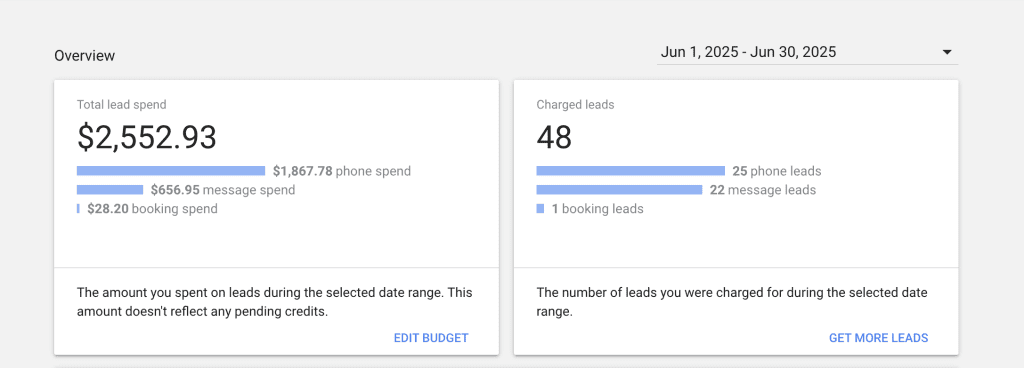
LSA Campaign in New Jersey

Here are examples from an HVAC LSA campaign in New Jersey. It’s a dense and competitive market with a high cost of living. Plus, this is a smaller operation with just three trucks, which many contractors assume would limit lead volume and drive up costs.

The data tells a more nuanced story.

Here’s what stands out:

  • Company size alone does not determine LSA performance

    Despite being a smaller business, this contractor generated consistent LSA leads in a very competitive market. LSAs do not exclusively favor large companies with massive fleets.

  • Demand plays a bigger role than market competition

    Lead volume closely followed seasonal demand.

    – 48 qualified leads in June, driven by a heatwave and urgent AC repairs

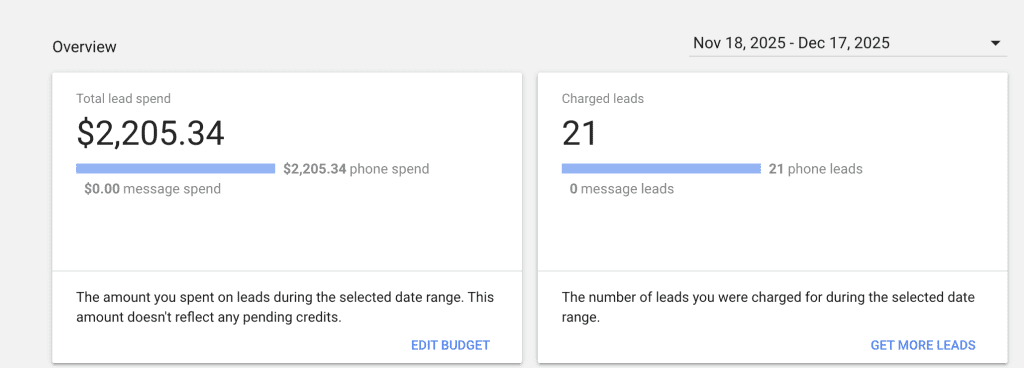
    – 21 qualified leads in early winter, as homeowners shifted to furnace maintenance and early heating breakdowns

  • Cost per lead moves opposite demand

    When demand spikes, cost per lead drops.

    – $53.17 per lead in June

    – $105.02 per lead in early winter

    This inverse relationship is consistent across most LSA markets.

  • Smaller contractors can compete effectively in LSAs

    In high-demand periods, Google prioritizes availability and relevance over company size. Well-configured services and strong responsiveness matter more than fleet size.

Bottom line:

In competitive markets like New Jersey, LSAs can still produce strong results for smaller HVAC companies — especially during peak demand.

The biggest swings in lead volume and cost aren’t driven by business size, but by seasonality, service mix, and market demand. This is why LSAs perform best when they’re part of a broader lead strategy that adapts throughout the year.

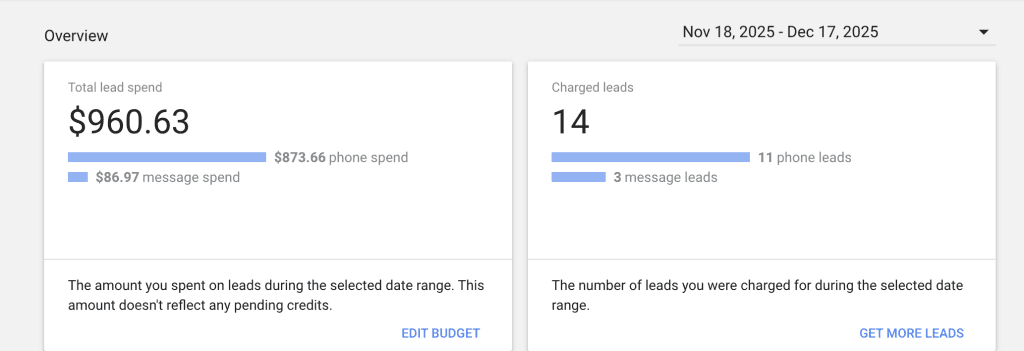
LSA Campaign in Florida

This HVAC company operates in central Florida, runs a large operation with 10 trucks, and has 600+ five-star Google reviews. On paper, you’d expect Google Local Services Ads to produce a steady, high volume of leads.

But that’s not always how LSAs work.

Here’s what this data from this LSA campaign in central Florida actually shows:

  • Business size does not guarantee unlimited LSA leads

    Even strong, established companies will often see LSAs cap out. Google intentionally spreads LSA exposure across multiple contractors so no single business dominates the entire lead pool.

  • LSAs are a shared ecosystem, not a winner-takes-all channel

    Once you hit a certain threshold, more reviews or more trucks don’t necessarily unlock more leads. Visibility is throttled to keep the marketplace balanced.

  • Seasonality still matters — even in Florida

    In November, Florida demand shifts. Cooling and heating calls slow down, and water heater repair and installation become a primary source of LSA leads.

  • Service mix directly impacts LSA performance

    Without water heater services enabled, this account’s LSA volume would have been even lower. Broader service coverage matters during shoulder seasons.

Bottom line:

LSAs are powerful, but they are not designed to scale endlessly, even for large HVAC companies. This is why relying on LSAs alone creates ceilings — and why successful contractors pair them with SEO, Maps visibility, and paid search to maintain consistent lead flow year-round.

In many markets, we see:

  • $80–$110 per Local Service Ad lead
  • Sometimes less in smaller markets
  • Occasionally higher in competitive metro areas
  • Low lead volume during shoulder season—sometimes only 3-10 leads per month in March or September

Even then, LSAs are often cheaper than traditional Google Search Ads.



HVAC

Marketing Tips and Industry Updates

Add a heading | RS Gonzales | HVAC Business and Marketing Solutions


Why Setting a High LSA Budget Doesn’t Mean You’ll Spend It

This part surprises a lot of contractors. You might set your LSA budget at $10,000+ per month. But Google might have you spending $500 per week.

Why?

Because Google:

  • Spreads leads across multiple contractors
  • Limits volume to maintain fairness
  • Adjusts delivery based on demand

LSAs are not a volume lever. They are a visibility tool. In peak seasons (extreme heat or cold), you may see more leads. But most of the year, LSAs are a steady but limited source of leads.

Google Search Ads: Bigger Opportunity, More Responsibility

Once LSAs hit their natural ceiling, the next place contractors look for scalable lead volume is Google Search Ads. Google PPC Ads give you more control, but also more responsibility.

With Search Ads:

  • You pay for every click
  • Google does not pre-qualify leads
  • Your website and sales process do the heavy lifting

This means:

  • A weak landing page wastes money
  • A strong landing page prints opportunity

Search Ads can outperform LSAs over time, but only when done correctly.

Key Takeaways From HVAC PPC Ads Campaigns

Let’s take a look at what Google Pay Per Click ads can do for HVAC companies of all sizes— from helping a one-truck start-up get traction to enabling a mid-sized HVAC contractor to scale aggressively and profitably to multiple seven-figures.

Cleveland Area: Small Budget, Strong Early Results

This first campaign is for a new business launching its first HVAC PPC campaign near Cleveland. The budget is limited to $50 per day, and this is only their second month running ads.
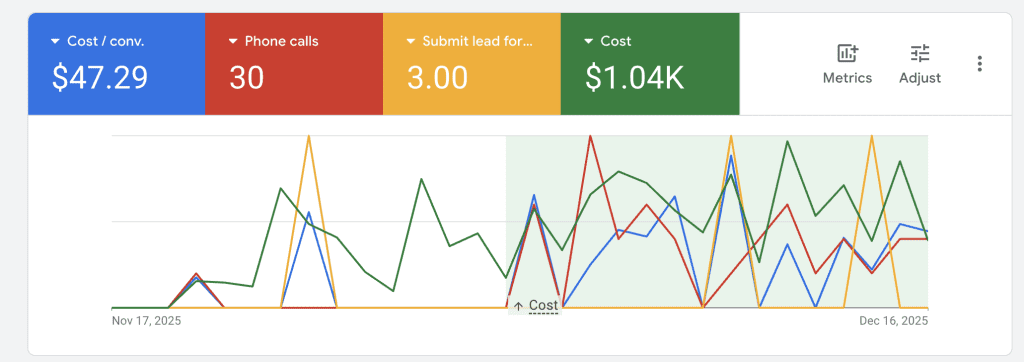
Despite that, the results are strong:

  • Low cost per lead relative to market norms and even LSAs
  • Qualified phone calls, not just form fills
  • Consistent lead flow without needing a large budget

What’s driving this performance isn’t company size — it’s market conditions and setup:

  • Less competition than major metro areas
  • Focused service targeting
  • Tight geographic coverage
  • Clear intent-driven keywords

A cost per lead under $50 is extremely rare among HVAC contractors. But these results show that Google Search Ads can work even for very small HVAC businesses when the market and strategy are aligned.

Maryland: From Modest Spend to Scaled Growth

The second campaign tells a different — but equally important — story.

This HVAC PPC campaign in Maryland started cautiously:

  • $1,500 per month in ad spend
  • Testing demand, cost per lead, and close rates

Very quickly, the data showed that the ads were profitable. Instead of guessing, the contractor used PPC metrics to make decisions:

  • Cost per lead was predictable
  • Lead volume scaled with budget
  • Jobs closed at a healthy margin

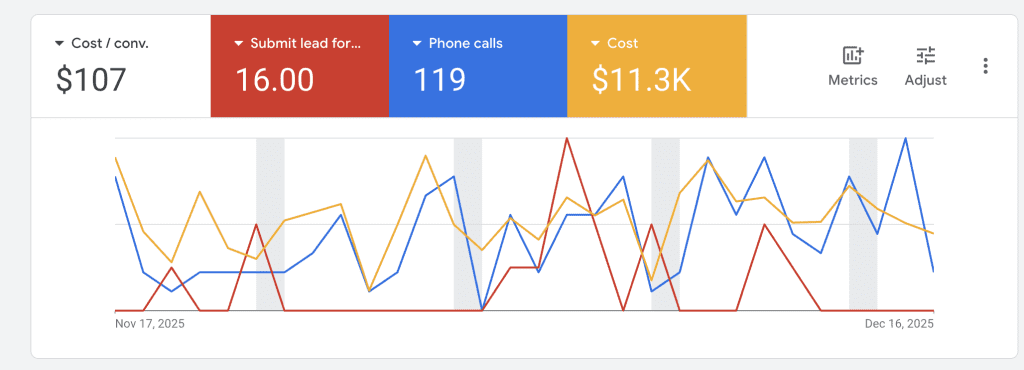
Over eight months, they:

  • Increased ad spend to $11,300 per month
  • Added two trucks
  • Closed 200+ leads per month between LSAs, PPC and SEO
  • Scaled profitably, not blindly

This is the core advantage of PPC.

The Bigger Point About Google Search Ads

Unlike LSAs, Google Search Ads are not capped by design.

With PPC, you can:

  • Control how many leads you generate
  • See your true cost per lead in real time
  • Decide when it makes sense to hire
  • Scale up or pull back based on data, not gut feeling

Bottom line:

Google Search Ads won’t magically work for everyone, and they require more responsibility than LSAs. But when done correctly, PPC is the most flexible and scalable lead generation channel available to HVAC contractors — whether you’re running one truck or building toward ten.

What PPC Budget Should HVAC Contractors Start With?

Here’s what we typically recommend.

Minimum Starting Budget

  • $50 per day (absolute minimum)

Ideal Starting Budget

  • $100 per day

Why?

Because Google uses a learning phase. And that learning requires data — from clicks, calls, messages and more.

The more data Google gets:

  • The faster it learns
  • The better your targeting becomes
  • The lower your cost per lead over time

Starting too low often slows down that ad optimization. And that means you end up spending more per lead in the long run.

What Happens in the First 30 Days of a PPC Campaign?

Understanding how long it takes to see results from your PPC ads will help you manage both your budget and your workforce.

Week 1

  • Ads go live
  • Google begins learning
  • Spend may be inconsistent
  • Lead volume may be low

Week 2

  • Spend starts stabilizing
  • Early lead feedback comes in
  • Adjustments are made

Week 3–4

  • Targeting improves
  • Cost per lead becomes clearer
  • Campaigns get more predictable

Month 2 and Beyond

You won’t find success if you expect your Google Search ads to become “set it and forget it.”

We review call records and keywords daily, fine-tuning ads by analyzing data based on the right questions:

  • Are these the right leads?
  • Are calls turning into jobs?
  • Do we need to adjust services or geographic targeting?

Why Expectations Matter More Than Tactics

You’ve probably heard HVAC business owners say: “Google ads didn’t work for me.” But most disappointment with Google Ads comes from misaligned expectations, not bad platforms.

Google Ads work best when:

  • You know how much you can spend on a lead and still be profitable
  • You understand volume limits (especially on LSAs)
  • You give campaigns time to learn
  • You have enough financial runway to keep ads running for at least three months, even if early results are uneven

When contractors understand this upfront, results tend to feel far more predictable and controllable. When ads get shut off after a slow couple of weeks, the real cost isn’t the spend — it’s the lost data and momentum that make success harder later on.

The Bottom Line on Google Ads for HVAC Companies

Google LSA and PPC ads are neither a silver bullet nor a gamble.

Instead, paid ads are a measurable growth tool.

When expectations are set correctly, Google Ads allow HVAC companies to:

  • Control lead volume
  • Understand true cost per lead
  • Adjust spend based on real demand
  • Scale when the numbers support it

LSAs can provide steady visibility.

SEO builds long-term equity.

But Google Search Ads are where speed, data, and scalability come together.

The contractors who succeed with Google Ads aren’t guessing. They’re making decisions based on numbers, not hope.

How RS Gonzales Manages Google Ads (The Right Way)

At RS Gonzales, we don’t run Google Ads in isolation.

We treat ads as one part of a complete HVAC growth system, where every channel supports the others. That means we look at:

  • Google Maps and local visibility
  • Website structure and conversion paths
  • Call and form tracking
  • Cost per lead over time, not just week to week
  • How ads fit alongside SEO and LSAs

Our goal isn’t just to generate leads.

It’s to help you understand:

  • What a lead is actually costing you
  • How many leads you can handle
  • When it makes sense to spend more
  • When it’s smarter to pull back or rebalance

That’s how Google Ads turn from an expense into a predictable growth lever.

Ready to Find Success With Google Ads in Your Market?

If you’re considering Google Ads — or already running them and unsure whether they’re working — a short strategy session can help clarify what’s realistic for your area, your budget, and your growth goals.

We’ll walk through:

  • Your local market
  • Competitive pressure
  • Expected cost per lead
  • Whether LSAs, SEO, PPC, or a mix makes the most sense right now

No pressure. No generic pitch.

You can book a strategy session here:

👉 Book a Strategy Session with RS Gonzales

Sometimes the most valuable thing isn’t more leads — it’s knowing what to expect before you invest.