The phone was ringing. Then it wasn’t. One slow week turns into a quiet month, and now you’re refreshing the ad dashboard at 11 pm, wondering where everyone went.
We’ve sat with many HVAC owners at exactly that moment. The fear is always the same: what if the leads stop coming?
So here’s the honest answer to the question keeping you up at night. This is where HVAC leads come from in 2026, and how to build a flow that doesn’t dry up on you.
Is There One Best Place To Get HVAC Leads?

Every contractor wants the same thing: the one source that fixes everything. The magic ad. The SEO switch. The referral spike that never slows down.
It doesn’t exist, and that’s good news, because the contractors who win aren’t the ones who found a secret channel. They’re the ones who connected a few ordinary ones.
Watch how a single job comes together:
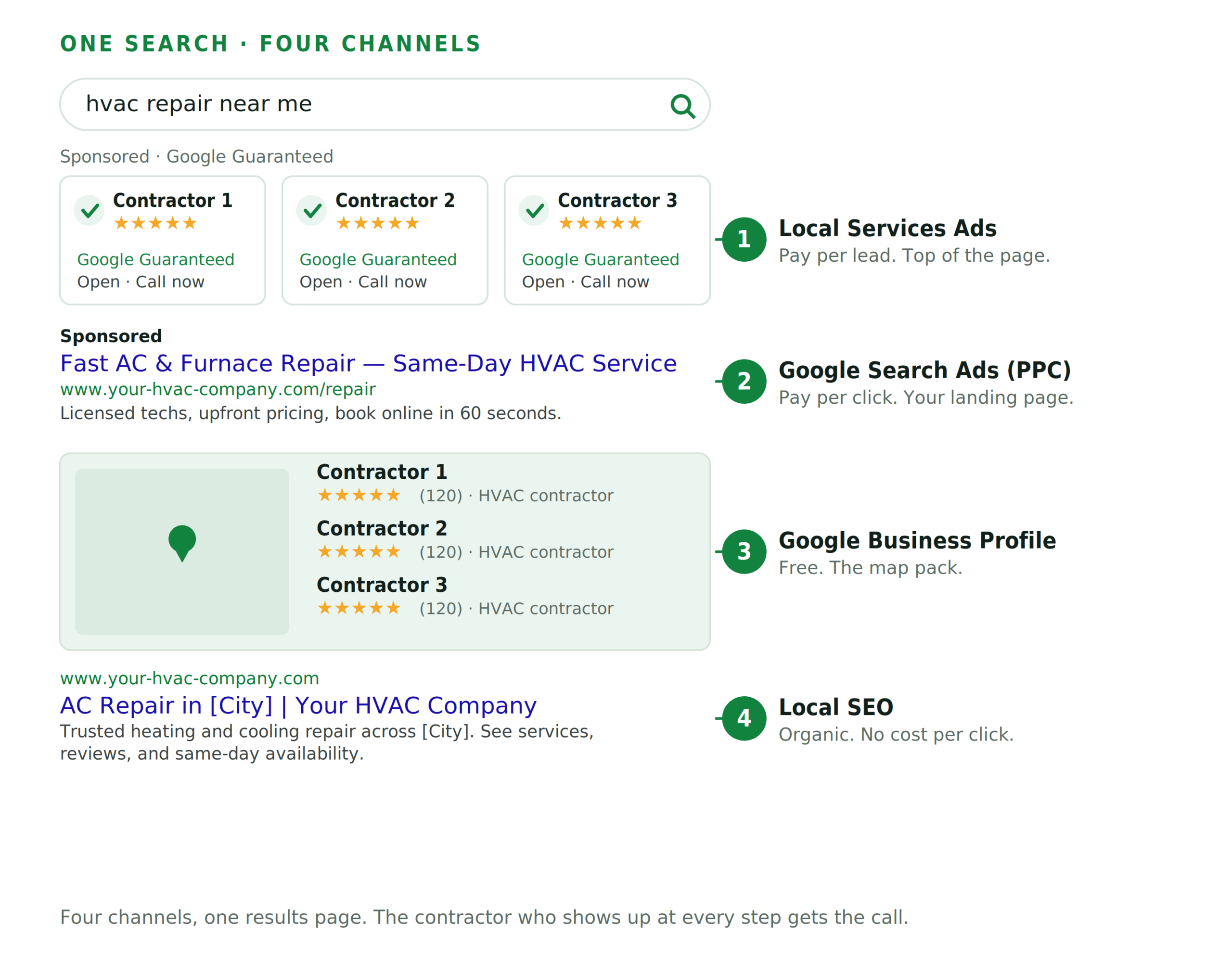
- They search first. A homeowner types “AC repair near me” and sees your Local Services Ad at the top.
- They see you again. Scrolling down, your business shows up in the Google map results too.
- They check you out. They click your website, then open a second tab to read your reviews.
- They call the name they trust. It’s the contractor who showed up at every step and looked legitimate. That’s either you, or the competitor who did show up everywhere.
That is four channels for one phone call. Miss any single one, and you hand the job to whoever filled the gap. So the goal is not hunting for the best channel. It’s getting your channels to reinforce each other, so a homeowner meets you at every step instead of once. That connected approach is the heart of HVAC lead generation done right, seen in our work on HVAC lead generation.
Here is the full map before we break down each one:
| # | Channel | Who it reaches | Speed to first lead | How you pay |
|---|---|---|---|---|
|
1
|
Google Local Services Ads
|
Homeowners ready to hire now
|
Days
|
Per lead
|
|
2
|
Google Search Ads (PPC)
|
Same buyers, your landing page
|
Days
|
Per click
|
|
3
|
Google Business Profile
|
Nearby searchers on the map
|
Weeks
|
Free
|
|
4
|
Local SEO
|
Researchers below the ads
|
Months
|
No per-lead cost
|
|
5
|
Yelp
|
Comparison shoppers, bigger jobs
|
Days to weeks
|
Per lead or ad
|
|
6
|
Meta (Facebook, Instagram)
|
Homeowners not searching yet
|
Days
|
Per lead or click
|
|
7
|
AI search
|
People asking an assistant
|
Weeks to months
|
Earned
|
|
8
|
Email and SMS
|
Customers you already served
|
Same day
|
Near-free
|
|
9
|
Reviews and reputation
|
Everyone comparing you
|
Ongoing
|
Free to earn
|
High-Intent Channels: Where Ready-To-Buy Homeowners Find You
Start with the buyers who already have their wallet out. These four channels reach homeowners the moment they want to hire. The leads cost more per head, and they close faster.
1. Google Local Services Ads (LSA)
Local Service Ads are the pay-per-lead boxes at the top of Google, marked with a green Google Guaranteed badge and a call button.
- Who it reaches: homeowners ready to hire now, the AC-died-at-9-pm calls.
- How you pay: per lead, not per click. No contact, no charge, and you can dispute out-of-area calls.
- How you rank: answer fast, keep new reviews coming, and feed booked jobs back to Google.
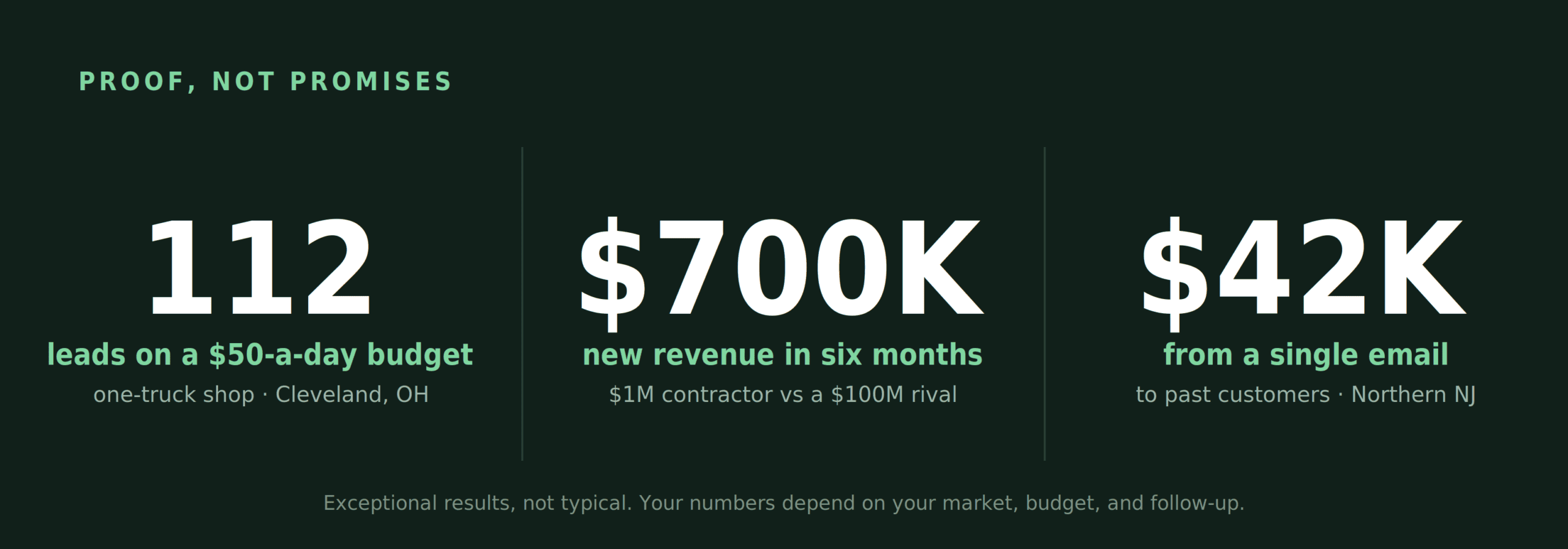
A one-truck shop in Cleveland, Ohio, capped spend at $50 a day and still pulled 112 leads at about $80 each. Exceptional, not a promise, but the entry bar is low.
2. Google Search Ads (PPC)
Pay-per-click ads, or PPC, are the text ads that sit directly below LSA. You pay per click, whether or not they call, so the landing page does the heavy lifting.
- What you control: the keywords, the offer, and a landing page built around one service like installs.
- Negative keywords: the words you block so you never pay for “HVAC jobs hiring” or “HVAC school.”
- Best for: scaling volume past what LSA can give you, and chasing high-ticket install buyers.
A roughly $1 million business in Maryland we ran paid search for beat a $100 million competitor, 728 calls and about $700,000 in new revenue over six months. Size didn't win. Setup did.
3. Google Business Profile
Your Google Business Profile is your free listing in the Google map pack. It is the block of three businesses shown with a small map. For most contractors, it is the most valuable free space in local search.
- Who it reaches: nearby searchers picking a name straight off the map.
- How you rank: proximity to the searcher, review strength, and how active the profile is with posts and photos.
- The edge: a filled-out, active profile with fresh reviews often outranks a bigger competitor who set theirs up once and walked away.
- Cost: nothing but attention, which is exactly why it gets ignored. Optimize your GBP correctly, and it covers the fields that move the ranking.
Get More From One of Your Best Free Lead Sources
Discover how to strengthen your Google Business Profile and reach more homeowners without paying for every click.
4. Local SEO
Local SEO is the work that gets your website and listing into the unpaid results below the ads. No cost per lead, but it builds over months, which is why it pairs with the faster paid channels above.
- Who it reaches: homeowners who scroll past ads and trust organic results more.
- The payoff: leads keep arriving after the work is done, with nothing paid per click.
A Seattle contractor we built local SEO for hit roughly one organic lead a day at zero ad spend in under two months. A startup in Mentor, Ohio, went from no presence to 136 leads in 90 days.
Curious Where You Rank Right Now?
A free HVAC SEO audit shows which of these searches you're missing and which competitors are catching them instead.
Discovery And Comparison Channels: Buyers Who Aren’t Sold Yet
Not every lead is ready today. Some are weighing three contractors. Some don’t know they need you yet. These channels catch buyers earlier, which usually means a lower cost per lead and a longer path to the booked job.
5. Yelp
Yelp is a lead source that does not depend on Google at all, reaching homeowners in comparison mode on bigger-ticket jobs.
- Who it reaches: shoppers comparing a few contractors, often for installs.
- Why it matters: it keeps the phone ringing the day a Google update scrambles your rankings.
A One HVAC contractor based in Maryland ran a $1,500 test on Yelp and booked a $37,000 install in two weeks. Best-case, not a rule, but it reached a buyer Google never showed them.
Each platform charges differently. That’s why you need to compare Google, Yelp, and Facebook side by side to understand why HVAC advertising costs vary by platform and where your budget is most likely to generate qualified leads.
6. Meta (Facebook and Instagram) Ads
Paid ads in the Facebook and Instagram feeds. These homeowners aren’t searching, so instead of catching demand, you create it.
- Who it reaches: people with an aging system or high bills who haven’t started looking yet.
- Best for: installs, financing offers, and seasonal promotions that plant a seed early.
- The catch: interrupted buyers need fast, consistent follow-up, or the budget drains with no calls.
A Miami contractor spent $4,000 on Facebook ads in one month, generated 100 leads, and closed 4 installs worth $77,000.
7. AI Search (ChatGPT, Google AI Overviews, Perplexity)
The newest lead source, and the one many contractors still overlook, is AI search. When a homeowner asks an assistant, “Who’s a good HVAC company near me?” they may receive a short list of recommended businesses instead of a page of traditional search results. Those recommendations can be influenced by signals such as your website content, local relevance, service information, reviews, and how consistently your business is mentioned across the web. If your company is not clearly represented in those sources, you may never appear in the conversation.
- How you get named: structured content and answer-focused pages the assistant can read and trust, not ad spend.
- Why now: most agencies aren’t covering this yet, so early movers get the mentions.
Su’Coy Heating in Washington, DC shows up in AI answers ahead of competitors with more than 5,000 reviews, with 222 reviews and a 4.9 rating. The review count didn’t win it. The AI search setup did.
Want This Mapped For Your Market?
In one call, we'll show you which of these lead sources fit your budget, your team, and your goals. No pressure, founder-led.
The Leads You Already Own: Your Database
Every channel so far pays to find a stranger. The cheapest leads you will ever get are the customers whose names are already in your phone.
8. Email And SMS To Past Customers
Sitting inside your CRM is a list of past customers who already know and trust your company. Maintenance reminders, seasonal check-ins, and reactivation messages give them a timely reason to book again.
These campaigns can bring back customers who have not scheduled service in months or even years. Because the relationship already exists, the leads are often easier and less expensive to convert than brand-new prospects.
- Who it reaches: your existing list, so the cost per message is close to nothing.
- Best for: filling slow weeks and turning one-time repairs into repeat installs.
An established contractor in Northern New Jersey sent one plain, non-salesy email to every customer with a system over 10 years old. It produced 3 installs worth $42,000, all from people they'd already served.
The goal is not to send constant promotions, but to stay relevant and reach out when a real service need is likely. Done well, reactivation turns an overlooked customer list into a steady source of repeat business.
9. Reviews As A Lead Engine
Reviews are not a scoreboard. They are the fuel for almost every other channel on this list.
- What they drive: your LSA rank, your map rank, and the split-second choice between your name and the next one.
- How to earn them: ask at the end of every call, and explain why it matters for a local business.
- The point: review and reputation management belongs in the lead conversation, not off to the side.
A two-person shop in Kaufman County, Texas did exactly that and turned it into 50-plus reviews a month, top-of-map rankings, and an extra 25 to 30 organic leads a month.
Why Most Leads Die After They Arrive
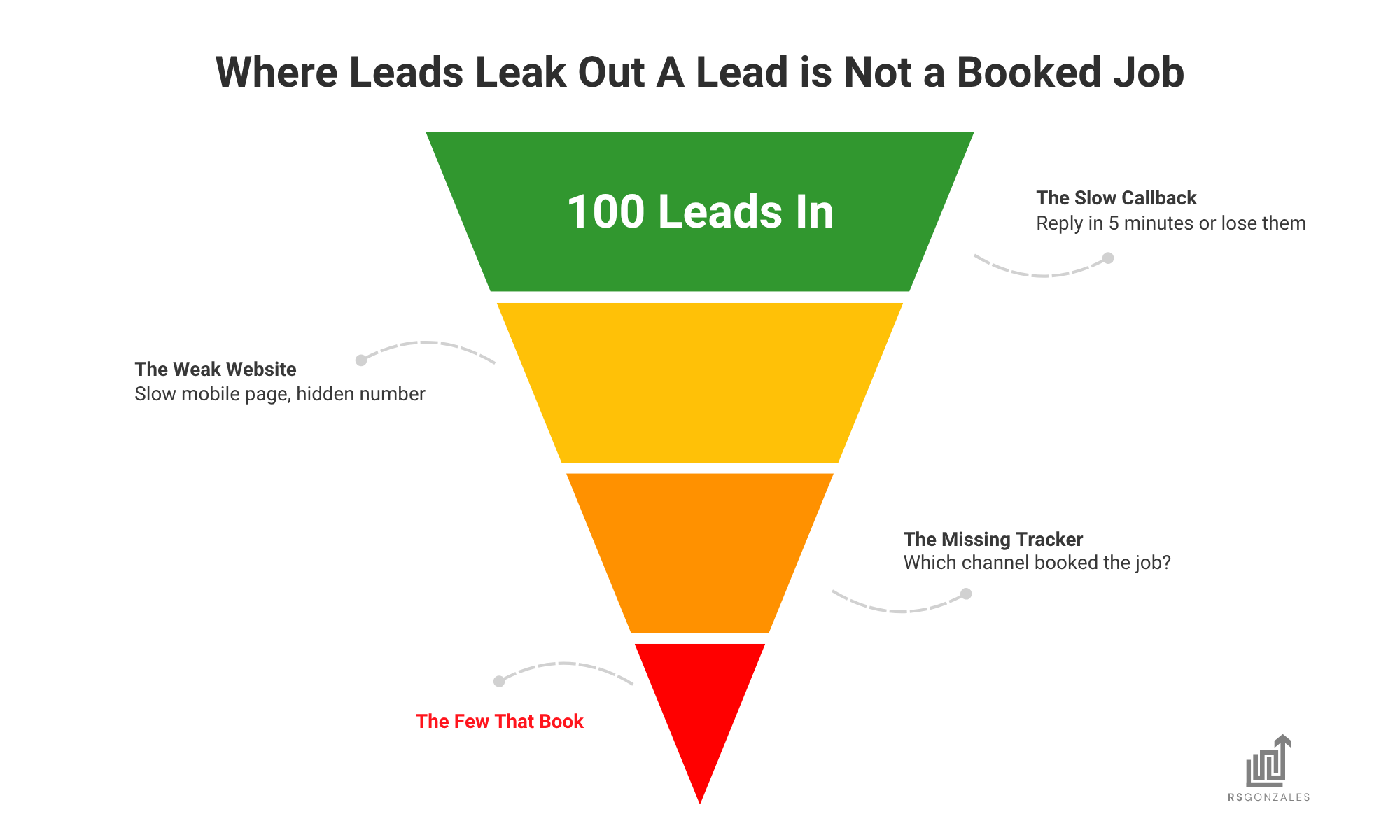
You can nail every channel above and still lose, because a lead is not a booked job. What happens in the first five minutes after it lands decides more than the channel it came from. Here are the three places leads leak out.
The Slow Callback
Speed-to-lead is how fast you respond to a new lead, and the gap is brutal.
- Reach a lead in the first five minutes, and your odds of connecting are far higher than at 30 minutes.
- Miss the call, and the homeowner dials the next contractor before your voicemail finishes.
- Every dollar you spent to earn that lead is gone, no matter how good the channel was.
The Weak Website
A paid click is worthless if the page can’t turn it into a call.
- If your site loads slowly on a phone, buyers bounce before it finishes rendering.
- If the phone number is buried, you make a ready-to-call homeowner hunt for it, and many won’t.
- The job of the site is to turn a visitor into a call, not to sit there looking pretty.
The Missing Tracker
The third leak is not knowing which channel booked the job.
- Without tracking, you keep funding channels that don’t produce and starve the ones that do.
- A CRM, the software that catches every lead and follows up automatically, closes that gap.
- One solo contractor in New Jersey moved off his old system, saved $630 a month, and put it straight back into ads.
See What The Whole System Costs
Every deliverable, every number, laid out by program, so you can compare us against any agency you're considering.
So Where Should You Start?
Nine channels is a lot, and you do not build them all at once. Build in the order that matches your budget and how fast you need the phone to ring.
1. Claim your Google Business Profile. It is free, and it feeds your map rank, your LSA, and the click decision.
2. Get reviews flowing. Ask at the end of every call. Reviews lift every other channel on this list.
3. Turn on Local Services Ads. It is the fastest paid path to calls from ready-to-hire homeowners.
4. Fix the response first. Speed-to-lead and a mobile-fast website come before you spend more on traffic.
5. Add search ads and local SEO together. One buys leads today, the other builds them for free later.
6. Layer in Yelp, Meta, and AI search. Add these once the core is converting reliably.
Further Reading
7. Mine your database. Email and SMS to past customers is the cheapest revenue on the whole list.
Notice the order. The free and owned channels come first, then paid, then the rest. That’s not about being cheap. Paid traffic poured into a leaky system wastes money, and a pipeline built only on ads disappears the day you stop paying. The goal is a mix you own.
If you want that mix mapped for your market, that’s the work behind our HVAC lead generation programs. And if you’re weighing whether an agency is worth it at all, here’s what to expect from an HVAC digital marketing agency before you sign anything.