


Most contractors we work with land somewhere between $40 and $200+ per lead. That range isn’t a hedge. It’s the truth, because a $45 Meta lead and a $180 LSA lead were never competing for the same job.
So forget what you should be paying. Ask this instead: are you paying the right amount for the right kind of lead, and is it turning into work on your schedule?
The 2026 HVAC CPL Cheat Sheet
These are RS Gonzales field benchmarks based on the campaigns we manage day-to-day. They are not universal guarantees, but they are useful working ranges for spotting when your numbers look healthy, inflated, or worth a closer look.
|
Channel
|
Typical CPL Range
|
Lead Intent
|
Best Use Case
|
|---|---|---|---|
|
Google Local Services Ads
|
$113-$180
|
Very high
|
Emergency repairs and urgent service calls
|
|
Google Search Ads / PPC
|
$40-$200+ (varies by market size)
|
High
|
System replacement, installs, financing offers
|
|
Yelp Ads
|
$66-$87
|
Medium
|
Comparison shoppers in competitive markets
|
|
Meta Ads
|
No fixed range — highly performance-dependent
|
Lower to medium
|
Maintenance promos, rebates, off-season offers
|
|
Local SEO & Google Maps
|
No fixed CPL, drops over time
|
High
|
Sustainable, year-round lead flow
|
Before you start panicking at these numbers, here’s the context that makes them make sense:
Google LSA: Higher CPL, Higher Intent
Google Local Services Ads typically run $113-$180 per lead because Google charges you for a qualified contact, not just a click. That’s why intent is strongest here, especially for urgent repair calls. But LSA also ranks and prices you based on the number of your Google reviews and response speed, so a thin profile means you’re paying premium rates without the placement to match.
Google PPC: More Range, More Control
HVAC PPC swings more widely. In smaller markets, leads may land closer to $40-$80, while competitive metros like Miami, Dallas, or Los Angeles can push PPC leads into the $150-$200+ range. You’re paying per click regardless of who clicks, so your targeting, landing pages, and negative keywords do the heavy lifting here, not the platform.
Yelp and Meta: Cheaper Isn’t The Same As Easier
Yelp and Meta ads can look cheaper on paper, but the buyer intent is softer. That’s not a flaw. It means these leads need faster follow-up and a stronger offer before they turn into a booked job, not a lower price before they turn into a discount.
Local SEO: No Click Cost, Still Requires Investment
HVAC SEO works differently because you’re not paying per click. You invest upfront in your website, content, Google Business Profile, reviews, and local authority, before you see a lead. Once that system is running, every organic call comes without another ad click behind it, so your blended cost per lead drops over time instead of staying flat.
The mistake is comparing every channel like it has the same job. It doesn’t. For a deeper breakdown of what drives cost on each of these platforms, see why HVAC ads cost what they do.
Why Your HVAC Leads Cost More Than They Should
“The platform is ripping me off” is usually the first thought when CPL climbs. Sometimes that’s fair. But nine times out of ten, it’s not one big thing. It’s five or six small leaks, all draining from the same bucket. Here’s what those leaks actually look like, in practice:
- You’re bidding against every other HVAC company in town, at the same moment. When someone searches “AC repair near me,” you’re not the only contractor showing up. You might be one of eight. Google runs a live auction for that search, and the more contractors fighting for it, the higher the price climbs before you’ve done anything wrong at all.
- A homeowner sees your ad next to a competitor’s, and picks them because of reviews. Say you both show up for the same search. They have 300 five-star reviews. You have 12. You paid the same amount for that click, but they get the call, and you don’t. Your bill doesn’t change. Your results do.
- Someone clicks your ad, then leaves before they even see your phone number. If your website takes 8 seconds to load, or the page doesn’t clearly say “we fix furnaces” when they searched “furnace repair,” they hit back and call the next name on the list. You already paid for that click. It’s gone either way.
- Your ad shows up for searches that were never going to become a job. Google will show your ad for things like “HVAC technician jobs near me” or “how to fix my AC myself” unless you specifically tell it not to. Every one of those clicks costs you money and produces exactly zero paying customers.
- Your ad looks the same as everyone else’s. If your ad and website say “HVAC company, we do repairs and installs”, same as every competitor, the homeowner has no reason to pick you over the next name. When nothing sets you apart, price becomes the only thing left for them to compare.
- The lead calls, and nobody picks up in time. A homeowner with a broken AC in July isn’t going to wait around. If your team doesn’t answer or call back within about an hour, that “lead” you paid for just became somebody else’s booked job, and it won’t show up as a loss on any report you’re looking at.
None of this shows up on your CPL dashboard. That number only tells you what you paid. It never tells you which of these six things happened, and it’s almost always one of them, not the platform itself.
Why the Cheaper Lead Isn’t the Better Deal
A cheap lead only helps you if it actually picks up the phone and books a job. A $35 lead that never answers, or ties up whoever’s answering your phones for a week and still doesn’t book, isn’t a deal. It’s a lead you paid for twice: once in ad spend, once in wasted time.
That’s why low-cost channels need more tracking, not less. You want to know how many leads came in, how many you could reach, how many booked an appointment, how many of those turned into a paid job, and what that job was worth. Skip that, and your cheapest channel can quietly become your most expensive one.
How a $45 Lead Can Cost You More Than a $180 Lead
This is where a lot of contractors get misled by their own dashboard. A $45 lead can look like a win at first. Then you find out it was someone just browsing, not ready to book. It took three follow-up calls, but they never picked up the phone, and it never became a job. On paper, it was cheap. In practice, it costs your team an afternoon for nothing.
A $180 lead can look expensive at first, too. Then it turns into a homeowner who needs a full system replacement, books on the first call, and closes into a $9,000 install. That lead wasn’t expensive. It was the best money you spent all month.
Chasing the lowest number on your dashboard can backfire for exactly this reason. The goal was never the cheapest lead. It’s the lead most likely to turn into paid work.
Why You Need To Stop Judging Your Marketing By CPL Alone
Cost per lead tells you what you paid to get someone on the phone. It doesn’t tell you if that call turned into a paycheck.
That’s the gap that trips up most contractors: they cut a channel because the CPL “looked bad,” when it was actually the most profitable thing they were running. Or they keep a cheap channel that never puts a single job on the schedule.
To know which is which, you need four numbers, not one. Here’s what each one is asking:
- Cost Per Lead asks: what did it cost just to get someone to call or fill out a form?
- Cost Per Booked Job asks: what did it cost to actually get an appointment on your calendar?
- Booking Rate asks: out of everyone who called, how many did your team turn into a scheduled job?
- Revenue Per Lead asks: when you average it all out, was the lead worth what you paid for it?
|
Metric
|
Formula
|
What It Tells You
|
|---|---|---|
|
Cost Per Lead
|
Total ad spend divided by total leads
|
What each inquiry cost
|
|
Cost Per Booked Job
|
Total ad spend divided by booked jobs
|
What it cost to get work on the schedule
|
|
Booking Rate
|
Booked jobs divided by total leads
|
How well your team turns leads into appointments
|
|
Revenue Per Lead
|
Total revenue divided by total leads
|
Whether the leads are worth the spend
|
Here’s what that looks like:
- Say you spend $5,000 in a month and it brings in 50 leads. Your cost per lead is $100. Out of those 50, your team books 20 jobs. Now your cost per booked job is $250, more than double what the CPL alone suggested.
- That $250 number is the one that matters. From here, the only question left is simple: did those 20 booked jobs bring in enough revenue to make the $5,000 worth it? If they did, that $100 CPL you were worried about was never the problem.
This is the level of visibility that separates contractors guessing at their marketing from ones scaling it with confidence.
What Should You Spend On HVAC Advertising?
Now that you know how to tell if a lead is making you money, the next question is obvious: how much should you be putting into this in the first place?
Most contractors answer that by guessing. Some pick a number that feels comfortable. Others just copy whatever a competitor down the street says they’re spending. Neither is a strategy. Both are a shot in the dark.
Here’s a better way to think about it: your budget shouldn’t come from what feels safe. It should come from the business you’re actually trying to build. For most HVAC contractors focused on growth, a healthy marketing budget, ad spend included, lands around 5% to 10% of your annual revenue.
Here’s what that looks like at different revenue levels:
|
Revenue Goal
|
5% Marketing Budget
|
10% Marketing Budget
|
Monthly Range
|
|---|---|---|---|
|
$1,000,000
|
$50,000
|
$100,000
|
$4,167-$8,333
|
|
$2,000,000
|
$100,000
|
$200,000
|
$8,333-$16,667
|
|
$5,000,000
|
$250,000
|
$500,000
|
$20,833-$41,667
|
Once you know your number, here’s how to actually put it to work:
1. Start with your revenue goal, not your current spend. Where do you want the business to be, not where it’s been.
2. Set aside 5 to 10 percent of that goal for marketing, ad spend included.
3. Split it two ways. Some goes toward channels that bring calls this week, like LSA and PPC. The rest builds something that keeps paying off long after you stop running it, like SEO.
4. Track it the way we just covered. Leads, booked jobs, revenue, and repeat business, not just how many calls came in.
Here’s the part most contractors get wrong: the mistake usually isn’t spending too much. It’s spending on HVAC advertising without a system behind it. A bigger budget poured into a broken process just gets you a bigger version of the same problem.
One Channel Won’t Grow Your Business. A System Will
You’ve got your budget. Now here’s where most contractors go wrong with it: they treat marketing like a single decision. Should I run LSA or SEO? Is PPC better than Meta? That’s the wrong fight to pick.
The contractors who actually grow year over year aren’t choosing one channel over another. They’re building a handful of pieces that all work together, so the whole thing gets stronger than any one part could on its own.
Here’s what that looks like, and what each piece is doing for you:
- Google LSA brings in the calls that need answering today, like a broken furnace in January.
- Google PPC targets the bigger jobs, replacements, installs, and financing offers, in a way you have more control over than LSA.
- Local SEO builds visibility that keeps working for you without a click cost attached, and gets cheaper per lead the longer it runs.
- Your Google Business Profile is what shows up when someone searches your name or “HVAC near me” on Google Maps. Keeping it accurate and active helps you rank higher there.
- Your website is what turns a click into a call. If it’s slow or confusing, you’re paying for traffic that never picks up the phone.
- A CRM, which is the system that tracks and reminds your team to follow up with a lead, keeps a warm call from going cold because nobody got back to them in time.
- Email and text follow-ups bring past customers back for maintenance, tune-ups, and their next replacement, instead of losing them to whoever they Google next time.
- A tighter sales process means more of the leads you’re already paying for turn into a signed job, not just a phone call that went nowhere.
None of these are supposed to work alone. When your website, ads, SEO, Google Maps presence, follow-up system, and sales process are all pulling in the same direction, you stop guessing where your next job is coming from and start being able to predict it.
That’s the difference between throwing money at marketing and running a growth engine. You can see exactly how we build that system on our HVAC marketing packages and pricing page.
One HVAC Contractor Stopped Chasing Cheap Leads. Here’s What Happened
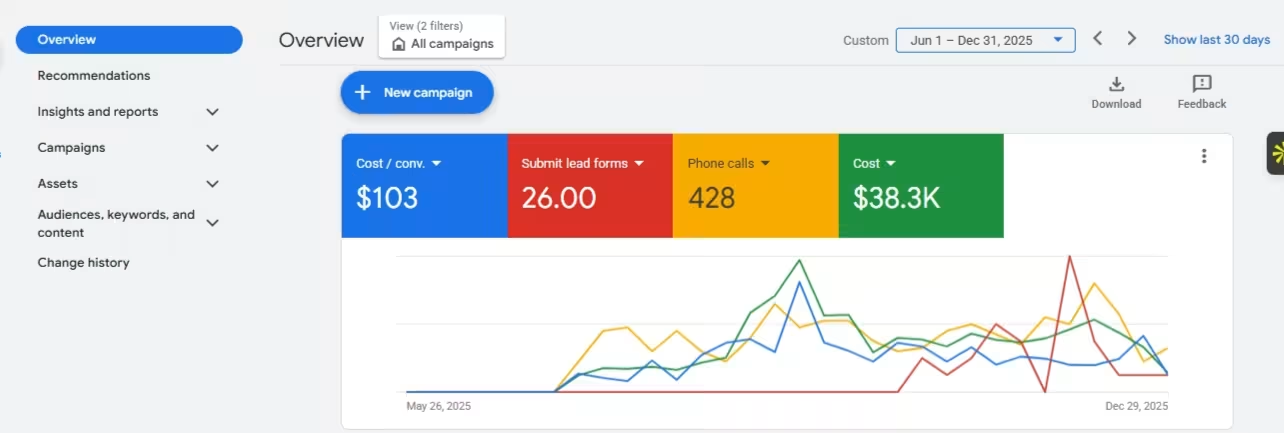
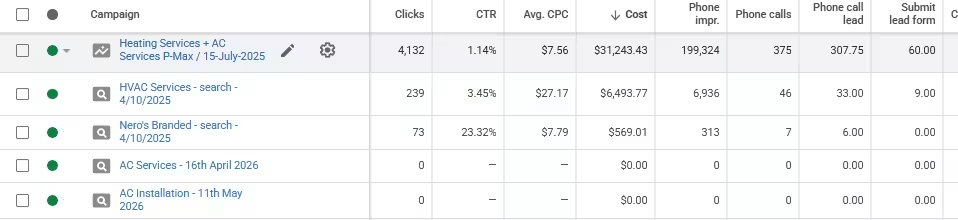
An HVAC contractor based in Maryland came to us stuck in a familiar spot: lead flow that showed up some months and disappeared the next, and too much of their business riding on leads bought from third-party sellers they had zero control over.
The problem wasn’t even the cost of those leads. It was that they didn’t own any part of their own marketing system, so every slow month was a surprise they couldn’t do anything about.
We didn’t go looking for the cheapest lead source we could find. We built a system: paid ads, SEO, Google visibility, and follow-up, all working together instead of one channel carrying the whole business alone.
Six months in: 728 calls, $700,000+ added to their pipeline, and stronger organic visibility that kept bringing in leads even in the months paid ads slowed down. They stopped needing to buy leads from someone else, because their own system was finally doing the job.
Your numbers won’t look identical; every market and every business is different. But the lesson holds regardless: cost per lead only becomes a useful number once it’s part of a real system. On its own, it’s just a number you’re chasing with no way to know if you’re catching anything worth having.
So What Should You Pay For A Lead?
That contractor’s story points to the answer: there isn’t one number. What you should pay depends on what the lead is worth to you, not what shows up on your dashboard. A $45 lead can be a good deal for one campaign, while a $150 lead is reasonable for another, especially if the job behind it pays more or your market is more competitive.
Before you decide whether your CPL is good or bad, walk through these:
- Where did the lead come from? A call from LSA behaves differently than a click from Meta. Same dollar amount, different odds of turning into a job.
- What were they calling about? A tune-up and a full system replacement aren’t the same lead, even if they cost the same to generate.
- What could this job be worth? A $45 lead that turns into a $300 repair is fine. A $45 lead that could’ve turned into a $12,000 installation, but got lost somewhere, is not.
- Is your team closing these? The best lead means nothing if nobody turns the call into a booked, paid job.
- How competitive is your market? A $150 lead in a crowded city might be normal. That same number in a smaller town might mean something’s off.
- Do you have enough reviews to earn the call? You can pay for the click. You can’t buy the trust that gets someone to pick up the phone and say yes.
- Is someone answering fast and following up? A great lead handled slowly becomes a bad lead, no matter what it cost.
- What are you trying to do right now? Staying steady and pushing to scale calls for different numbers, and both can be right depending on where you are.
Here’s the test that matters more than any of this: did the lead book? Did it close? What did that job pay? Is that customer likely to call again for a tune-up, a referral, or their next replacement down the road?
That’s how the contractors who grow think about this. They’re not chasing the cheapest lead on the page. They’re building a system that turns the right leads, whatever they cost, into paying work.
Your Market Sets The Price. Let’s Find Out What Yours Should Be
Every HVAC market is different. The right CPL for a contractor in a crowded metro area looks nothing like the right CPL for a company in a smaller service area. The number changes again depending on whether you’re promoting repairs, replacements, maintenance, heat pumps, or financing offers.
That’s exactly what we dig into with a free strategy session. We’ll look at your website, your ads, your rankings, your competitors, and where you’re trying to take the business. You’ll walk away knowing whether your lead costs are healthy, where your marketing system is leaking money, and what to fix first, whether that’s your ads, your full HVAC advertising strategy, or something upstream of the ads entirely.