
For three years, one line did a lot of your heat pump selling for you: “Save up to $2,000 with the federal tax credit.” It sat on the landing page, in the follow-up email, and in the ad. It gave a hesitant homeowner a reason to sign this year instead of next.
On January 1, 2026, that line started selling a discount that no longer exists. And the equipment underneath it costs more than it did a year ago. If your heat pump marketing still leads with the credit, you’re pointing customers at a promise you can’t keep and quoting a higher price behind it.
Here’s the honest part: the credit was never the reason people needed a heat pump. It was a nudge. Take the nudge away, and the reasons are still there. You have to say them out loud again. This is how to reset the offer and keep booking installs.
What Changed for Heat Pump Buyers on January 1, 2026
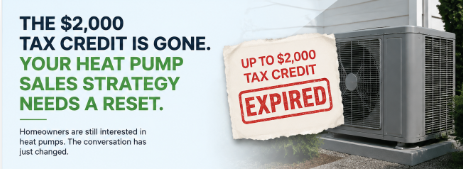
Two things happened at once, and together they flipped your pitch upside down. The credit that lowered the price disappeared the same year the equipment got more expensive. Your customer feels both.
The $2,000 federal credit expired
The 25C credit was a federal tax credit. “25C” is the section of the tax code it came from. It covered 30% of a qualifying heat pump installation, capped at $2,000, and a homeowner claimed it on their tax return.
- It ended December 31, 2025. The One Big Beautiful Bill Act, signed in July 2025, moved the expiration up. The credit had been scheduled to run through 2032.
- 2025 installs can still claim it. If the system was installed and running by December 31, 2025, the homeowner files for it on their 2025 tax return. Anything installed in 2026 does not qualify.
- Some rebates survived. State programs, utility rebates, and the income-qualified federal HEAR and HOMES programs are still active in many areas. They are not the same as the old credit, and they vary by location.
The refrigerant switch raised equipment prices
At the same time, the refrigerant inside new systems changed. Older systems used R-410A. New ones use A2L refrigerants like R-454B and R-32, which are better for the environment but come with new safety requirements.
- R-410A is no longer made for new systems. The EPA stopped its production and import for new residential equipment on January 1, 2025.
- A2L equipment costs more to build and install. These refrigerants are mildly flammable, so new systems need built-in leak detection and technicians trained to handle them. That cost lands in the quote.
- The cheaper old inventory is nearly gone. Installing leftover R-410A stock is still allowed, but most of that equipment has already sold through.
Put the two together, and your customer walks in expecting a rebate and facing a higher price. The old “save money now” story doesn’t match what they see on the quote. When every quote is higher, a wasted lead hurts more, which is part of why HVAC ads feel so expensive right now.
Find Every Place Your Old Offer Still Lives
Before you write a new offer, kill the old one. The credit line hides in spots you forgot to update, and every homeowner who finds it is being promised savings you can’t deliver. That erodes trust before the first call.
Walk through every place the “$2,000 credit” message could still be sitting:
- Your website. Service pages, the heat pump page, any “specials” or “offers” page, and the footer.
- Your email templates. Automated follow-ups and seasonal campaigns that name the credit.
- Your ad copy. Google, Local Service Ads, and Meta ads still running the credit as the hook. (Local Service Ads are the “Google Guaranteed” ads with the green checkmark that show at the top of search.)
- Your Google Business Profile. Posts and offers you added last year.
- Your financing page. Anywhere the credit was stacked into the math you showed homeowners.
Rewriting all of that cleanly, in a way that still sells, is a copywriting job, not a find-and-replace. Vague edits leave you with a page that used to have a point and now doesn’t.
Give Homeowners a New Reason to Say Yes To Heat Pump Installations
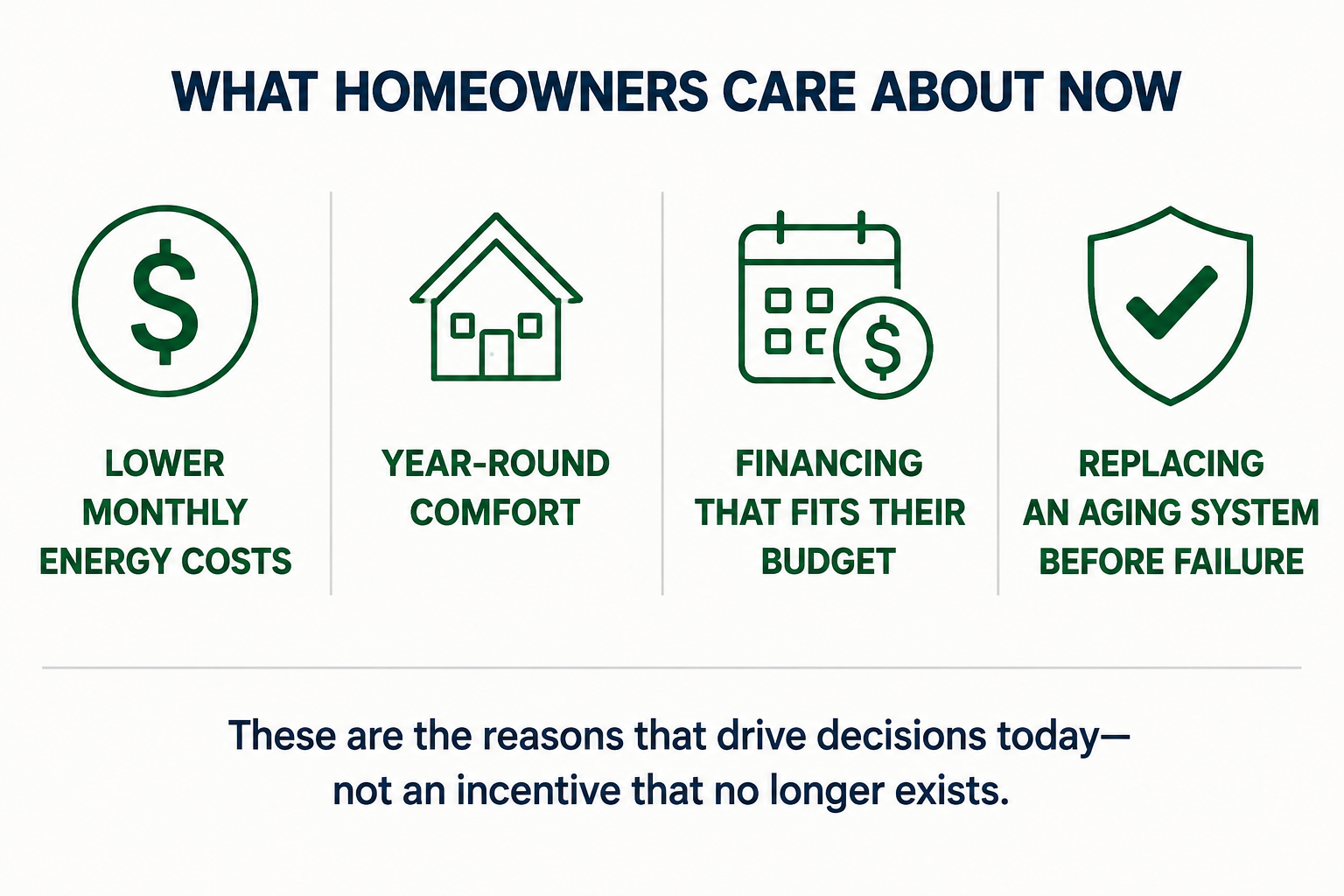
With the credit gone, you need a reason to buy that doesn’t depend on a deadline. Heat pumps were always an easy thing to believe in once someone explains the value in plain terms. The credit let a lot of contractors skip that explanation. Now it’s the whole game.
Here are the reasons that still land, none of which need a tax credit:
- One system heats and cools the home. A heat pump replaces both the furnace and the air conditioner. For a homeowner staring at two aging units, that’s one replacement instead of two.
- Lower monthly operating costs. A heat pump moves heat instead of burning fuel to make it, so it often costs less to run month to month. That saving shows up on every bill, not once at tax time.
- Waiting gets expensive. A 12-year-old system that fails in July is an emergency purchase at the worst possible price. Replacing on their schedule beats replacing in a heat wave.
- Financing makes the number small. Most homeowners don’t buy on sticker price; they buy on the monthly payment. A clear financing offer turns a $12,000 quote into a number that fits next to a car payment.
Here’s the shift in one view:
| The old pitch (expired) | What works now |
|---|---|
| “Save $2,000 with the federal tax credit” | “One system for heating and cooling, at a monthly payment that fits” |
| A deadline that forced a decision | A financing offer that shrinks the number |
| Savings once, at tax time | Lower operating cost on every bill |
| The credit as the reason to buy | The aging system as the reason to buy |
Lead with the monthly payment, not the total. When the price went up and the credit went away, the payment is the number that keeps the deal alive. Say it early and say it clearly. The place it has to be obvious is your website, because that’s where a homeowner decides whether to call. Our HVAC website design team builds pages that put the new reason to buy and the financing offer right where visitors can see them.
Sell to the Customers You Already Have First
You don’t need a new lead to sell a heat pump. The cheapest install you’ll book this year is to a homeowner already in your database whose system is on its last legs. They know you, they trust you, and you’re not paying an ad platform to reach them.
The move is simple: pull every customer with a system more than 10 years old and send them one honest message. Not a blast to your whole list, a targeted note to the people whose equipment is aging out. To do that, your customer records need to live in one place you can filter. That’s what a customer database, or CRM, is for: it holds each customer’s history so you can pull “installed before 2016” in a few clicks.
Here’s what that looks like when it’s done right:
See How We Run HVAC Email Campaigns
Reach Homeowners Before They Start Searching
Your database will only take you so far. To grow, you need homeowners who aren’t your customers yet, and most of them aren’t typing “heat pump installer” into Google. They’re scrolling. That’s where paid social comes in.
Search ads catch people who already decided they need something. Meta ads, meaning Facebook and Instagram, reach homeowners earlier, before they start looking, and plant the idea. For a considered purchase like a heat pump, that head start matters. It’s a different job from search, and it works alongside it. If you’re weighing where ad dollars go across search and social, our guide to paid ads for HVAC breaks down what each channel is good at.
See How Meta Ads Fit Your HVAC Mix
Become the Honest Answer to “Heat Pump Tax Credit 2026”
Right now, homeowners in your area are Googling “heat pump tax credit 2026,” and a lot of what they find is wrong. Old contractor pages still promise a credit that expired. Search engines and AI assistants pull from those stale pages and repeat the mistake.
That confusion is an opening. The contractor who publishes the clear, correct answer becomes the trusted source and picks up the traffic everyone else is misinforming.
Two things are happening in search you can win at the same time:
- Homeowners searching the question directly. A plain page answering “what happened to the heat pump tax credit, and what still saves me money” ranks for a question thousands of people are asking and few are answering honestly. Getting that page to the top is what our HVAC SEO work is built for.
- AI assistants answering for them. More people ask ChatGPT, Gemini, and Google’s AI overview instead of scrolling links. Those tools quote websites they trust. If your page is the accurate, clearly written source, it gets named. If it isn’t, a competitor’s does. Earning those mentions is the job of HVAC AI search optimization.
Being right, in public, is marketing now. The credit questions aren’t going away, and every honest answer you publish builds trust you can’t buy.
Reset Your Heat Pump Offer With This 2026 Checklist
You do not need to rebuild your entire marketing strategy overnight. But you do need to remove outdated messaging, update your sales process, and give homeowners a new reason to say yes.
Work through this checklist before your next heat pump campaign: