

Today, that gap is wider than most contractors think. In a tracking study across ten mid-size U.S. metros, Mecha found less than 35% overlap between Google’s top organic result and the companies’ AI assistants recommended for plumbing and HVAC queries. Ranking first and being recommended are two separate contests, and you can win one while losing the other badly.
There are two halves to this problem. The first half is on-page: your service pages, your business details, and your schema, which together decide the gap between being ranked and being recommended. The second half is off-page: the directories, map platforms, review sites, and community threads you do not own, which supply most of what the answer gets built from.
This piece is the second half.
Why Does AI Name Only Two or Three HVAC Companies?
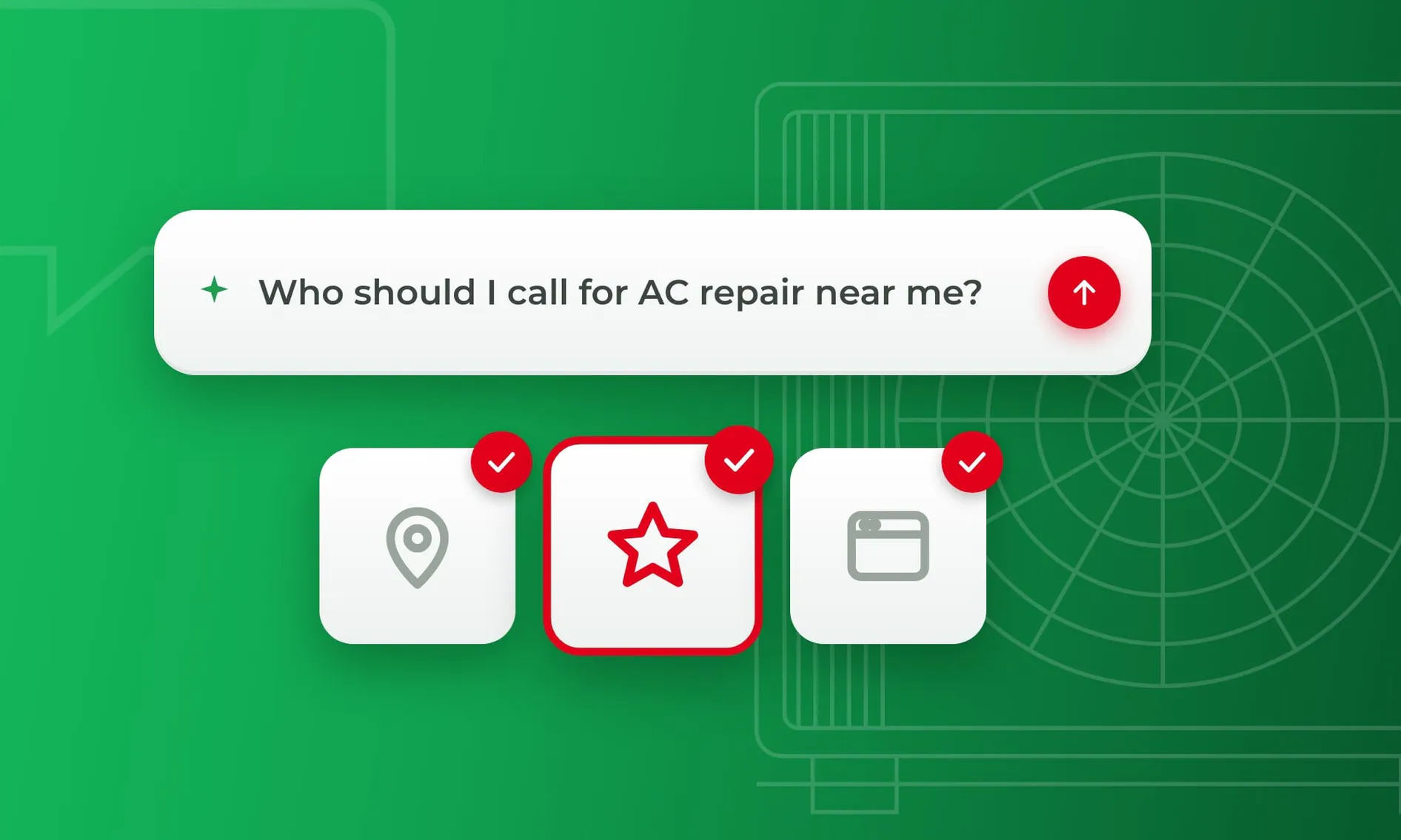
Traditional search hands the homeowner a list and lets them choose. AI search does the choosing first and hands back a short answer, usually two or three names with one line of reasoning each.
That compression is brutal on the middle of the pack. Independent testing has found that when asked for local recommendations, ChatGPT names roughly 1.2% of the business locations it knows about. Google’s map pack shows three companies out of the dozens in your city, and this is tighter than that.
- There is no page two. A homeowner who gets three names rarely asks for more. Position four does not exist inside an answer box.
- The answer arrives pre-justified. AI does not say “here are some options” it says “this company is known for fast emergency response.” The homeowner walks in already believing something about whoever got named.
- You never see the loss. A skipped AI recommendation leaves no impression count, no click, and no line in your analytics. The call that never happened looks identical to a slow week.
How Does AI Decide Which HVAC Company to Recommend?
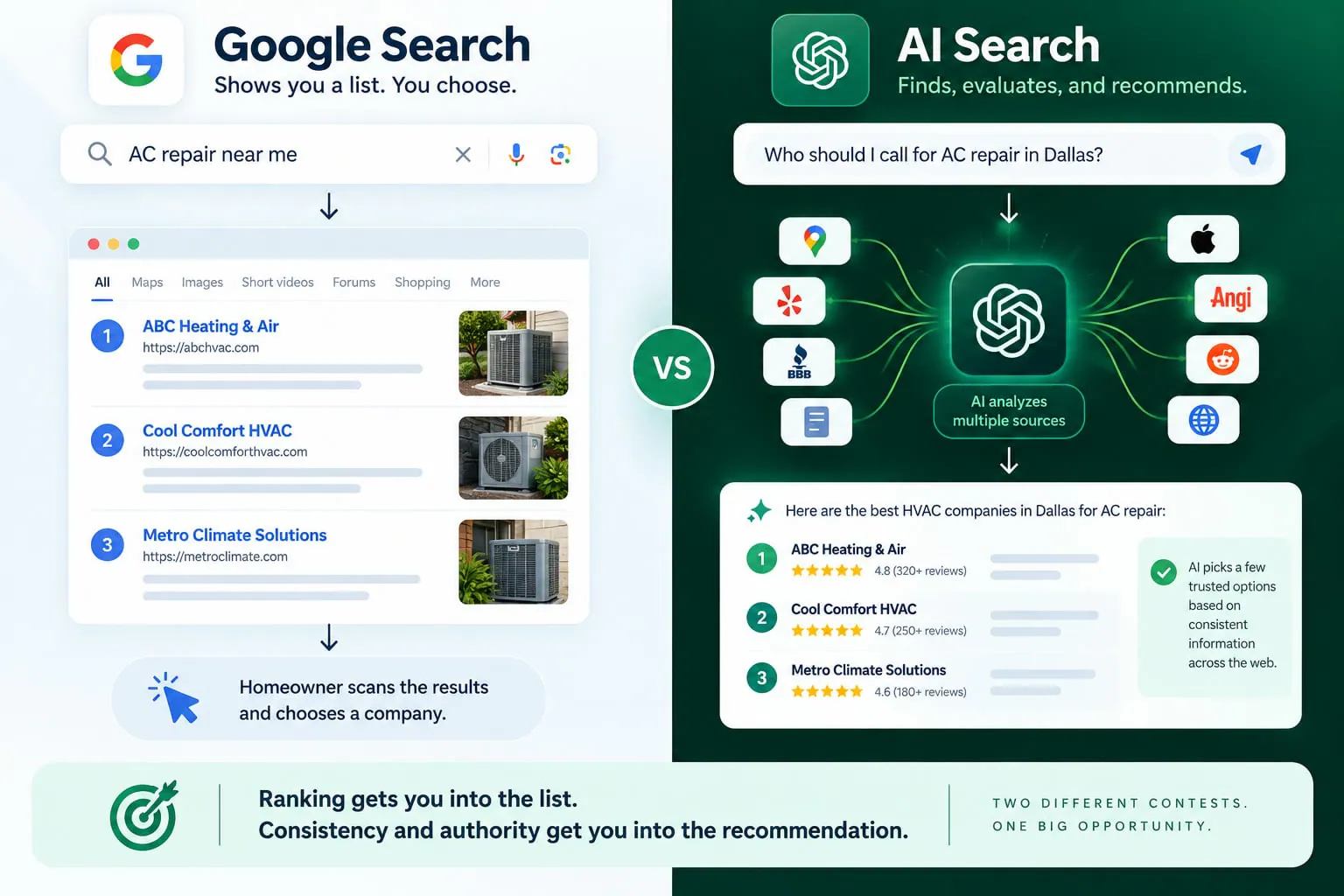
When someone asks an AI assistant for an HVAC company in a city, four things happen in order:
- It reads the question for two facts: the service (AC repair, furnace install, duct cleaning) and the place (the city, sometimes the neighborhood).
- It pulls from a short list of sources it already trusts for local business data. Not the whole internet. A handful of directories, map platforms, review sites, and discussion threads, and the list differs by engine.
- It looks for names that appear in more than one of those sources saying the same thing. A company listed in one place is a maybe. A company listed in six places, all agreeing on the same address, the same services, and the same reputation, is a safe answer.
- It writes two or three names with a reason for each. The reason gets lifted from what those sources said about you, which is why a company with a plain website can get described as “highly rated for same-day service” while a company with a beautiful website gets no description at all.
Step three is the whole game. AI is not grading your marketing. It is looking for agreement across sources, because agreement is the cheapest available proxy for truth.
See How We Get HVAC Companies Into AI Answers
Seven Places AI Looks Before It Looks at You
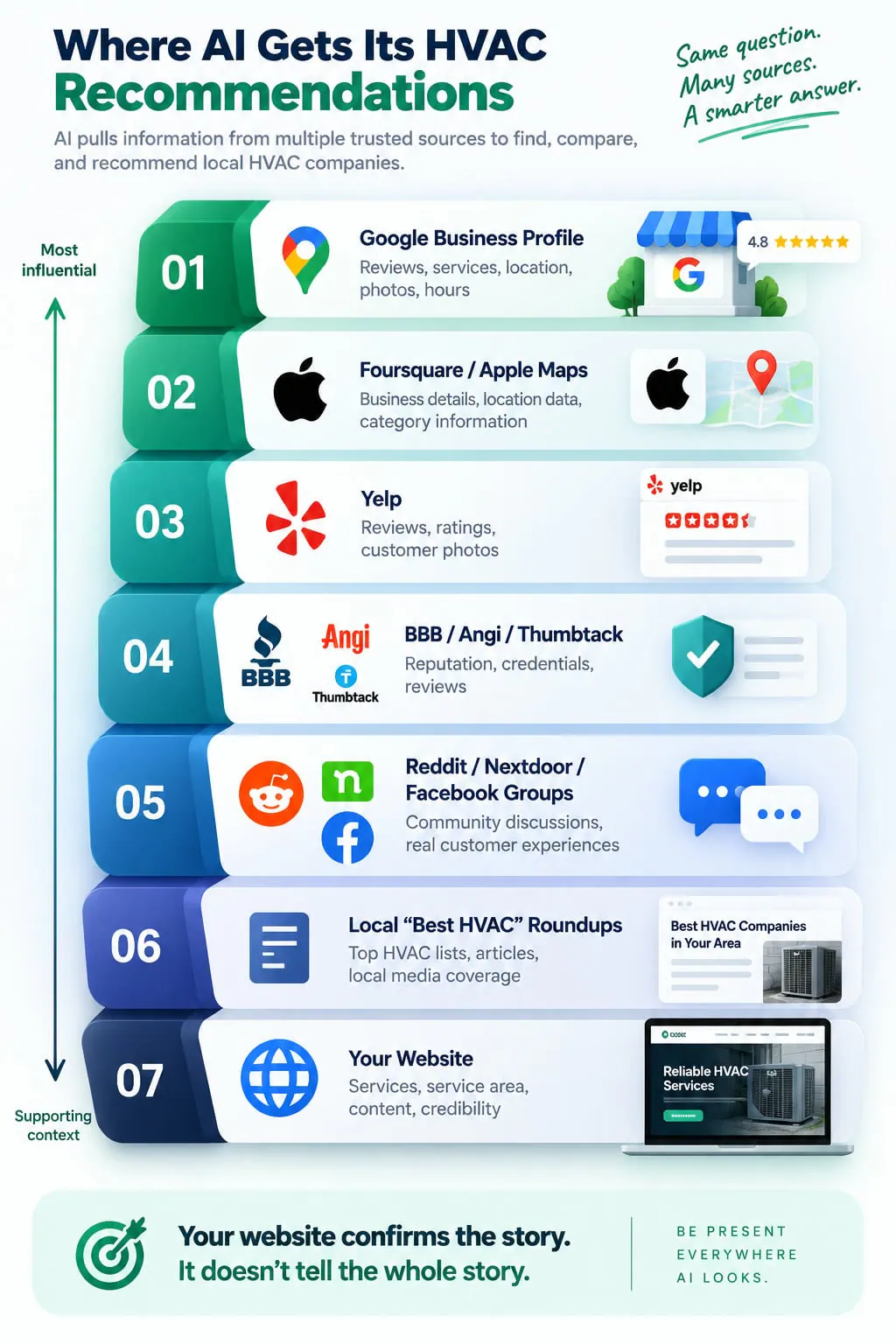
These are the sources feeding local home-services answers, ordered by how much weight they carry. Your own website comes last, and that ordering is the point.
1. Your Google Business Profile
Gemini and Google’s AI Mode lean on Google Business Profile and Google reviews more than any other source, which makes sense given who owns both. Your categories, service list, service area and hours are being read as fact.
The detail contractors miss is the service list. If your profile says “HVAC contractor” and nothing else, you are eligible for the generic question and invisible for “who installs heat pumps in Charlotte.” The same categories and service entries that decide your place in the Google Maps pack are the ones Gemini reads as fact.
Get Your Google Business Profile Optimized
2. Foursquare and Apple Maps
This is the one that surprises people. Foursquare, the check-in app most contractors wrote off a decade ago, became a location-data company, and reporting suggests it supplies somewhere between 60% and 70% of the local business data ChatGPT uses, with the share running highest in smaller towns and narrower niches.
Foursquare also feeds Apple Maps, Uber and a long tail of other apps. A free, claimed, correct Foursquare listing takes about twenty minutes, and no single twenty minutes in this article will buy you more. That same twenty-minute logic runs through the whole directory layer sitting underneath your Google listing.
3. Yelp
BrightLocal’s citation study found Yelp cited in 33% of the AI searches it tested, and Perplexity used Yelp in every single industry examined. Gemini was the one engine that did not cite Yelp directly, which tells you something useful: a source that is invisible on one platform can be load-bearing on another.
You do not have to advertise on Yelp for this to matter. You do have to own a claimed, accurate, reviewed profile, because the profile gets read whether you spend a dollar there or not.
See How Yelp Fits Into Your Lead Mix
4. BBB, Angi and Thumbtack
ChatGPT pulls heavily from aggregated directories, and Perplexity surfaces BBB and Thumbtack companies often enough that the pattern is hard to miss. These platforms are unglamorous, and many contractors have profiles sitting on them from years ago that nobody has opened since.
A stale profile is worse than no profile. An old address or a dead phone number creates disagreement across sources, and disagreement is the fastest way to get filtered out of an answer.
5. Reddit, Nextdoor and Local Facebook Groups
Community threads carry weight out of all proportion to their traffic. In that ten-metro study, the companies getting recommended shared one trait beyond their directory presence: people had named them in Reddit threads, Nextdoor posts, or local Facebook groups.
This is the part you cannot buy, and you should not try to fake it. What you can do is be the kind of company people name, then make sure the name they use matches the name on every profile you own.
- Use one company name everywhere. “Smith Heating” on Facebook and “Smith Heating & Air LLC” on Yelp reads as two different companies to a system hunting for agreement.
- Answer questions in local groups under your business name, not a personal profile, wherever the group allows it.
- Do not astroturf. Fake recommendation threads get spotted by moderators, and a banned account leaves a permanent hole in your source layer.
See How We Run HVAC Social Media
6. “Best HVAC Companies In [City]” Roundups
Listicles published by local news sites, trade blogs, and marketing sites get pulled into AI answers constantly, because they are the closest thing to a pre-written ranked list. Being named in one is a shortcut into the answer.
The format these systems reach for on a “who is good at this” question is a fair comparison page, which is why a ranked look at HVAC marketing agencies gets pulled ahead of any sales page covering the same ground.
7. Your Own Website
It matters, and it matters last. BrightLocal found business websites were the most common source type overall, which sounds like a contradiction until you look at what the website is being used for: confirmation, not discovery.
AI finds you through the sources above, then checks your site to confirm you exist, do what the directories claim, and serve the area they claim. Clear service pages and correct schema markup make that confirmation easy. Schema markup is code that labels your business details so a machine reads them as facts rather than decoration.
See How We Write HVAC Service Pages
Can an HVAC Company With Fewer Reviews Beat a Franchise in AI Results?
The most common objection we hear is that the franchise with 4,000 reviews will always take this. Review count is a signal, not the signal, and Mecha’s ten-metro tracking study put the practical threshold far lower than contractors assume: the companies getting recommended averaged 230 or more Google reviews at 4.5 stars or better, and appeared on 17 or more directories with identical information.
That second number is the one nobody works on. Two hundred reviews is a year of asking properly. Seventeen consistent directory listings is a Tuesday.
The mechanism underneath that is agreement. A company whose name, address, phone, services, and service area match across seventeen sources hands an AI system a high-confidence answer. A company with 4,000 reviews and three different phone numbers floating around the internet hands it a risk.
- Reviews that name the service and the city do double duty. “Fast AC repair in Silver Spring” tells the system what you do and where. “Great guys” tells it nothing, which is the same reason review wording moves rankings while star counts on their own sit still.
- One wrong suite number can cost you a whole category. Consistency work is boring and unpaid, and it is worth more right now than the next thousand dollars of ad spend.
How Do You Check Whether AI Recommends Your HVAC Company?
You do not need a tool or an agency to find out where you stand. You need a browser, three tabs, and a willingness to see the result.
- Open ChatGPT, Gemini, and Perplexity in a logged-out or incognito mode. Logged in, the assistant remembers you, and your own company gets an unfair boost. Logged out is what the homeowner sees.
- Ask the emergency question first. “My AC stopped working in [your city], who should I call today.” This is the highest-intent question a homeowner asks and the one you most want to win.
- Ask the research question second. “Best HVAC company in [your city] for a heat pump installation.” Different question, often a different set of names, because it rewards service specificity rather than speed.
- Ask the trust question third. “Is [your company name] a good HVAC company?” If the answer is vague, contradicts your site, or lists services you dropped in 2023, your source layer is out of date.
- Write down which sources each engine cites. Perplexity shows its links outright. That list is your work order, because it names the exact platforms deciding your visibility in your market.
- Repeat the same three prompts a week later. Answers move. One test is a snapshot, three tests are a pattern.
Run that, and you will know more about your AI visibility than most agencies will volunteer on a sales call. What you do with the gaps is the harder part.
What Should You Fix First, and How Long Before AI Notices?
Not everything on the source layer moves at the same speed. This is the order we work in, and roughly what to expect from each step.
| Fix | Effort | Who owns it | When it shows up |
|---|---|---|---|
| Claim and correct your Foursquare listing | 20 minutes | Owner or office manager | 2 to 6 weeks |
| Match name, address and phone across every directory | 1 to 2 days | Office manager or agency | 4 to 8 weeks |
| Claim and complete Yelp, BBB and Angi profiles | Half a day | Office manager | 3 to 6 weeks |
| Expand your Google Business Profile service list | 1 hour | Owner | 1 to 3 weeks |
| Build a dedicated page for each service you want named | Ongoing | Writer or agency | 6 to 12 weeks |
| Earn reviews that name the service and the city | Ongoing | Every technician | 3 to 6 months |
| Get named in local threads and roundups | Ongoing | Owner and marketing | 3 to 12 months |
The pattern is that the cheap fixes are the fast ones, and they are sitting untouched at most contractors. The expensive work, reviews and reputation, was always going to take a year, and AI search did not change that.
What Can You Change on Your Own Website to Get Named by AI?
Everything above sits on platforms you do not control. Your site is the one layer you own outright, and its job is narrow: make the answer easy to lift in one piece, so a machine never has to assemble it out of four paragraphs.
Answer the question in the first two sentences of the page
- Lead with the answer, then explain. A page opening with “A heat pump install in Charlotte takes one day and runs between four and eight thousand dollars” is quotable. One opening with “At Smith Heating, we pride ourselves on quality” is not.
- Put the city and the service in the same sentence, near the top, as plain text rather than inside a graphic or a header image.
- Keep the whole answer inside one paragraph. An answer split across three paragraphs gets summarized, and a summary is where your name falls out.
Give every question its own heading
- Write the heading as the question a homeowner types. “How much does a new furnace cost in Charlotte?” gets lifted whole. “Furnace Pricing” gets skipped.
- One question, one heading, one answer underneath. A heading covering three questions cannot be matched cleanly to any of them.
- Put an FAQ section on every service page and answer what your phone team fields all week, not what a keyword tool suggests.
Write blog posts shaped like the question, not the keyword
- Mine your call log. The questions customers ask before they book are the same ones they now type into ChatGPT, and almost nobody has published a straight answer to them.
- Cover the decisions, not only the services. Repair against replace, brand comparisons, what a fair quote includes. Those are the questions AI gets asked most and struggles hardest to source.
- One post per question. Three questions in one post compete with each other and leave a machine no clean block to quote.
Publish numbers you are willing to stand behind
- Ranges beat adjectives. “Most furnace installs run four to seven hours” is citable. “Fast, professional installation” is wallpaper.
- Name your equipment brands, certifications, and service-area cities in body text. Those are the facts a machine cross-checks against your directory listings, and a match raises its confidence in you.
- Keep it current. A page still listing a service you dropped is a contradiction, and contradictions are what get you dropped from the answer.
The structural side of this, heading depth, schema, and internal links, is what separates a service page a machine can read from one it skims past.
See How We Build HVAC SEO Content
What AI Search Optimization Cannot Do for Your HVAC Company
We would rather tell you the limits now than let you find them in month three.
- Nobody can guarantee an AI recommendation. These systems change their answers between sessions and between weeks. Anyone selling guaranteed placement in ChatGPT is selling something that does not exist.
- This does not replace the map pack. HVAC emergency searches still lean hard on Google Maps, and that is still where most of your calls come from today. The source layer is an addition, not a swap.
- It compounds slowly, then holds. Directory consistency and review language take weeks to register and months to mature, which is why the contractors who started this in 2025 are the ones getting named now.
- A thin company cannot fake a thick profile. If your service area, staffing or reviews do not support the claim, this work will surface that rather than hide it. That is a feature.
Want to Know Why AI Recommends Your Competitors Instead of You?
We built the same audit we use to find the gaps between an HVAC company and the names AI keeps recommending. You’ll get the prompt test script, a seven-source scorecard, and a 30-day action plan for fixing what AI sees.
Get the AI Recommendation Audit
So Where Should an HVAC Contractor Start This Week?
The homeowner asking an AI assistant for an HVAC company is never going to visit your website first. They are going to get three names, and those names came from a set of sources you can list, claim, and correct.
If you do nothing else after reading this, do these three:
- Run the three prompts logged out. Emergency, specialist, vetting. Write down whether you appear and what the engine says about you when you do.
- Claim your Foursquare listing today. Twenty minutes, no cost, and it is the one source almost no contractor has touched since 2014.
- Make your phone number identical everywhere. A single mismatched tracking number undoes more than a month of content work.
Everything past that is the same work good local marketing always was. What changed is that a machine now grades your consistency, and it grades on a curve of three.