

The short answer: let the winners in your market write your rules
The companies already ranking for your money searches, in your town, are the best evidence of what Google rewards there. So we stopped starting from a general checklist. We start from your market, count what the winners share, and turn those patterns into rules for your website and your Google Business Profile.
I have given the method a name, because our team now uses it in client work:
Rulesourcing (n.): deriving a business’s search, advertising or AI-visibility rules from the businesses already winning in its own target market, instead of from universal checklists. Each rule carries the count it rests on, its source and a pass/fail gate, and the market is re-measured every month.
In this blog, we cover how it works, why two HVAC markets can need opposite rules, what we refuse to copy from the winners, and three things you can check this week.
It is fair to tell you where I stand. RS Gonzales sells local search and AI-visibility work to HVAC and home-services contractors. Every number below comes from our own research runs for real clients in October and November 2026. We do not name the clients or their competitors.
How Does Rulesourcing Work for an HVAC Company?
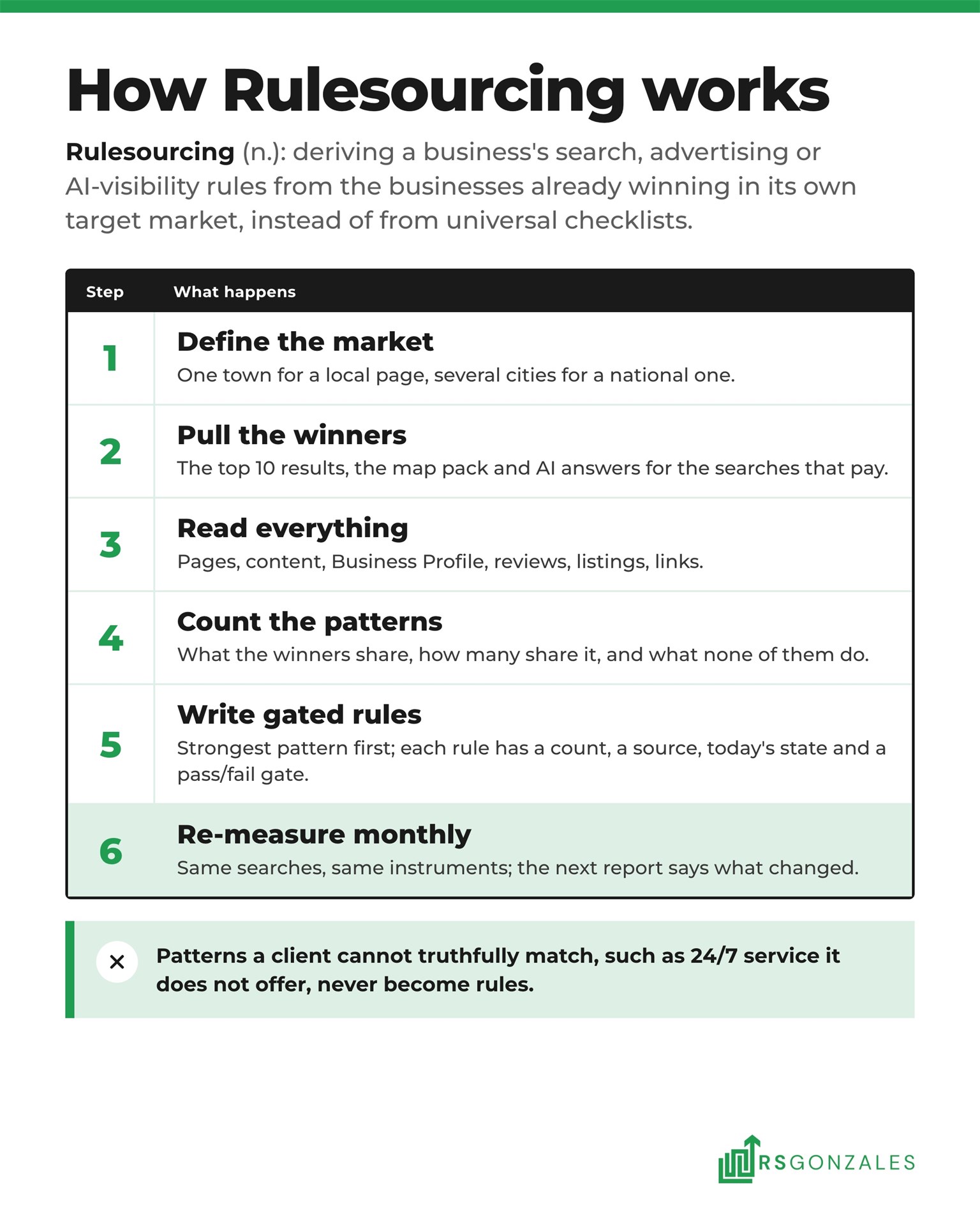
There are six steps. Most of the counting is done by software; a person on our team signs off every rule.
1. Define your market
For a local company, the market is your town and the searches that bring paying jobs, like “ac repair” or “furnace replacement” with your town’s name. For a page meant to rank nationwide, it is several cities at once.
2. Pull the winners
We record which companies are in Google’s top 10, who is in the map pack of three, and which companies AI assistants name, for each of those searches.
3. Read everything about them
Their websites, page by page. Their Google Business Profiles, their reviews, their listings on sites like Yelp, and the links pointing to them.
4. Count the patterns
What do most winners share? How many of them share it? What do none of them do? A pattern that only two winners show is noise; one that most of them show is a signal worth acting on.
5. Write rules with a pass or fail test
The strongest pattern is always first. Each rule says what the winners do, where the count came from, where you stand today, and a test your page either passes or fails.
6. Measure again every month
The searches and tools are the same each time. The next report opens with what changed, so nobody has to guess whether the work paid off.
Why Can’t One HVAC SEO Checklist Work in Every Market?
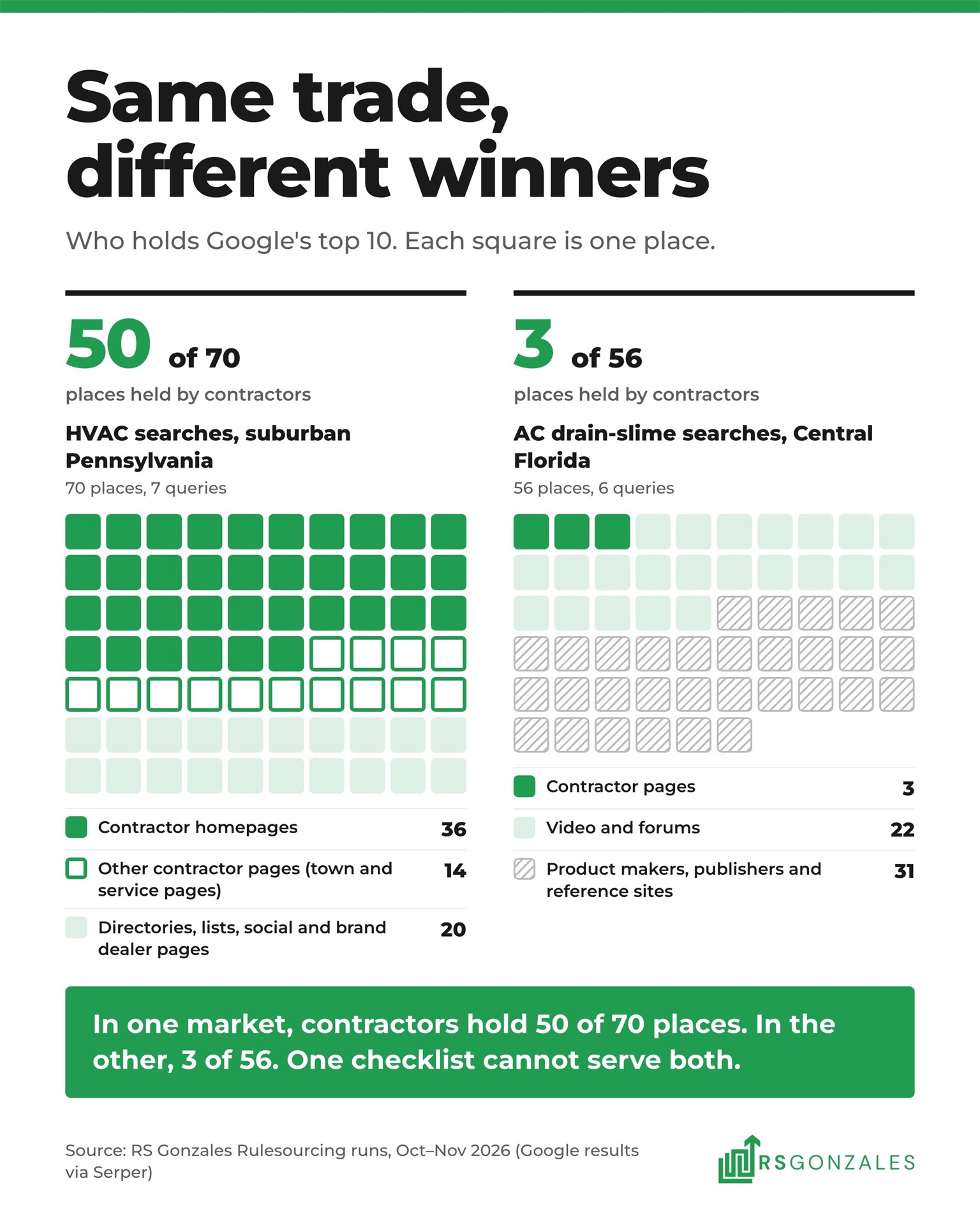
Because the winners are different kinds of pages in different markets, and the advice has to follow them. Here are two from our October runs.
HVAC searches in a suburban Pennsylvania market. Contractor homepages held 36 of the 70 places in Google’s top 10. Town and service pages from contractors held 14 more. Directories, lists, social pages and brand dealer pages held the other 20. The rule there was to put the town in the homepage title, because the homepage is the page that wins.
AC drain-slime searches in Central Florida. Contractors held only 3 of the 56 places. Videos and forum threads held 22. Product makers, publishers and reference sites held 31. A YouTube video was in the top 10 for all six searches. The rule there was to film a technician clearing a real drain line, with the customer’s permission, and put it on the page.
It was the same trade, and the rules were opposite. A checklist would have told both companies the same thing.
The map pack has its own rules too. In one California market, the eight companies leading the map pack all sat within 3.2 km of the town centre. Our client sat 7.4 km away. Your shop is where it is. So the rule there was to compete on what you can change: a steady flow of reviews that describe the job and the town, consistent listings, and links from other local sites. We saw a version of this in New York too, where Manhattan and Brooklyn play by different rules.
What Does a Rulesourced HVAC Rule Look Like?
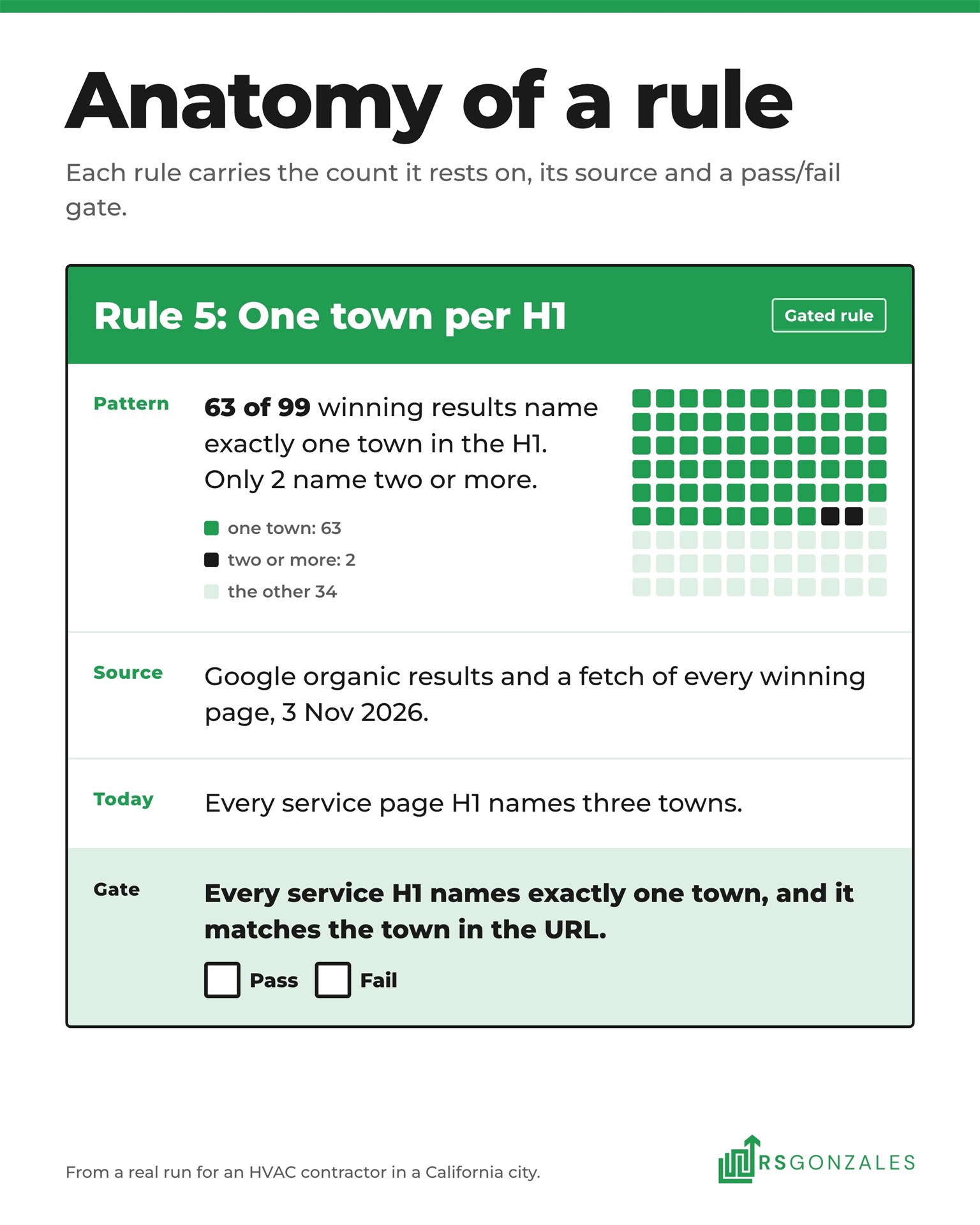
Here is a real one, from a run for an HVAC company in a California city on 3 November 2026.
| Rule 5: One town per H1 | |
|---|---|
| Pattern | 63 of 99 winning results name exactly one town in the page’s main heading. Only 2 name two or more. |
| Source | Google results, and a fetch of every winning page, 3 Nov 2026 |
| Today | Every one of the client’s service pages named three towns in its heading |
| Gate | Every service page heading names exactly one town, and it matches the town in the web address. Pass or fail. |
What is missing is opinion. Anyone on the team, or on your side, can check whether the page passes.
Isn’t This Just Copying Your HVAC Competitors?
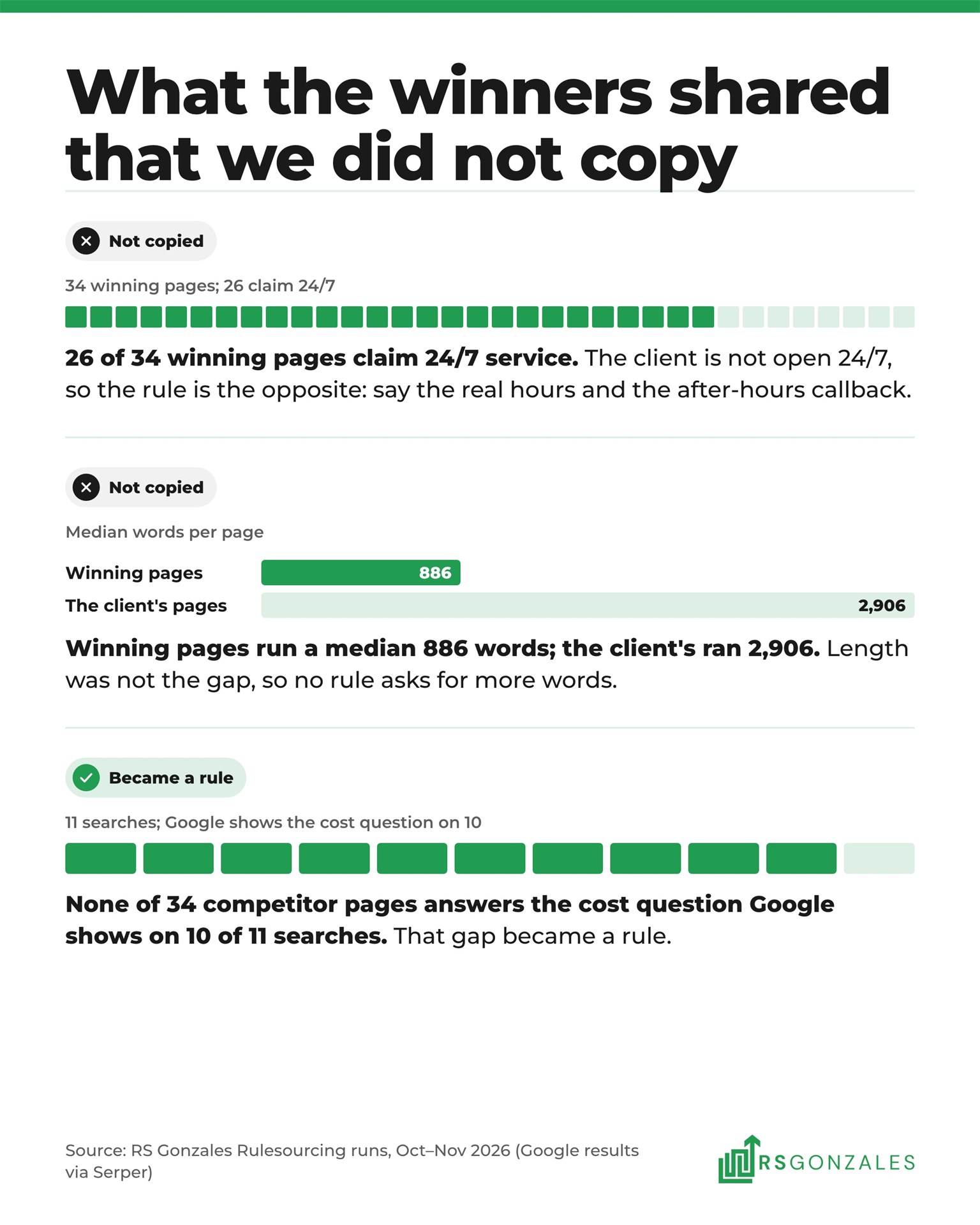
No. Copying is taking everything. Rulesourcing is counting first, then throwing out three kinds of pattern.
1. Claims you cannot keep. In one market, 26 of 34 winning pages promised 24/7 service. Our client is not open around the clock, so its rule was the opposite: state the real hours and the after-hours callback. A promise you cannot keep costs you the customer who believed it.
2. Advice the data does not back. The checklist says longer pages rank. In one market, the winning pages were a median 886 words long; our client’s were 2,906. Length was not the gap, so no rule asked for more words.
3. Gaps nobody has filled. In one market, Google showed the same cost question on 10 of the 11 searches that carried questions, and none of 34 competitor pages answered it. That gap became a rule, answered with the client’s own confirmed prices.
Does Rulesourcing Replace the HVAC SEO Checklist?
It is a sharper version of it. Our local SEO checklist for HVAC businesses still covers the basics every contractor needs. Rulesourcing decides what comes next in your market, and in what order.
| A general SEO checklist | Rulesourcing | |
|---|---|---|
| Where the advice comes from | Studies that pool many markets | The companies winning your searches, in your town |
| What a recommendation looks like | “Write longer pages” | “63 of 99 winners name one town in the heading; yours name three” |
| What it refuses | Nothing | Claims you cannot keep, and patterns the data does not back |
| How you know it worked | You hope | A monthly re-run of the same searches, and a pass or fail test on every rule |
Have We Tried It on Our Own HVAC SEO Pages?
Yes, and this is where it gets interesting. For our own page aimed at contractors searching “hvac seo agency”, we ran five national searches from eight US cities. Any two cities shared 69% to 91% of the same top 10, and none of the 400 results named the city the search came from. That told us the market for that page is national, so its rules came from all eight cities pooled. Our city pages take their rules from their own cities.
Between 2 and 6 November we rebuilt that national page and twelve city pages to rulesourced rules. Fourteen more city pages are next. Until they are rebuilt, they are our comparison: calls and clicks on the new pages against the same weeks on the pages we have not touched yet. We will publish what we find on 30 November, 28 December and 25 January, even if it shows nothing.
So Where Should Your HVAC Company Start This Week?
Software is not needed to try the idea. Start with these three:
- Search like a customer. On your phone, from your own town, search your three best-paying services with your town’s name. Write down the three companies in the map pack and the top 10 websites.
- Count three things. What kind of page wins: homepages, service pages, directories or videos? How many towns do the winners name in their main heading? Do they answer the price question?
- Fix the one you can truthfully match. Pick the pattern most winners share that you do not, and only if it is true of your business. Then check the same searches again in a month.
If you would rather we do the counting, that is the work our team does every month for the contractors we serve.