

The ad and the recommendation are two different spots on the same screen. A recommendation is a company ChatGPT names inside its answer. An ad sits under that answer, labeled as sponsored, and OpenAI’s ad principles say ads do not influence what the answer says.
So the question for an owner is which spot to work on first. In this blog, we compare the two, what each can and can’t do for an HVAC company, and which to start with. By the end, you will know where your next dollar or hour on ChatGPT should go.
Can Paying for ChatGPT Ads Get Your HVAC Company Recommended?
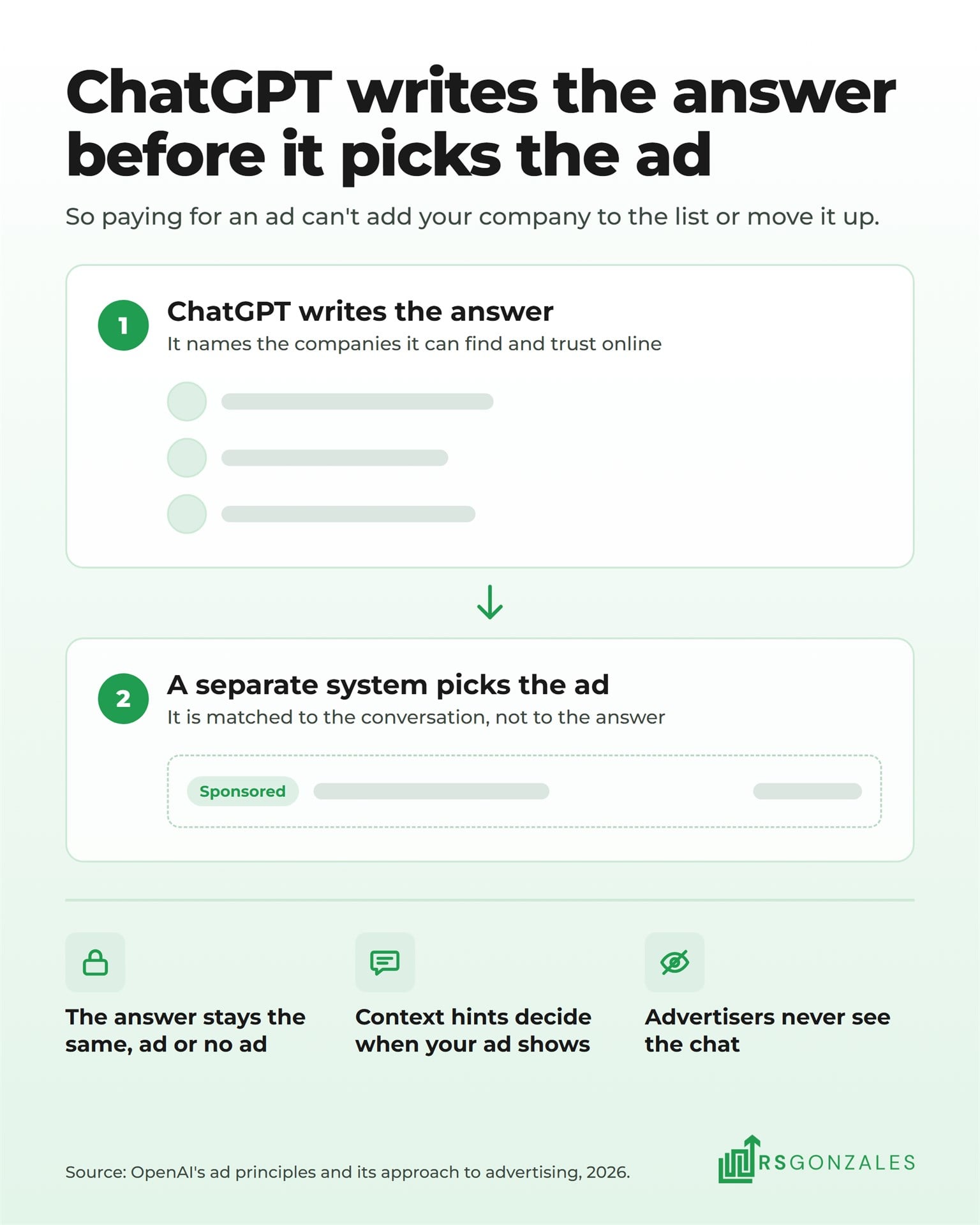
Running ads does not earn your company a place on the list because ChatGPT writes its answer before any ad is chosen. A separate system then picks an ad to show under that answer, matched to the topic of the conversation. That order matters for an HVAC company in three ways:
- The answer stays the same whether you advertise or not. If ChatGPT names three furnace companies in your town, buying an ad does not add yours to that list or move it up.
- The ad is matched to the conversation, not to the answer. You describe the situations your ad fits, such as a homeowner whose furnace won’t light, in short phrases OpenAI calls context hints. When a conversation matches them, your ad can show.
- Advertisers never see the conversation. OpenAI keeps each chat private from advertisers and reports only totals, like how many people saw and clicked your ad.
This is also why nobody can sell you a guaranteed spot inside ChatGPT’s answer. ChatGPT decides which companies to name, based on what it can find and trust about each one online.
Where Does a ChatGPT Ad Show Up Next to a ChatGPT Recommendation?
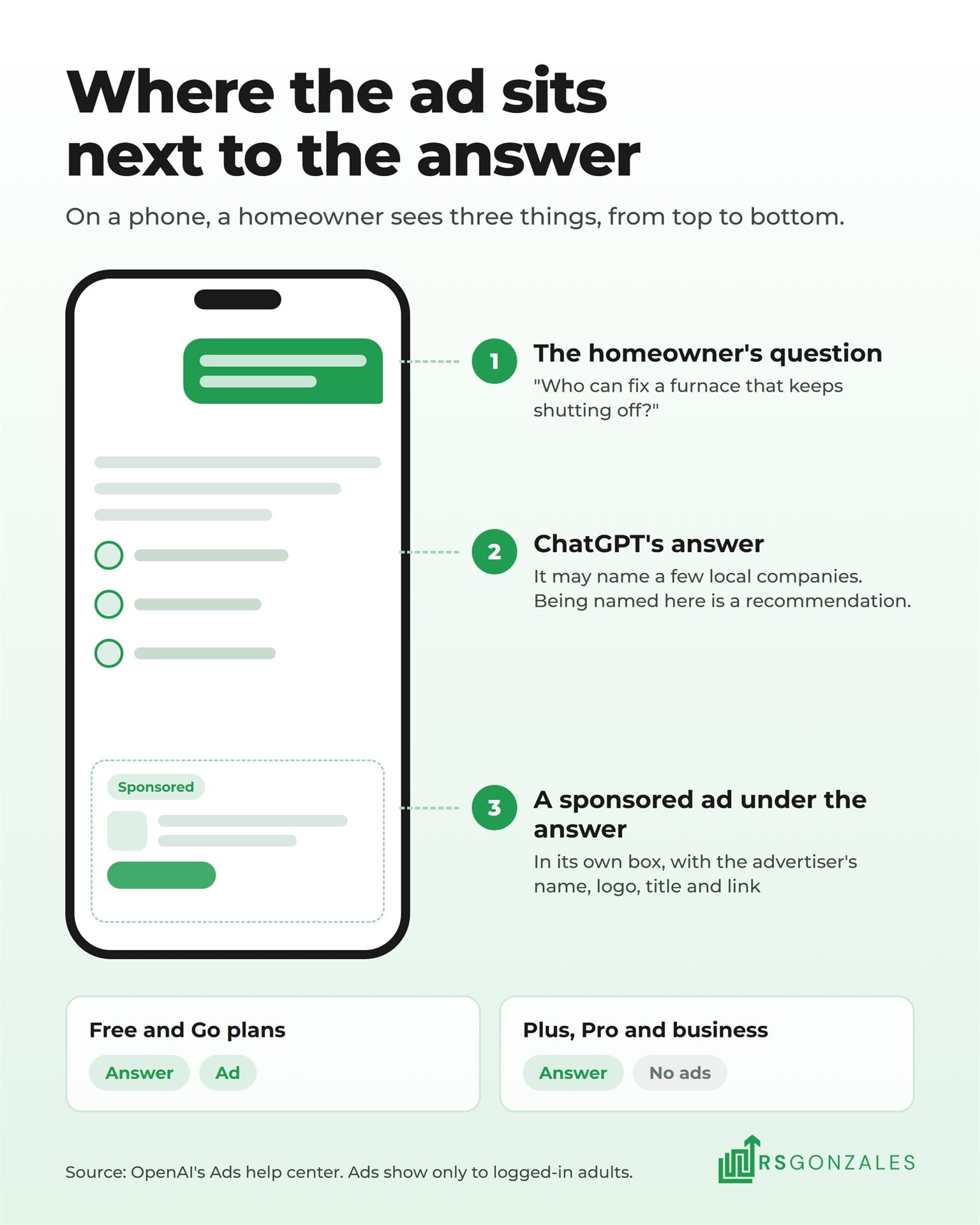
The answer and the ad are built separately, and they appear in separate places on the screen. On a phone, a homeowner sees them from top to bottom in this order:
- The homeowner’s question, such as “Who can fix a furnace that keeps shutting off?”
- ChatGPT’s answer, which may explain the likely causes and name a few local companies. Being named here is a recommendation.
- A sponsored ad under the answer, in its own box, with the advertiser’s name and logo, a short title and description, and a link to its website.
The two spots also reach different people. Ads show only to logged-in adults on ChatGPT’s free plan and its low-cost Go plan. People who pay for Plus, Pro, or a business account see no ads at all, but they still see the answer and every company named in it.
ChatGPT Ads vs Recommendations: What’s the Difference?
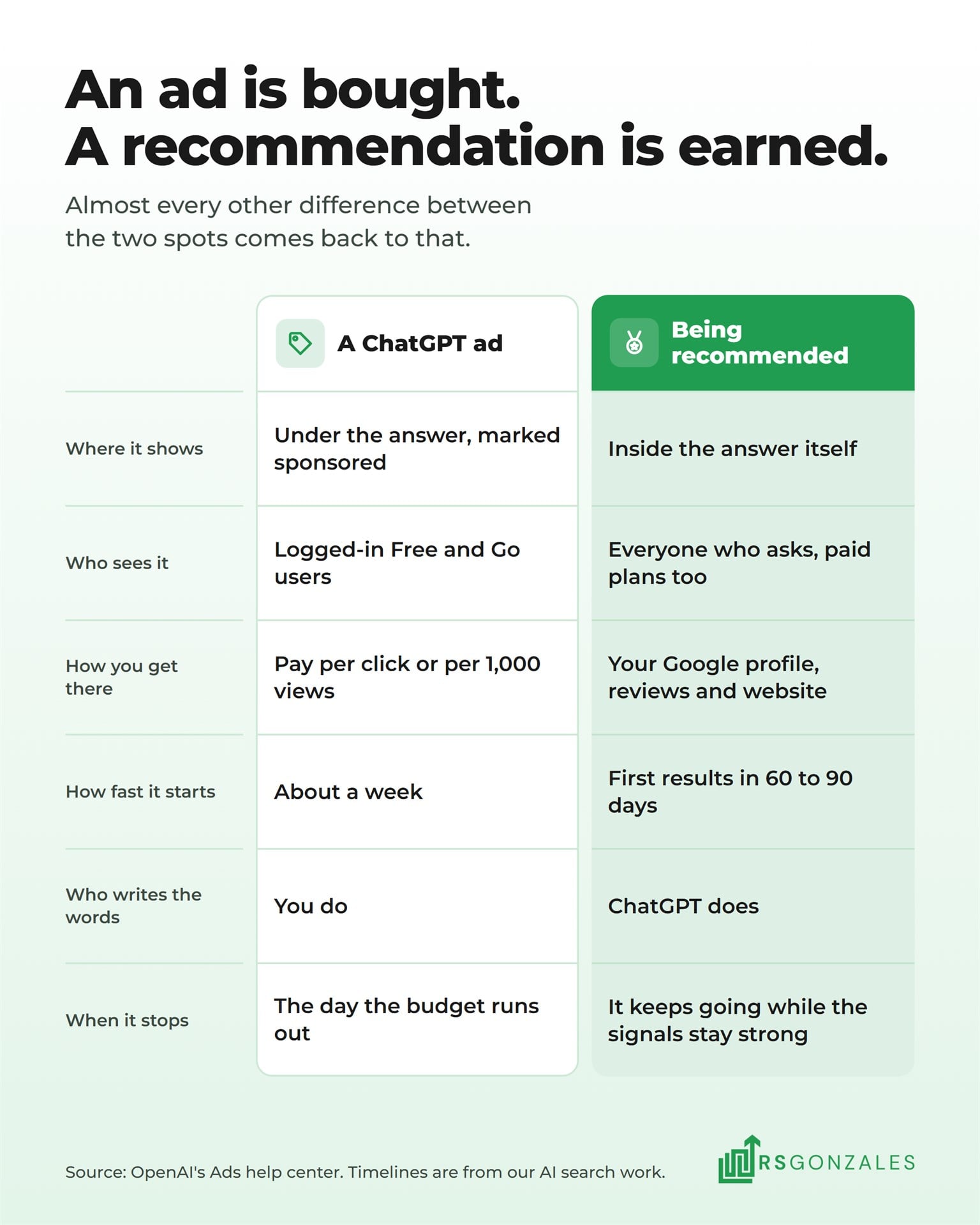
An ad is bought one click at a time, and a recommendation is earned over months, so almost every other difference between them traces back to that. Here is how the two compare for an HVAC company:
| A ChatGPT ad | Being recommended by ChatGPT | |
|---|---|---|
| Where it appears | Under the answer, in a box marked as sponsored | Inside the answer itself |
| Who sees it | Logged-in adults on the Free and Go plans | Everyone who asks, paid plans included |
| How you get there | Pay per click or per 1,000 views | Build up your Google Business Profile, reviews, and website |
| How fast it starts | About a week, once OpenAI verifies your business | Early results can take 60 to 90 days, and content and reviews 3 to 6 months |
| Who writes the words | You do, in a 50-character title and a 100-character body | ChatGPT does, from what it finds about you |
| What you can track | Views, clicks, form fills, and calls to a tracking number | No report from OpenAI, so you check by asking ChatGPT yourself |
| What it costs | OpenAI’s minimum is $25 a day, and we recommend $50 for a test | The work on your profile, reviews, and website, with no charge per click |
| When it stops | The day the budget runs out | It keeps going while the signals behind it stay strong |
| How homeowners read it | As an ad, because it is labeled sponsored | As ChatGPT’s own suggestion |
What ChatGPT Ads Can and Can’t Do for an HVAC Company
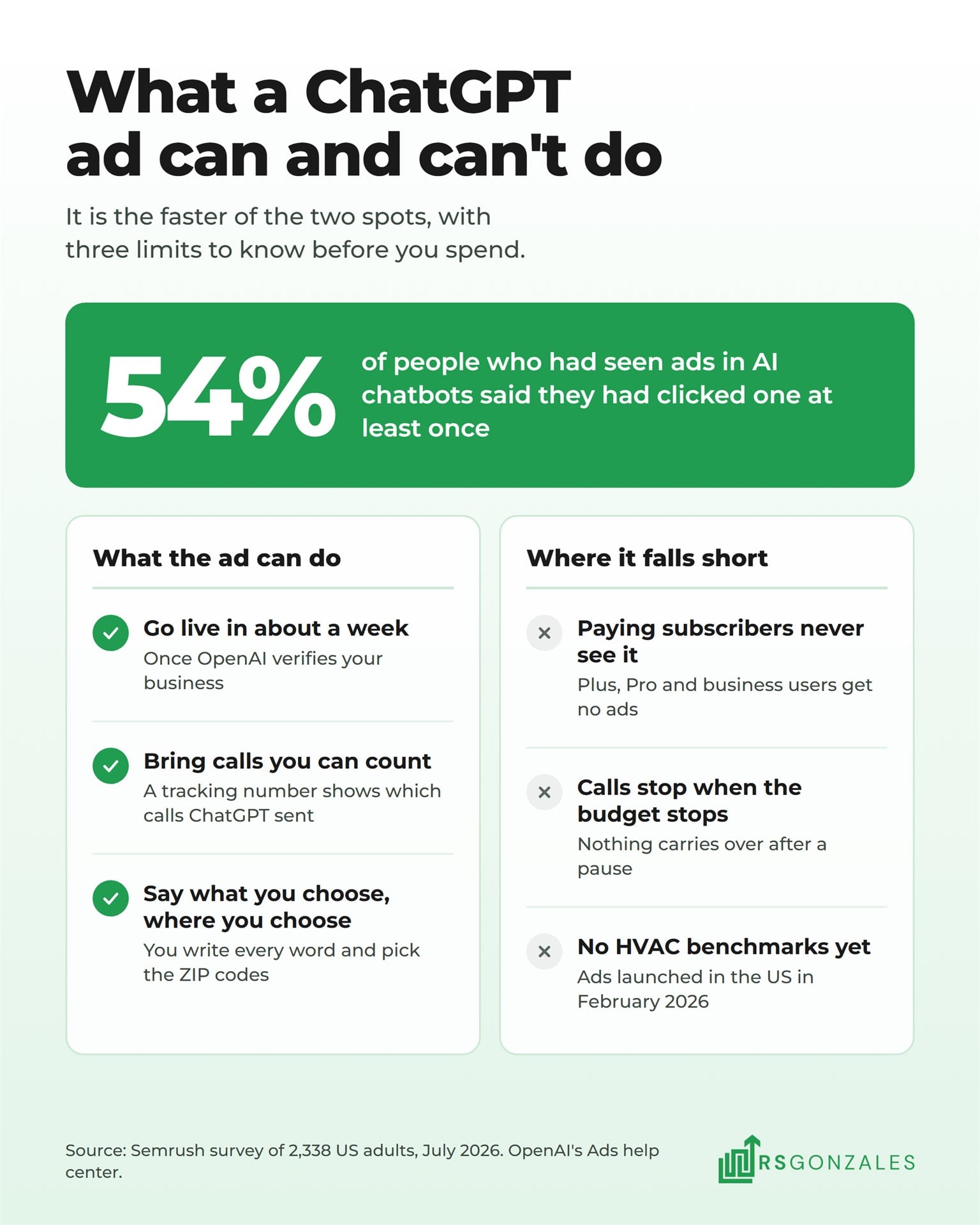
A ChatGPT ad can be live within about a week of opening an account, which makes it the faster of the two spots. The ad also lets you choose its wording and the ZIP codes it runs in, and it has three limits to know before you spend.
Calls You Can Count Within the First Month
Once OpenAI verifies your business, which can take up to seven business days, a campaign can go live the same day. Every click lands on a page you choose, and a call tracking number on that page shows which calls ChatGPT sent. A call tracking number is a separate phone number that forwards to your office and records where each call came from.
People do click these ads. In a July 2026 Semrush survey of 2,338 US adults, 54% of those who had seen ads in AI chatbots said they had clicked at least once. After 30 days at $50 a day, you have a cost per call to set next to Google Local Services Ads, the pay-per-lead listings at the top of Google.
Control Over the Message, the Service, and the ZIP Codes
You write every word of the ad, so you decide whether it sells furnace repair this week or AC replacement in the spring. You also decide where it runs. ChatGPT ads can target states, metro areas, or individual ZIP codes, so a company serving 14 ZIP codes pays only for homeowners in those 14.
A recommendation gives you none of that control. ChatGPT picks the words, and it decides which questions your company comes up for.
Where ChatGPT Ads Fall Short
The same setup that makes ads fast also limits them. Three limits matter most for an HVAC company:
- ChatGPT’s paying subscribers never see them. Plus, Pro, and business users get no ads, so part of your market is out of reach.
- The calls stop when the budget stops. Nothing carries over once you pause the campaign.
- Nobody has HVAC benchmarks yet. Ads launched in the US in February 2026, so no one, us included, can promise what a click or a call will cost in your market.
See How We Run ChatGPT Ads for HVAC Companies
What Being Recommended by ChatGPT Can and Can’t Do for an HVAC Company
A recommendation reaches every ChatGPT user who asks, including the paid subscribers who never see an ad, and it costs nothing per click. It works the opposite way from an ad on almost every point.
The Trust That Comes With Being Named in the Answer
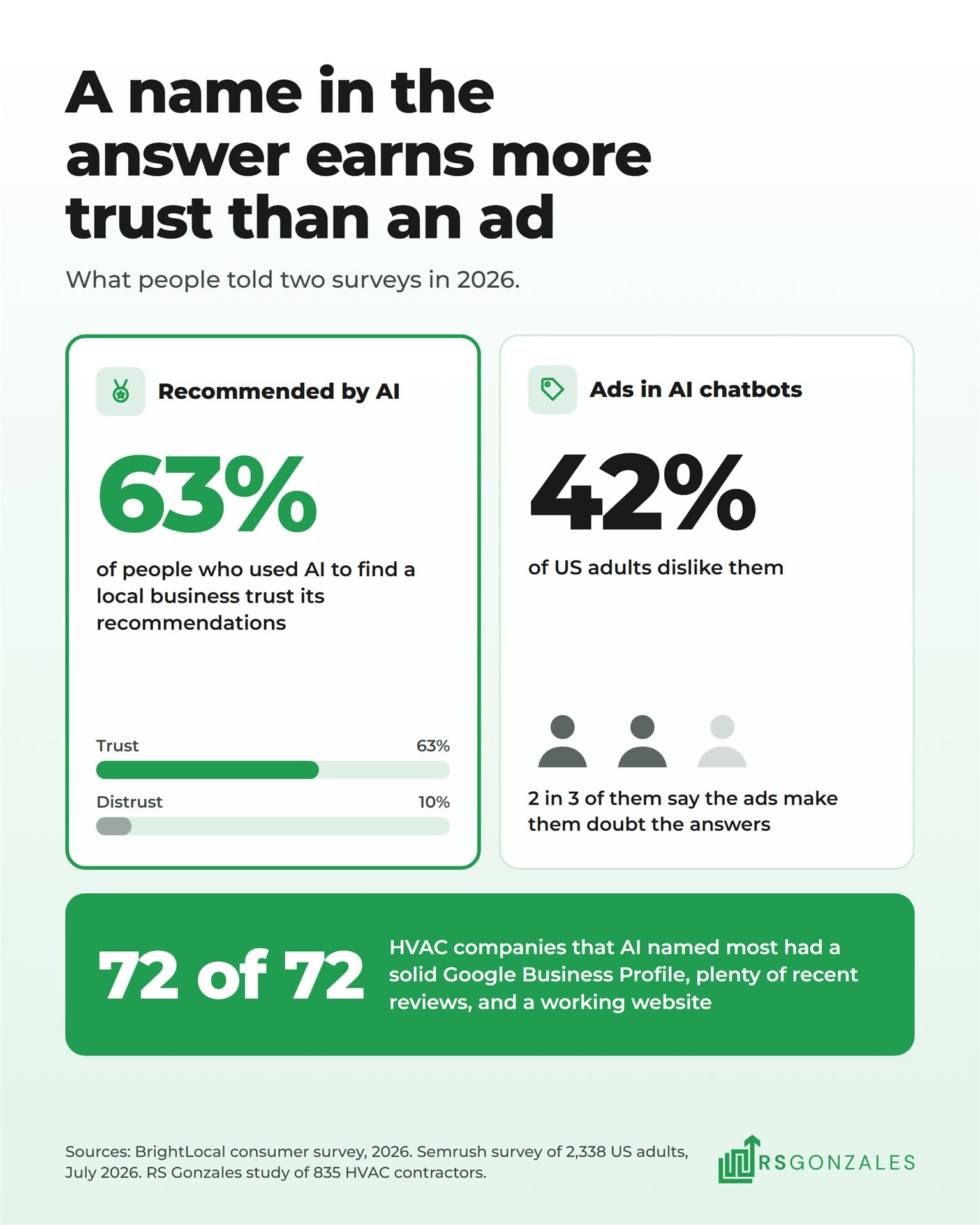
Homeowners read a name in the answer as ChatGPT’s own suggestion, and most people who use AI this way trust it. BrightLocal’s 2026 consumer survey found that 63% of people who used an AI tool to find a local business trust its recommendations, and only 10% distrust them.
An ad does not get the same benefit of the doubt. In the same Semrush survey, 42% of US adults disliked ads in AI chatbots, and two in three of them said the ads make them doubt the answers.
Reach Across Every ChatGPT User, With No Daily Budget
A name in the answer shows up for free and paid users alike, at any hour, for as long as ChatGPT keeps choosing you. There is no budget to run out. The places ChatGPT checks before naming an HVAC company start with your Google Business Profile and run through Yelp, Reddit, and your own website.
That groundwork does double duty, because the same profile, reviews, and website also help you on Google Maps.
Where Being Recommended Falls Short
Earning the answer is slower and harder to measure than buying the ad. Three limits stand out:
- It takes months. Our AI search work can show first results from the basics in 60 to 90 days, and content and review signals take 3 to 6 months to add up.
- You don’t control the words. ChatGPT may name you for furnace repair and leave you out for AC installation, and the same question can get a different list on a different day.
- OpenAI gives you no report. Nothing tells you how often ChatGPT named your company, so you check by asking it the questions your customers ask.
See How We Get HVAC Companies Named in AI Answers
Which Should Your HVAC Company Start With: ChatGPT Ads or AI Recommendations?
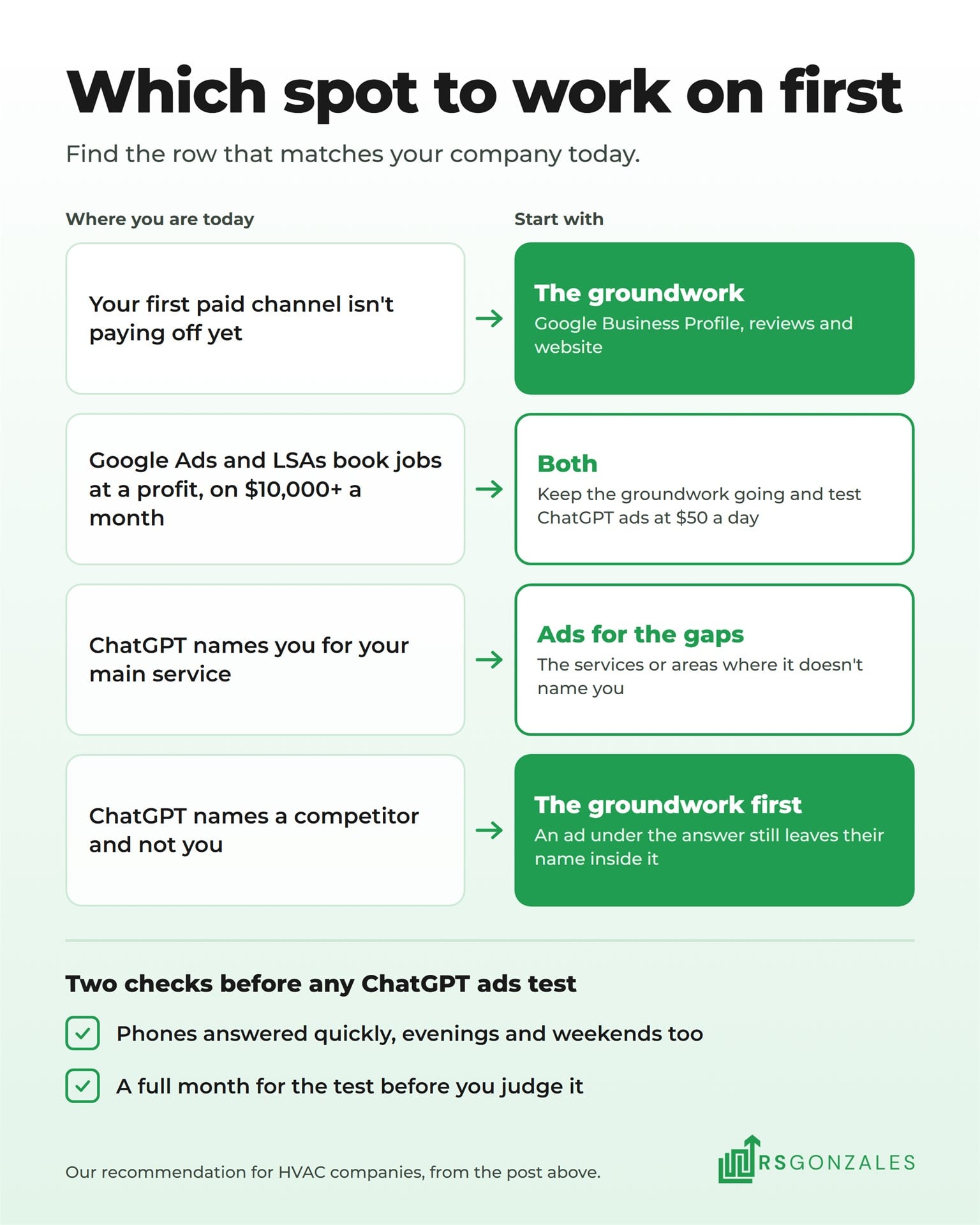
Most HVAC companies should start with the groundwork that gets them recommended. Add ChatGPT ads once Google pay-per-click ads, the paid results at the top of a Google search, and Local Services Ads already book jobs at a profit.
The groundwork pays off on Google and ChatGPT at once, while an ad test needs money and attention you may still be spending on channels that work. Find your situation in the table:
| Where your company is today | Start with | Why |
|---|---|---|
| Still getting your first paid channel to pay off | The groundwork: Google Business Profile, reviews, and website | A new ad channel splits a budget that has not proven itself yet |
| Google Ads and Local Services Ads book jobs at a profit, with $10,000 or more a month in ad spend | Both: keep the groundwork going and test ChatGPT ads at $50 a day | You can fund a month-long test without cutting a channel that works |
| ChatGPT names you for your main service | Ads for the services or areas where it doesn’t name you | The ad covers the questions the answer leaves you out of |
| ChatGPT names a competitor and not you | The groundwork first | An ad under the answer still leaves the competitor’s name inside it |
Two more checks come before any ChatGPT ads test. Your phones need to be answered quickly, evenings and weekends included, and you need to give the test a full month before judging it.
RS Gonzales runs ChatGPT ads for HVAC contractors and offers AI SEO services for HVAC companies. We sell both, and we still tell most owners to start with the groundwork and add the ads second.
How ChatGPT Ads and AI Recommendations Work Together for an HVAC Company
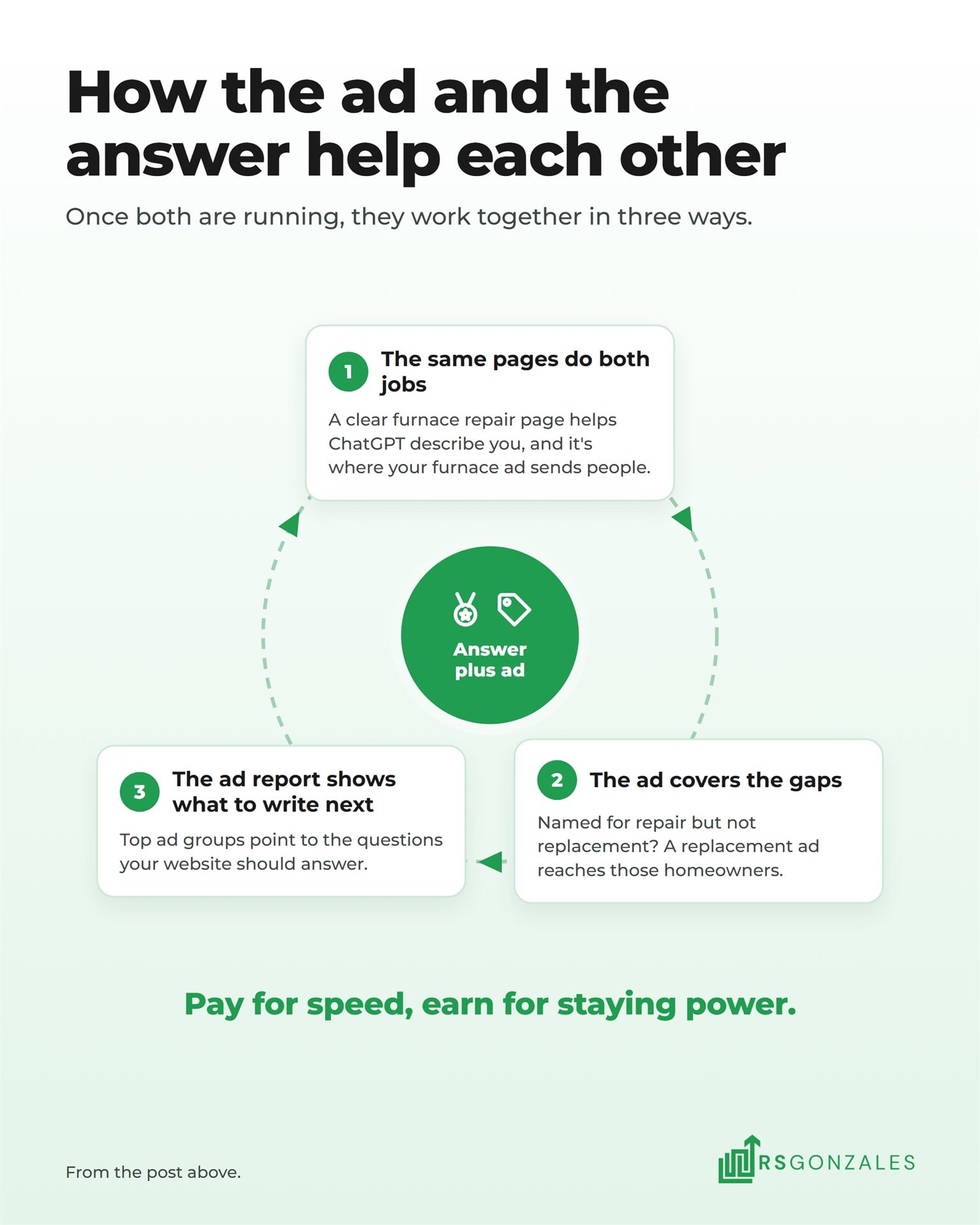
A homeowner who sees your company named in ChatGPT’s answer and your ad right under it has two reasons to call you. You only pay when they click the ad. Once both are running, they help each other in three ways:
- The same pages do both jobs. A furnace repair page that answers homeowners’ questions plainly helps ChatGPT describe you, and it is also the page your furnace repair ad sends people to.
- The ad covers the gaps in the answer. If ChatGPT names you for repair but not for replacement, a replacement ad puts your company in front of those homeowners while the groundwork catches up.
- The ad report shows what to write next. The ad groups that get the most clicks show which homeowner problems bring people to you, and those are the questions your website should answer next.
HVAC owners already know this split from Google, where paid ads and SEO each do a different job. ChatGPT adds a second screen where the same rule holds: pay for speed, earn for staying power.
What HVAC Owners Should Take Away About ChatGPT Ads and Recommendations
A ChatGPT ad cannot buy your company a place in ChatGPT’s answer. What the ad buys is a labeled spot under the answer, for as long as the budget lasts. A place inside the answer is earned through your Google Business Profile, your reviews, and your website, and it keeps working after any ad is paused.
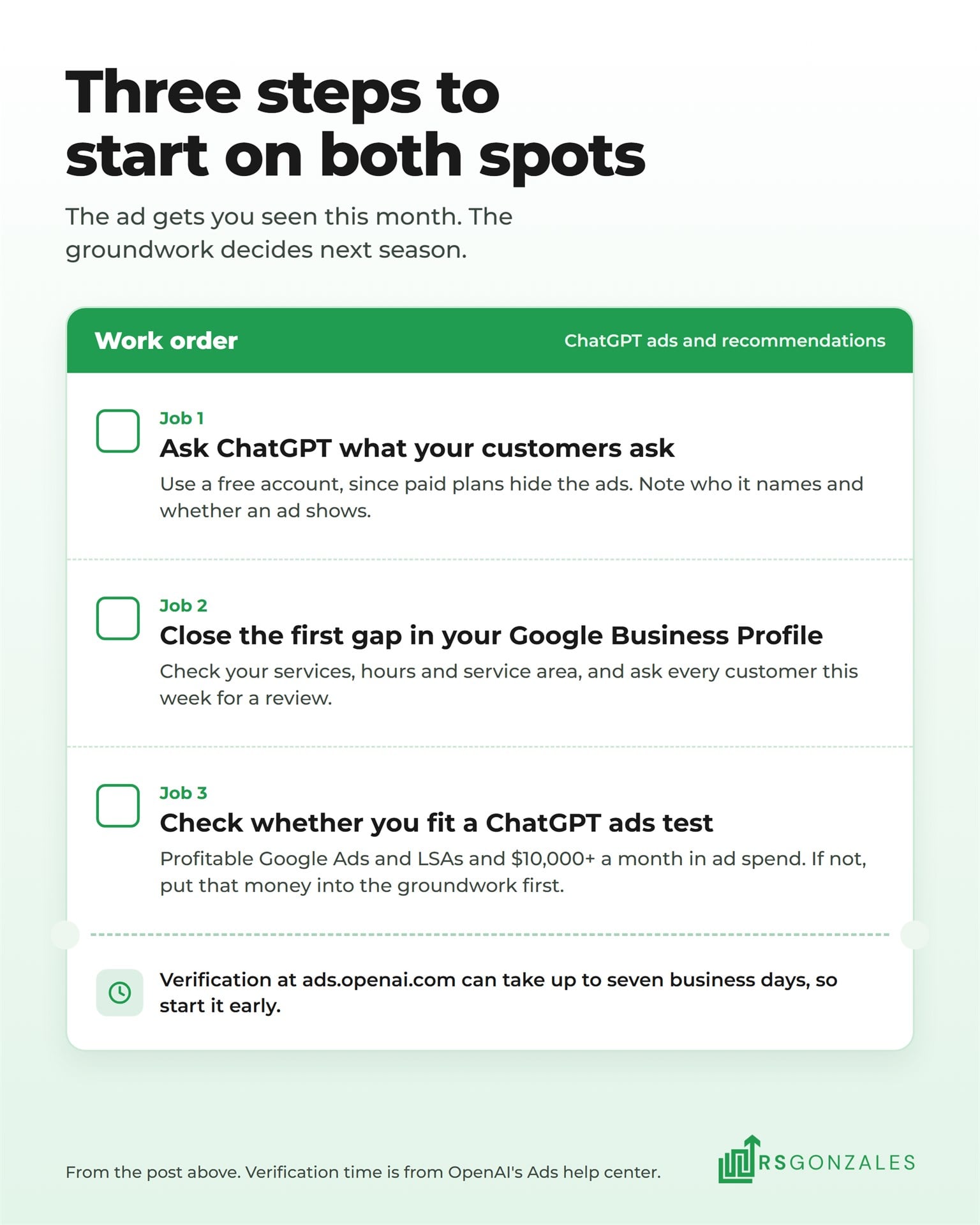
Most HVAC companies haven’t worked on either spot yet, so starting now puts you ahead of the other companies in your market. Start with these three steps:
- Ask ChatGPT what your customers ask. Use a free account, since paid plans hide the ads, and ask questions like “Who is the best furnace repair company in [your city]?” Note which companies it names and whether an ad shows under the answer, because that is your starting point.
- Close the first gap in your Google Business Profile. It is one of the first places ChatGPT looks, and it helps your Google Maps ranking at the same time. Check that your services, hours, and service area are complete, and ask every customer this week for a review. If nobody on your team owns that job, Google Business Profile and review management keeps it going every month.
- Check whether you fit a ChatGPT ads test. If your Google Ads and Local Services Ads already book jobs at a profit and you spend $10,000 or more a month on ads, open an account at ads.openai.com and start verification, which can take up to seven business days. If not, put that money into the groundwork first.
The ad gets your company seen this month. The groundwork decides whether ChatGPT names you next season, and a company with both gets two chances at the same call.