
Your customers are asking the same assistants. In BrightLocal’s 2026 Local Consumer Review Survey, 45% of the US adults surveyed said they had used AI tools for local recommendations. A year earlier, that figure was 6%.
We studied 835 HVAC contractors in ten US metros to find the answer. The companies AI named most often all had three basics in place. They had a solid Google Business Profile, plenty of recent reviews, and a working website. Once those were in place, breadth counted. Companies strong in two or more other marketing channels were named far more often.
RS Gonzales sells local search and AI-visibility work, which is why the full study, method and all, is public for you to check.
In this blog, we cover those three basics, what helped after them, and what didn’t set the recommended companies apart. This study is about the companies AI picks. Where AI finds those companies, from Google Business Profile to Yelp and local Facebook groups, is a separate topic.
835 HVAC Contractors, Four AI Assistants, and One Question: Who Gets Recommended?
We kept the setup simple. We compared the HVAC companies AI assistants named with the companies they skipped, using only what anyone can see online.
- 835 HVAC contractors in ten US metro areas.
- Eight things scored for each company, all from public information. Three turned out to be gates. The other five were marketing channels, like social profiles linked from the website and a site that’s kept up to date.
- Four AI assistants asked the questions homeowners ask when they need an HVAC company.
- One day of answers, so the results are a snapshot of that day.
- 72 fully measured companies the assistants named ten or more times. The main finding rests on this group.
Every scoring rule is in the full study, free to read on SSRN.
The Three Gates the Most-Recommended HVAC Companies All Passed
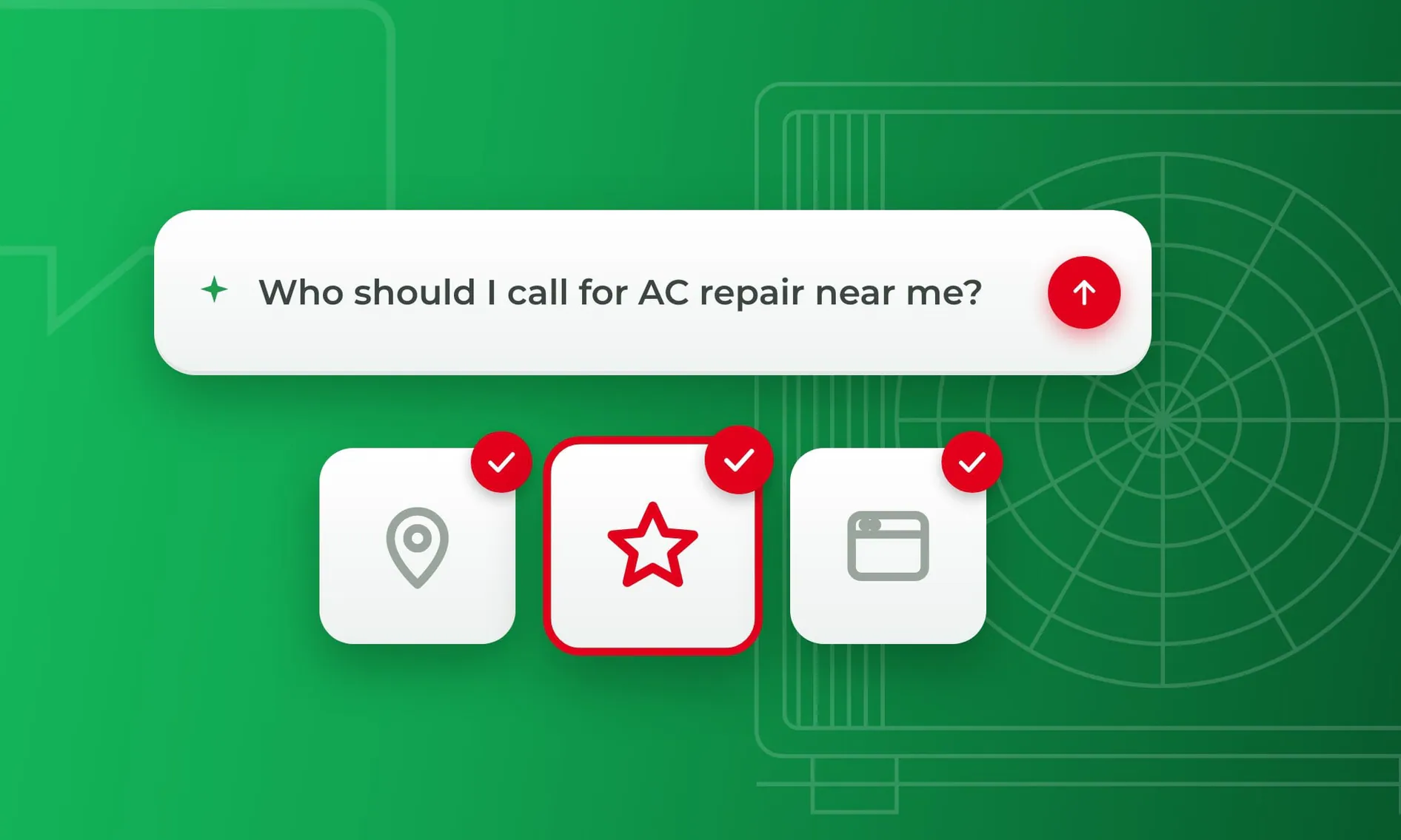
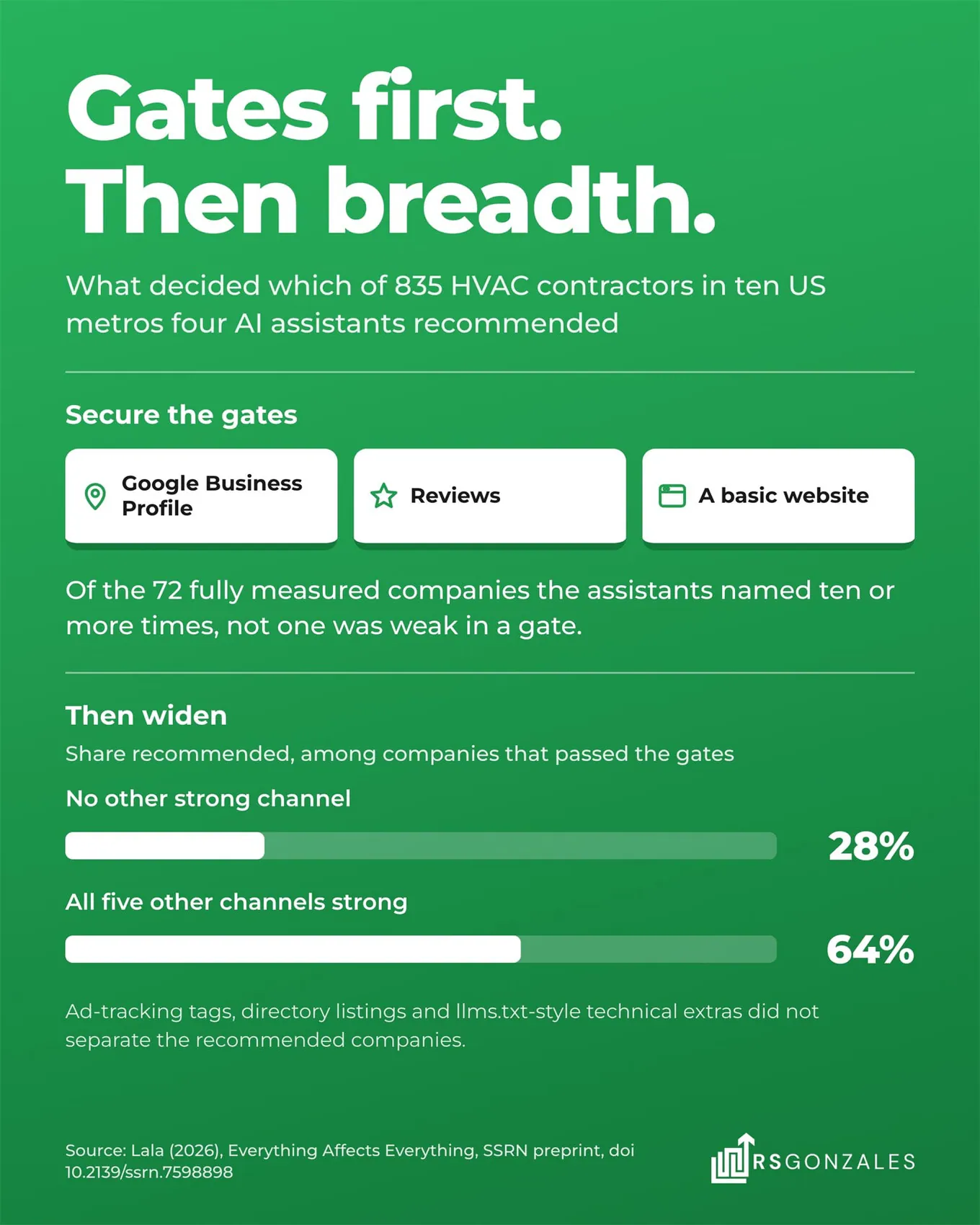
The three basics worked like gates. A company had to get through all three before anything else seemed to count. Of the 72 companies the assistants named ten or more times, not one was weak at any gate.
Each gate comes down to a short list you can check on your own business in a few minutes.
1. A Solid Google Business Profile
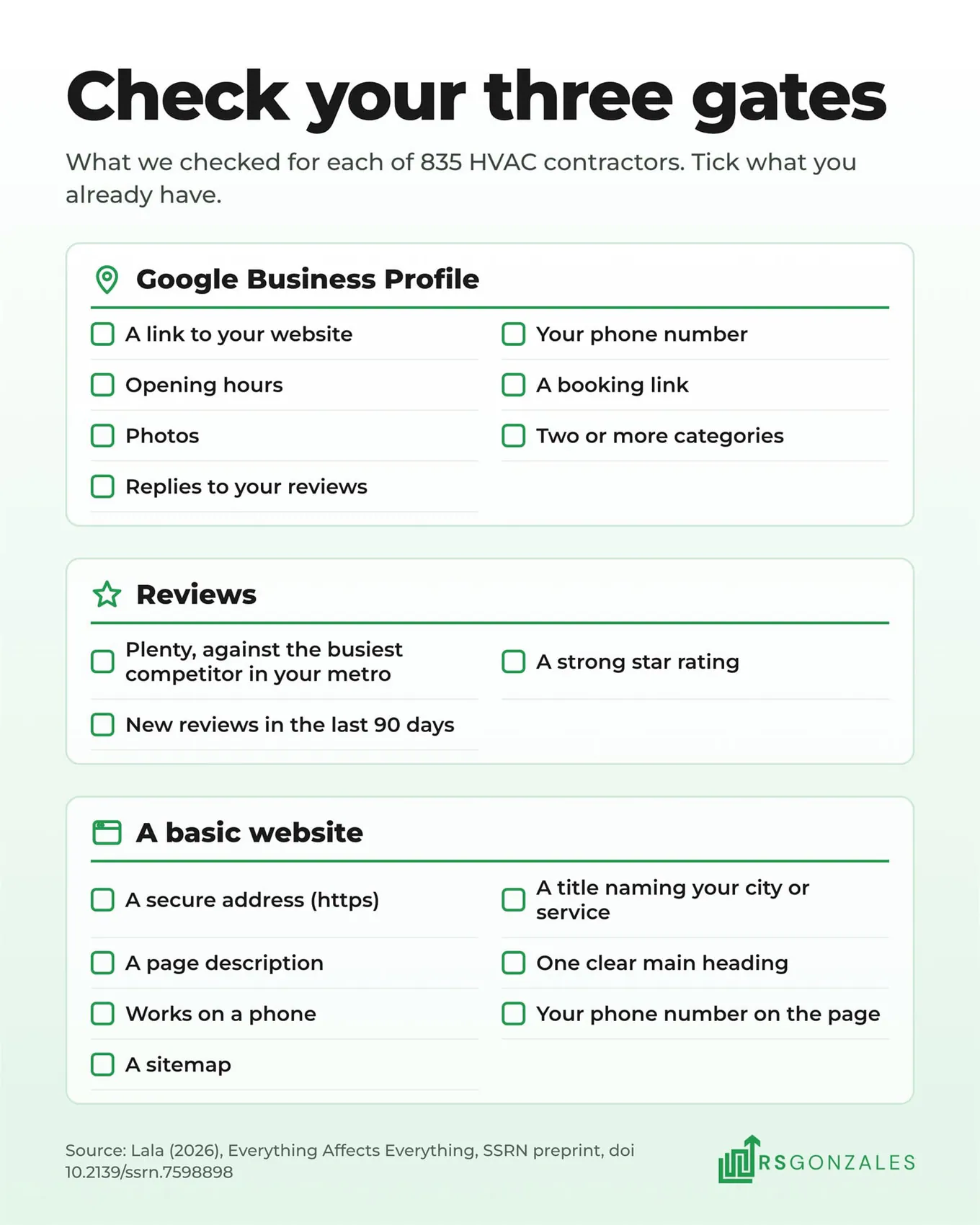
Your Google Business Profile is the listing that shows your hours, phone number, and reviews on Google Search and Maps. We looked for six things on each profile:
- A website link
- A phone number
- Opening hours
- A booking link
- Photos
- At least two business categories
We also checked whether the owner replies to reviews. The profile is the gate most contractors already pass, with 95% of the companies we could fully measure scoring strong. That makes a solid profile table stakes. A strong profile won’t set you apart, but a thin one can keep you off the list. The profile is also the cheapest gate to fix, since Google Business Profile optimization mostly comes down to filling every field and keeping it current.
Your check: open your profile on your phone. Are all six items there, and when did you last reply to a review?
2. Plenty of Recent Google Reviews
Reviews were scored on three things:
- Review count against the busiest competitor in your metro, not against a fixed number.
- Star rating.
- Recency, meaning how many of your newest reviews came in during the last 90 days.
For most companies with a website, reviews were the gate that held them back, more than the site itself or social media. There was no magic number. The review score counted recent reviews as well as the total, so a burst two years ago and nothing since scores lower. The fix is a habit: every technician asks every customer, every time, with one simple link. HVAC reputation management turns that habit into a system. Review requests keep going out in peak season, when nobody has time to remember.
Your check: how many Google reviews did you get in the last three months?
3. A Basic, Working HVAC Website
This gate is about basics, not design. We checked seven things:
- A secure address, the https and padlock in the browser bar.
- A page title that names your city or your service, the line that shows as the blue link in Google.
- A page description, the short summary under that link.
- One clear main heading at the top of the page.
- A layout that works on a phone.
- Your phone number on the page, written as text.
- A sitemap, a file that lists every page so search engines and AI tools can find them.
Companies without a website struggled to get named. A plain site that works was enough to pass. Once those seven basics are in place, load speed and AI crawler access are the next layer of an HVAC website built for Google and AI search.
Your check: open your site on your phone. Can a homeowner see what you do, where you work, and how to call you within five seconds?
After the Three Gates, Breadth Across Marketing Channels Counted
Getting through the gates put a company in the running. After that, breadth counted, meaning how many other marketing channels a company was strong in. Among companies that passed all three gates, the share AI recommended more than doubled when all five other channels were strong.
| Companies that passed all three gates | Share recommended by AI assistants |
|---|---|
| No other strong channel | 28% |
| One other strong channel | 26% |
| Two to five other strong channels | 49% to 64% |
The count mattered more than any one channel. Companies strong in two or more extra channels were recommended far more often than those with one or none. No two channels were worth more together than apart, so there’s no secret combination to buy. Fix the gates first, then keep adding channels you can run well.
Extra channels lined up with more recommendations only once the three gates were in place.
See How We Build AI Visibility for HVAC Companies
Three AI Shortcuts That Didn’t Set the Recommended HVAC Companies Apart
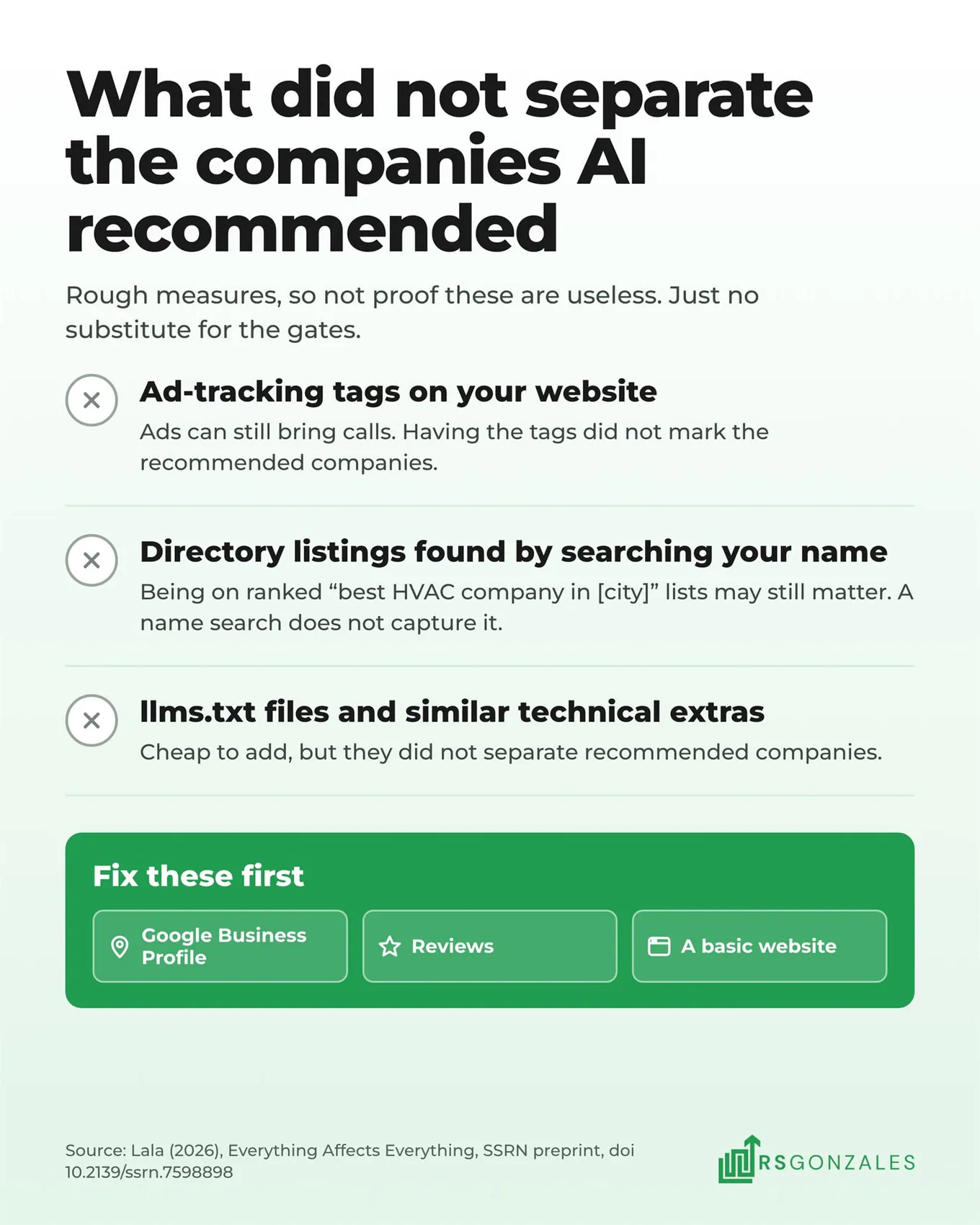
Plenty of things get sold as shortcuts to AI recommendations. In this study, three of them didn’t separate the companies AI named from the companies it skipped. A few of these measures were rough, so this doesn’t prove they’re useless. It does mean you should be wary of anyone promising AI recommendations from these alone.
Ad-Tracking Tags on an HVAC Website
Ad-tracking tags are small bits of code from Google or Meta (Facebook and Instagram). The tags record what a visitor does after clicking your ad. Having those tags on your site didn’t separate the recommended companies from the rest. Google pay-per-click ads can still bring in calls, but the tracking behind them didn’t stand in for any of the three gates.
Directory Listings That Show Up for Your Company Name
We counted the directory listings that show up when someone searches your company name. That count didn’t separate the companies AI named. Name-search listings are a different thing from ranked “best HVAC company in [city]” lists, which assistants seem to read. Name-search listings also differ from matching details across many directories. Ranked lists and matching details may still matter, and a name search doesn’t capture either one.
llms.txt Files and Other Technical Extras
An llms.txt file is a plain-text page that points AI tools to the content you most want them to read. The file is cheap to add. But in this study, llms.txt didn’t separate the recommended companies from the rest. Treat it as a signpost to add after the gates, not as a gate itself.
What Our Study of 835 HVAC Contractors Can’t Tell You
Every study has limits, and you should hear ours from us.
- One trade. Only HVAC contractors were studied, and other trades need their own test.
- Ten metros. Other markets may behave differently.
- One day of data. AI answers change from one try to the next.
- Which, not why. The study shows which companies were recommended, not why the assistants chose them.
The pattern was still clear enough to act on. One explanation we didn’t test is that an assistant screens companies first and compares them second.
A Ten-Minute Monthly Check for Your Three AI Gates
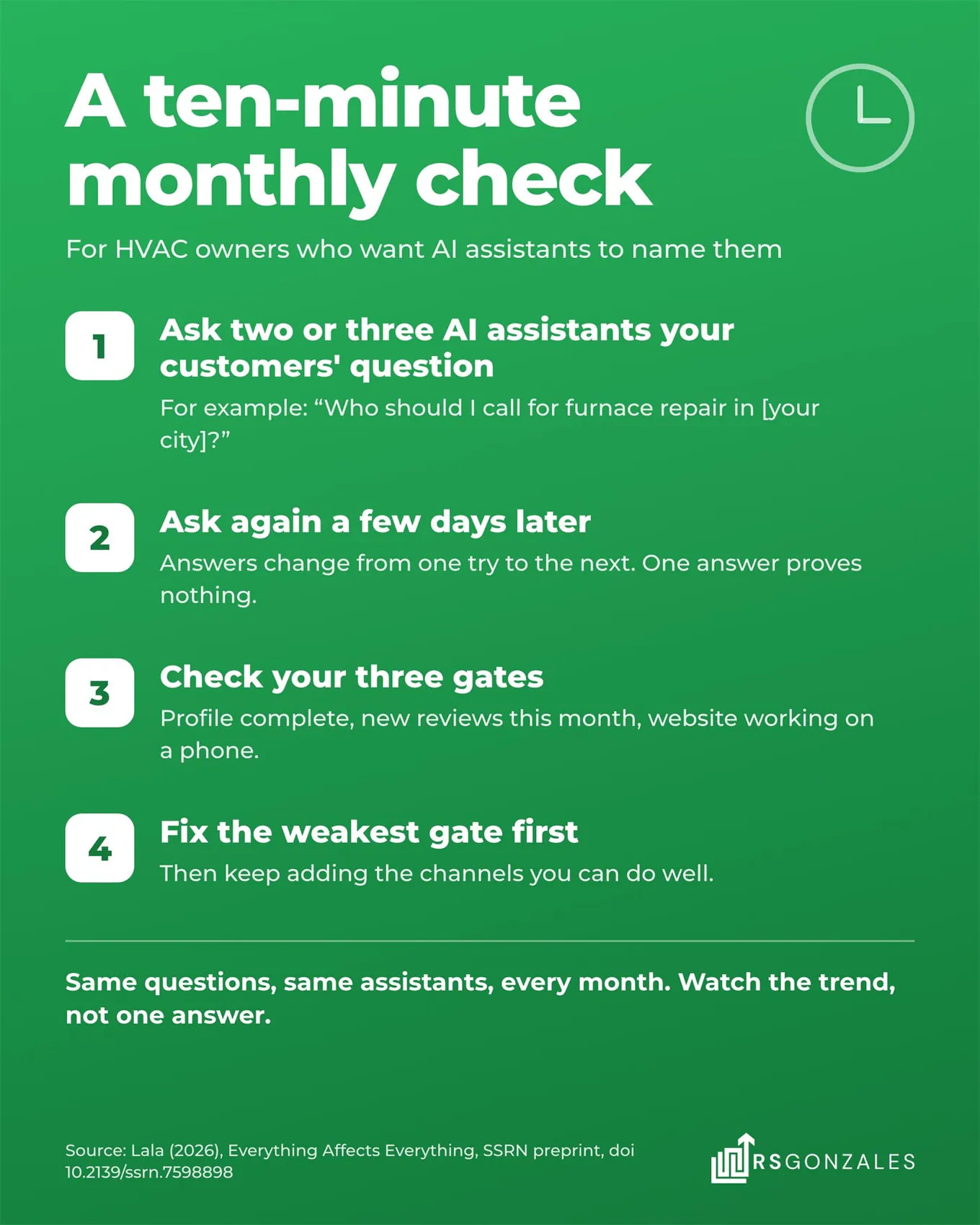
AI hands homeowners a short list, and the companies it named most in our study all had the same three basics in place. You can see where you stand in about ten minutes a month:
- Ask two or three AI assistants the question your customers ask, such as “Who should I call for furnace repair in [your city]?”
- Ask again a few days later. The answers change from one try to the next, so one answer proves nothing.
- Check your three gates: profile complete, reviews coming in this month, website working on a phone.
- Fix the weakest gate first.
Three gates first, then everything else. That’s the order that worked for the HVAC companies AI named most.
The study: Lala, M. A. (2026). Everything Affects Everything: Core Gates and Cumulative Breadth in the AI Visibility of HVAC Contractors. SSRN preprint. doi.org/10.2139/ssrn.7598898. The survey: BrightLocal, Local Consumer Review Survey 2026.