

Here is the squeeze. The clicks you want most are the clicks every other contractor in town wants, on the same hot afternoon. So the price climbs at exactly the moment you need them.
How much? A click on “AC not cooling” can cost double or triple what a click on “AC tune-up” costs. And in peak summer, that same click runs 30% to 60% higher than it does in April.
Meanwhile, the $14,000 job is sitting in a house where nobody has typed a single thing into Google.
Two questions come before this one, and we have answered both already. Why an HVAC click costs what it does explains the pricing, and how much to put behind Google covers daily budgets. This piece starts after both: you know your number, so where should it go?
Why Is Your HVAC Cost Per Click Rising Faster Than Your Booked Jobs?
Your ad costs are set by your competition, not by your revenue. Every click is sold in a live auction, so whoever is willing to pay the most on a given day sets the price for everybody else.
When three private equity-backed companies move into your city, your costs jump overnight. Nothing changed on your end. You got outbid.
In HVAC, the seasons then work against you twice over.
- Clicks cost the most when you are busiest. In July your techs are already slammed, and that is exactly when you are paying top dollar for more calls.
- Clicks cost the least when you are slowest. April and October are the bargain months, and that is when most contractors turn their ads down instead of up.
- Google does not care what the job is worth. It charges you the same for the click that ends in a $180 service call and the click that ends in a $14,000 system. Only you can tell those apart, and only if you set things up that way.
That last one is the whole problem, and it has a name.
What Is the Install Versus Repair Trap?
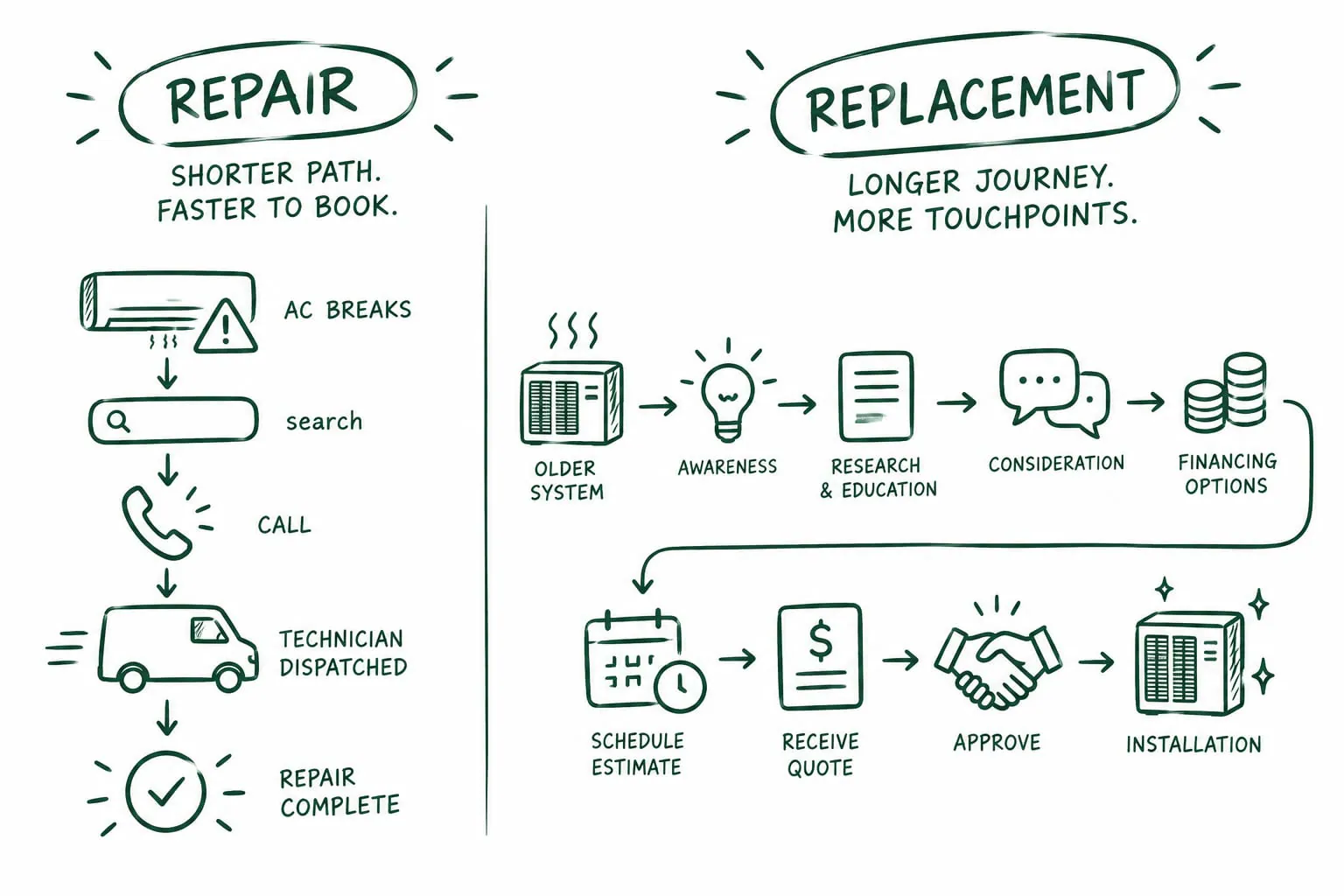
From inside your shop, repairs and replacements feel like one business. They are not. They are two different sales, to two different people, in two completely different moods, and you cannot buy them the same way.
- A repair customer is already looking for you. Their AC quit an hour ago. They are on their phone right now and they will call one of the first names they see. You are racing for attention, not convincing anybody.
- A replacement customer is not looking for anyone. Nobody googles “should I replace my fifteen-year-old system.” They think about it for months, mention it to a neighbor, and eventually call whoever they have been seeing all year.
- The trap is paying search prices for people who are not searching. Bidding on install keywords puts you in front of the handful of homeowners already shopping, at the highest price on the board. The much bigger group, the ones who have not started looking, never see you at all.
Our paid ads team calls this the install versus repair trap. It is the most common reason a perfectly healthy ad budget produces a disappointing month.
See How We Split Budget Across Four Channels
Which HVAC Jobs Should Google and LSA Pay For?
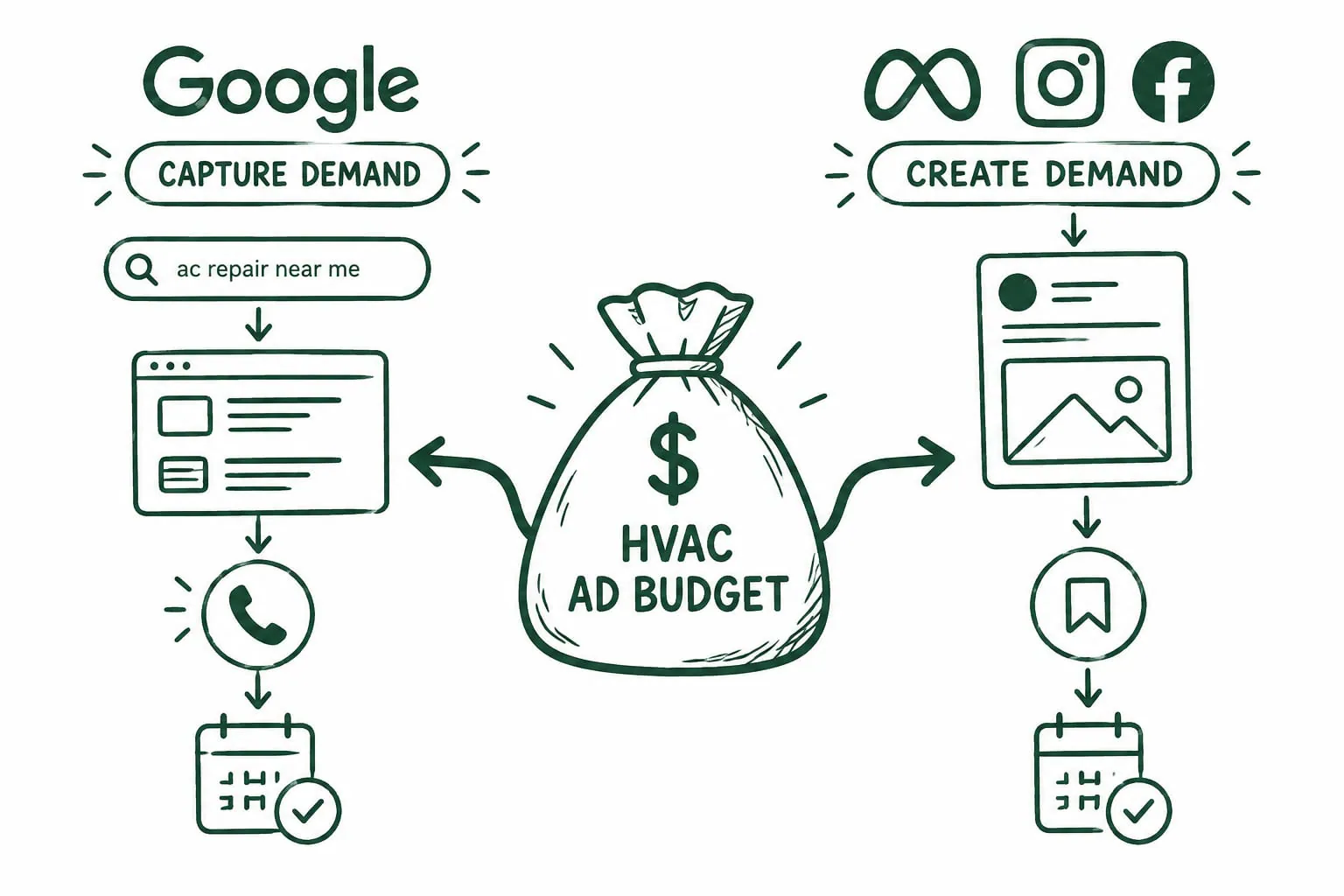
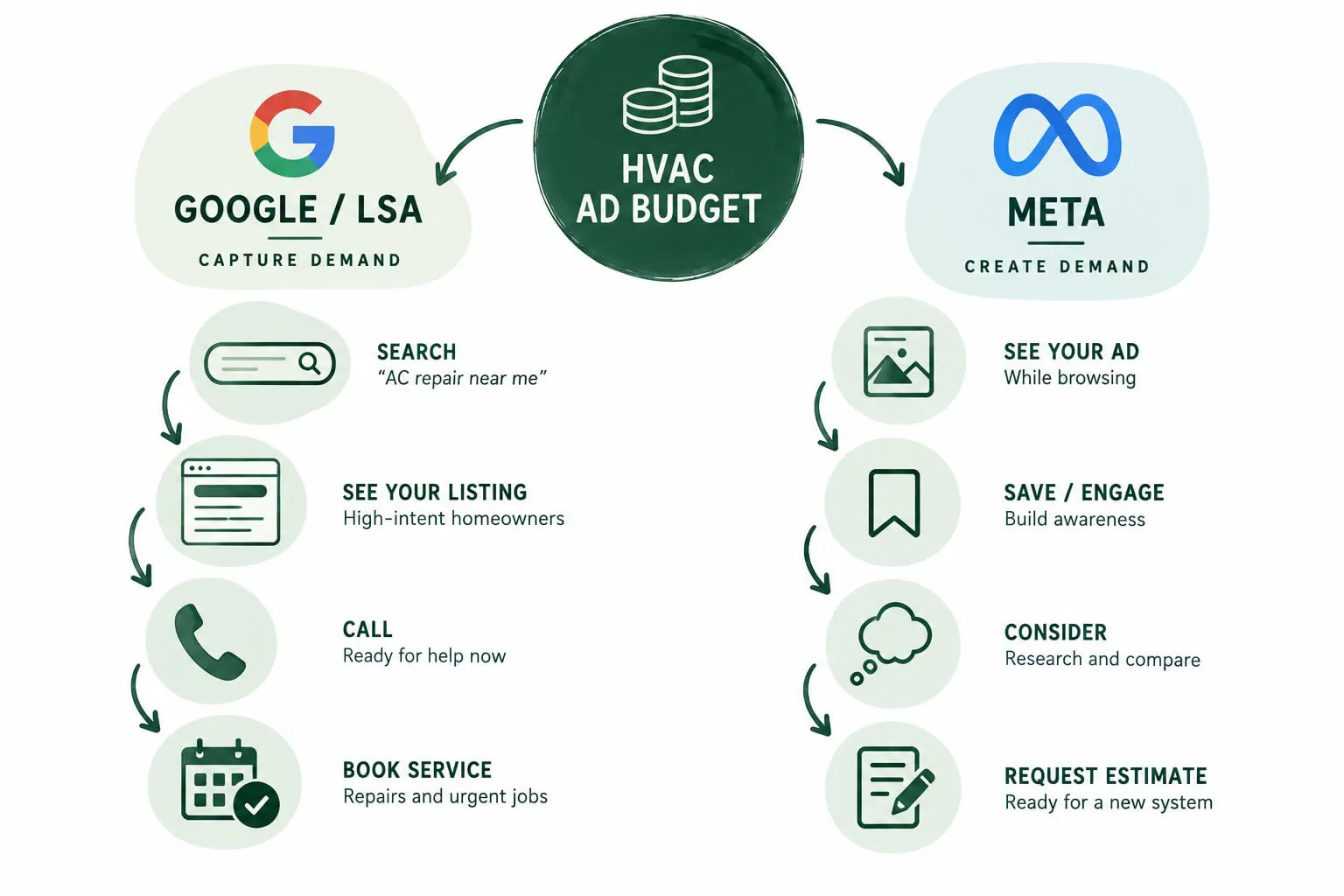
Google is where you catch the people already looking. So point it at the work that shows up as an emergency or a complaint.
Send these to Google
- No-cool and no-heat calls. Somebody needs help today and is picking from whoever shows up first.
- Repairs and diagnostics. They already know what they need. They are shopping for who can come out, not for the lowest price.
- Your own company name. The cheapest click you will ever buy. Skip it and a competitor will bid on your name and sit above you when your own customers search for you.
- Maintenance plans. Small tickets today, but those are the people you sell systems to in two years.
Start with Local Service Ads, then layer PPC
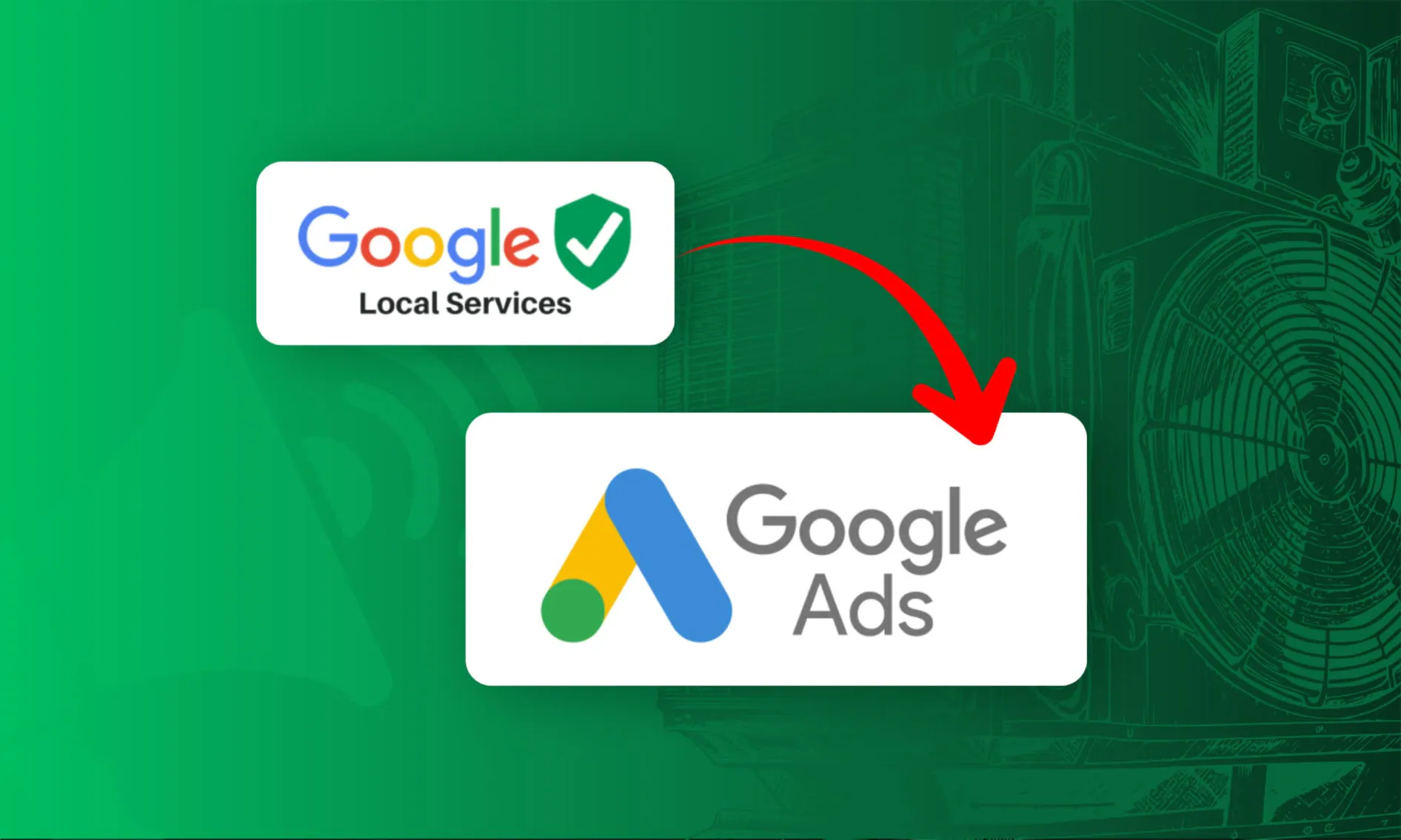
Local Service Ads (LSAs) are the listings at the very top with the green Google Guaranteed check. You pay per lead instead of per click, so you are only charged when somebody actually contacts you. That is why they usually get your first dollar.
Google is moving LSAs into the main Google Ads system. Instead of setting a price per lead yourself, you tell Google roughly what a lead is worth to you and it bids on your behalf. What you spend may not change. How you set it will.
Regular search ads, the pay-per-click kind where you are charged every time someone clicks, pick up what LSAs cannot reach. Specific services, specific neighborhoods, and any volume above the ceiling Google decides your LSA account gets.
See How We Run Local Service Ads See How We Manage HVAC Google Ads
Which HVAC Jobs Should Meta Ads Pay For?
Meta, meaning Facebook and Instagram, does the opposite job. Google finds people who are already looking. Meta puts you in front of people before they start looking, which is exactly what the big jobs need.
Send these to Meta
- Full system replacements. They know the unit is old. They have been putting it off. Nothing is going to make them search, so something has to show up in front of them.
- Heat pumps and rebate offers. These need explaining before anybody asks for a price, and you cannot explain anything in a search ad.
- Financing offers. “Twelve thousand dollars” stops a homeowner cold. “A hundred and forty a month” does not. Meta gives you the room to say the second one.
- Duct cleaning, filtration and air quality. Nobody wakes up wanting a filtration system. You have to bring it up first.
Budget for the follow-up, not only the ad
This is where most contractors lose money on Meta, and the ads are not the problem. Somebody who filled in a form while scrolling is not ready to book. It usually takes five or six attempts before one of them turns into a job.
- A lead that sits for two days is money you already spent. Every one you never call back is a job you paid for and never booked.
- Text before you call. They were not expecting to hear from you, so a text lands better than a cold call.
- Do not move money to Meta without automated follow-up. If you have no system that chases a lead for you, fix that first and reallocate after. Buying leads that will not work is a more expensive mistake than an overpriced click.
See How We Build HVAC Meta Campaigns
How Should You Divide an HVAC Ad Budget Between Google and Meta?
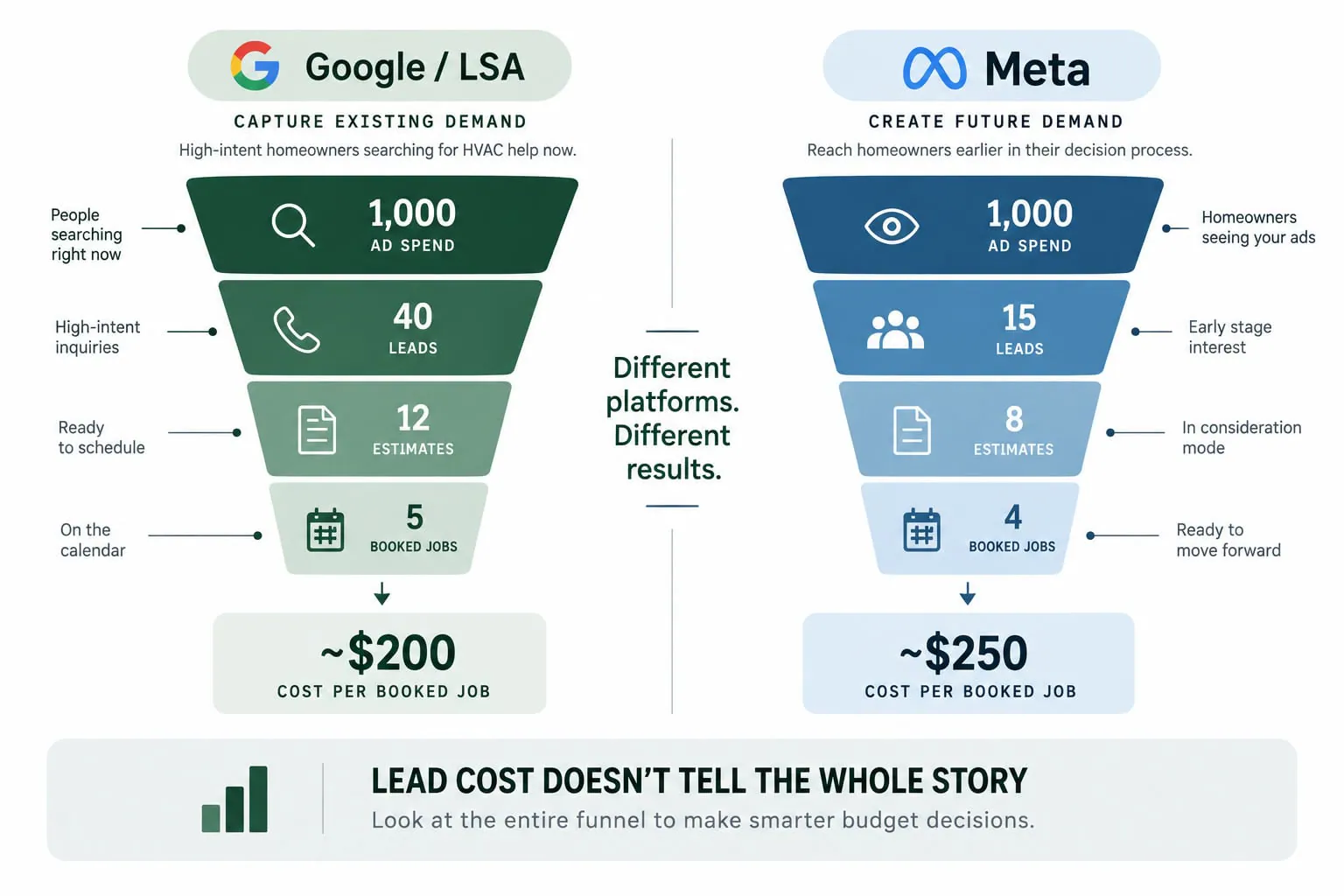
Split it by where your money actually comes from, not by what the company across town is doing. Pull last year’s jobs, add up service revenue and replacement revenue separately, then find your row.
| If your revenue is | Google LSA and PPC | Meta | Why this split |
|---|---|---|---|
| 70% or more service and repair | 75 to 85% | 15 to 25% | You make your money on volume and speed. Meta is a small seed for later, not a lead source yet. |
| Roughly even between the two | 60 to 70% | 30 to 40% | You need both engines running. Google keeps the trucks full, Meta fills the quote calendar six weeks out. |
| 50% or more replacement and install | 45 to 60% | 40 to 55% | Your jobs are big enough to be worth the wait. There are not enough people searching for installs to keep an install business full. |
Three rules sit on top of whichever row you land in.
- Never drop Google below 40%. It is the only channel that can bring you a job this week. Cut it too far and a slow month leaves you nothing to pull on.
- Do not start Meta on pocket change. Meta needs enough leads flowing to work out who your buyers are. Starve it and it never learns, and you walk away thinking Meta does not work when it never got a fair run.
- Change one thing at a time. Move 10 to 15%, leave it alone for a full sales cycle, then judge it. Change two channels at once and you will never know which one did what.
What Happens When You Split It Wrong?
There are two ways to get this wrong, and they look nothing alike. That is why most contractors never spot the one they have.
Too much on Google
- You buy a calendar full of small jobs. Repair leads arrive, techs run, revenue looks busy, and the install number stays flat.
- Cheap leads, thin months. Your cost per lead looks great. Then you notice most of them turned into $300 tickets, and a cheap lead that buys a small job is not cheap at all.
- You hit a wall in July. Only so many people are searching. Once you have bought all of them, extra budget buys you nothing.
Too much on Meta
- The leads pile up and nobody works them. Volume goes up, booked jobs do not, and the ads get blamed for a follow-up problem.
- The money goes out before it comes back. Meta you start in spring pays off in summer. Move too much too early and you have starved the channel that pays this week.
- You give up after thirty days. Nobody decides on a new system in a month. Judge Meta on a thirty-day window and it will always look like a failure.
The tell for both is the same. If your lead count and your booked revenue are moving in different directions, your split is wrong, not your ads.
Why Cost Per Lead Is the Wrong Number to Split On
Most contractors compare cost per lead across channels and move the money to whichever one is cheaper. That comparison tells you almost nothing, because the two channels are selling different things.
A Meta lead is cheaper, closes less often, takes longer, and turns into a much bigger job. A Google repair lead costs more, closes fast, and is worth a fraction as much. Comparing them on price alone tells you which is cheaper to buy. It does not tell you which one you would rather have.
The number that settles it is cost per booked job. Take what you spent on a channel and divide it by the jobs you actually booked from it, not the leads it sent. Do that separately for repairs and replacements and the right split usually jumps out at you in an afternoon. Our cost per lead benchmarks for 2026 carry the ranges themselves, which is why they are not repeated here.
- Track close rate per channel. One channel closing 12% and another closing 40% cannot be judged on lead price.
- Track how long each one takes to close. A lead that books in ninety days is not a bad lead. It is a slow one, and it needs to be budgeted differently.
- Track average ticket per channel. This is the number that exposes the install versus repair trap, and most contractors have never once pulled it.
So What Should Your Next $1,000 Ad Budget Do?
The right split depends on the jobs you want, what they are worth, and how quickly they close. Plug your numbers into our HVAC Ad Budget Split Planner and get a starting point built around your own business.
Download the HVAC Ad Budget Split Planner
When Should You Move Budget, and How Fast?
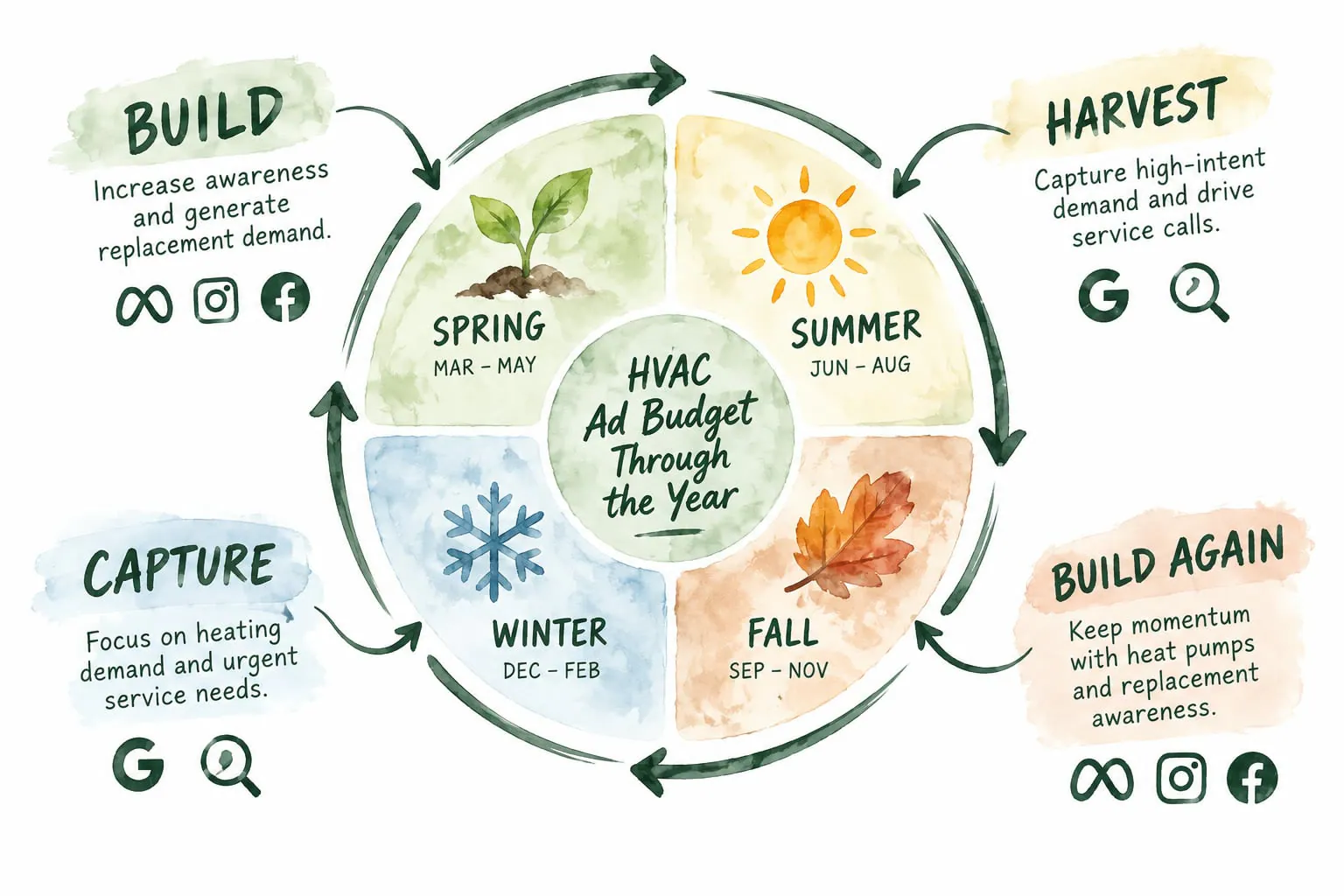
When you move your ad budget matters just as much as where you move it. For example, shifting too much money to Meta right before peak repair season can leave you with fewer high-intent leads. Moving it back to Google too late can also mean paying higher seasonal prices to catch up. The timing of each shift matters.
- Plant in the slow months. March and April, then September and October. Clicks are cheap, your crews have room, and a Meta lead from April becomes a June install.
- Harvest in the busy months. June through August, lean on Google. The demand is already out there, so your job is catching it rather than creating it.
- Give every change a full cycle before you judge it. Thirty days for repair channels, sixty to ninety for replacement channels. Judging Meta on a repair timeline is the most common mistake in HVAC advertising.
- Move 10 to 15% at a time, never more. A big swing makes it impossible to tell what caused what.
- Redo the split every quarter. Your job mix changes, your market changes, and January’s answer is not July’s.
None of this means switching a channel off. Both keep running all year. You are changing the ratio between them, not flipping a switch.
What This Approach Will Not Fix
A budget split fixes where your money goes. It does not fix the things sitting underneath it that matter, and we would rather say so now.
- It will not fix your sales process. If you close under 30% of the replacement quotes you hand out, more Meta money just buys you more quotes you lose. Fix the closing first.
- It will not create crews. More install leads with nobody free to install is a scheduling problem in a marketing costume.
- It will not make clicks cheap. Nothing will. The price is set by your competition, and the only thing you control is what you point it at.
- It will not show up in a month. One of these two channels runs on a much longer clock than the other, so give it a quarter before you decide anything.
So Where Should Your Next Thousand Dollars Go?
The contractor who wins 2026 is not the one who found cheaper clicks. There are none. It is the one who stopped paying search prices for jobs that search was never going to deliver.
If you do nothing else after reading this, do these three:
- Split last year’s revenue into service and replacement. One number each. It takes twenty minutes and it decides everything downstream.
- Work out your average ticket from each channel. If you have never looked at this, it will probably change your mind about which channel is the expensive one.
- Move 10% in one direction and hold it a full quarter. One change, one cycle, one clear answer.
The budget was never the problem. What it was pointed at was.