



Most residential HVAC business owners assume commercial leads come from the same places as homeowner leads, with bigger tickets attached. They mostly don’t. A property manager with a broken rooftop unit usually calls a contractor already on their approved vendor list, the short list of companies that have passed their paperwork, and the work goes to whoever is on it.
In this blog, we cover how commercial buyers choose an HVAC contractor, the paperwork they ask for before they call, seven places commercial HVAC leads come from, and whether commercial work fits your shop yet. Homeowner leads come from a different set of places, so this blog stays on the commercial side: where the first accounts come from and what to have ready before you go after them.
How Do Commercial HVAC Buyers Choose a Contractor?
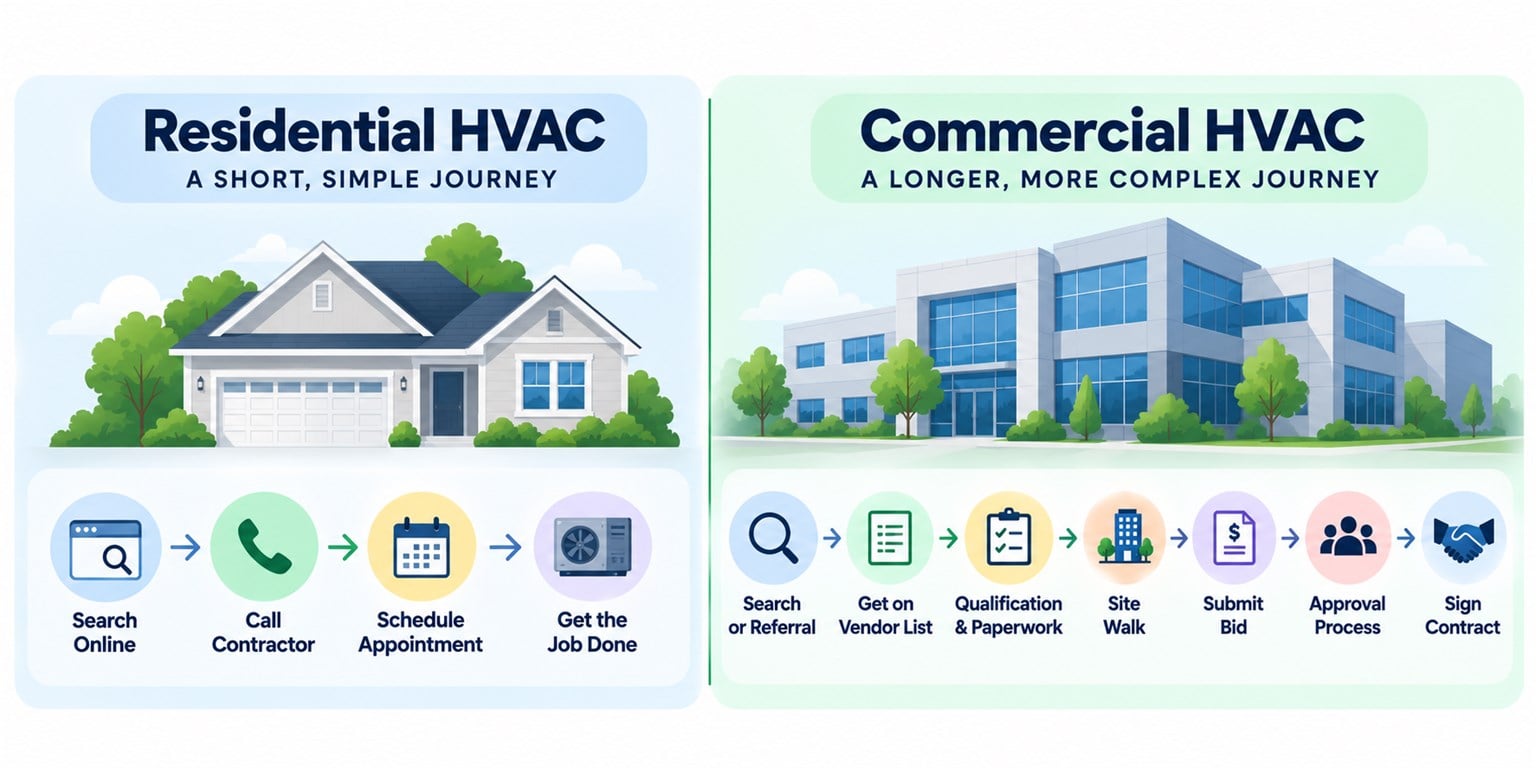
Commercial buyers pick their HVAC contractor before anything breaks. A homeowner with a dead AC calls whoever answers first. A property manager with a dead rooftop unit calls the contractor already on file, and that contractor was chosen weeks or months earlier, on paper, with more than one person signing off.
Three things shape how a commercial buyer picks that contractor, and each one changes how you should approach them.
Downtime Is What a Commercial HVAC Buyer Fears Most
A closed restaurant or a hot office loses money every hour its HVAC system is down. HVACR Business puts it plainly: “Business interruption is a business’s worst fear.” That is why a commercial buyer weighs how fast you can get to the building as heavily as the price on your quote. Put your response time in writing, during business hours and after hours, so the buyer can judge you on it before anything breaks.
A Facility Manager and a Finance Approver Both Have to Say Yes
The facility manager runs the building day to day and is the person who calls when a rooftop unit stops. They may like your crew, but a controller or business manager usually approves the spending, and that person reads the quote rather than watching the service call. ACCA’s advice on commercial service sales is to reach both people. Win over only the facility manager, and the conversation with finance turns into a fight over price.
Commercial HVAC Work Is Budgeted and Bid in Advance
Commercial buyers plan their maintenance spending ahead of time, often collect competing bids, and renew service contracts on a set schedule. A homeowner decides on the day the system fails, while a property manager decides on a calendar. Ask each buyer when their current service agreement renews and note the date, because the weeks before that renewal are when a new contractor gets a fair hearing.
All three point the same way. The work goes to contractors already on the list, so the job is getting onto the list before the unit fails.
What Paperwork Do Commercial Buyers Ask an HVAC Contractor For?
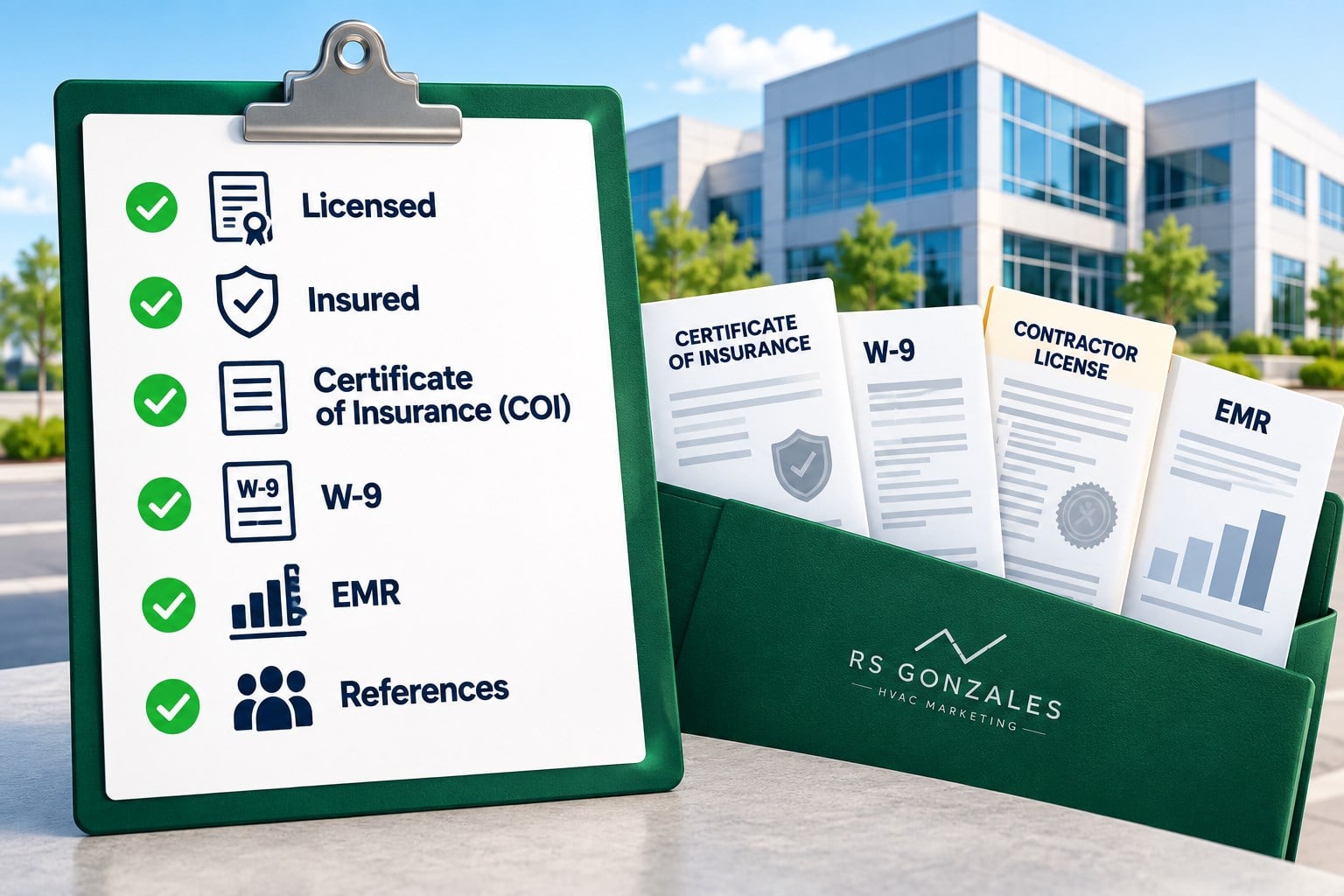
Before a property manager adds you to their vendor list, they ask for proof that you are insured, licensed, and safe to send onto their roof. Have it ready before you go after a single account, because a slow answer here loses the account before you have quoted anything.
| What they ask for | What it is | Why they ask |
|---|---|---|
| Certificate of insurance (COI) | A one-page form from your insurance agent showing your general liability and workers’ comp coverage and its limits | It proves an accident on their property is covered by your policy, not theirs |
| W-9 | The IRS form with your business name and tax ID number | Their accounts payable team needs it before they can pay you |
| Contractor license | Your state or city license for the work and equipment you plan to service | Commercial work can need a different license class than residential in some states, so confirm yours covers it |
| Safety record (EMR) | Your Experience Modification Rate, a number your workers’ comp insurer sets from your injury history, where 1.0 is average | Building owners and general contractors use it to screen out risky crews |
| Prequalification profile | An account on a vetting platform such as ISNetworld, which grades your insurance, safety programs, and injury rates | Some large companies hire only contractors who pass one |
| Response time and service area | How fast you can reach their building, and which areas you cover | It tells them whether you can protect them from downtime |
Most of this costs an afternoon, not money. Ask your insurance agent for a COI you can send the same day a buyer asks, and keep the W-9 and license number in the same folder.
Seven Places Commercial HVAC Leads Come From Before Anyone Searches Google
Commercial HVAC leads for a residential shop usually start with people who already know your work, then widen into networks, and search comes last. Here are the seven, roughly in the order most residential owners can reach them.
1. Homeowners You Already Serve Who Own a Business
Your customer list already holds restaurant owners, dentists, landlords, and shop owners. They know your work at home, which is the trust a commercial buyer usually has to build from nothing.
Ask your technicians to mention commercial service at the end of each visit. Then tag business owners in your CRM, the software that keeps every customer and job in one place, so you can send them a commercial maintenance offer before the season turns.
2. Light Commercial Maintenance Agreements
A maintenance agreement is the easiest way into a commercial building, and most residential shops already know how to sell one. Light commercial means smaller buildings with equipment of about 20 tons or less per unit, a size range many residential technicians can already handle.
Many of these businesses are open 8 to 5 and can be scheduled on short notice, so a commercial tune-up can fill a slow residential day. Keep the agreement simple, with regular visits and priority service, and every visit puts you in front of the person who calls when something breaks.
3. Property Managers and Building Owners
Property managers look after offices, retail strips, and apartment buildings for their owners, and one manager can control the HVAC choice for a dozen buildings. Most of them already have a contractor. What they may not have is a backup they trust when that contractor is booked out on a 98-degree day.
Visit in person with your COI, a one-page maintenance offer, and a clear response time, and ask to be the second call. Being the backup gets you the first job, and a first job done well is how you get onto the list.
4. Facility Management Networks
National retail and restaurant brands often hand out repair work through facility management platforms such as ServiceChannel, which connects brands with local contractors across more than 500,000 locations. These are not open lead feeds. A brand invites you into its network, you complete its compliance requirements, and then work orders arrive.
The invitation has to come from the brand, so a local store manager or regional facility manager who already likes your work is often the way in. That ties this door back to the first three.
5. General Contractors and Bid Boards
General contractors, the companies that run construction and renovation projects, hire HVAC subcontractors for new buildings and remodels. Bid boards such as PlanHub, BuildingConnected, Dodge Construction Network, and ConstructConnect list those projects and send invitations to bid.
This is installation work, not service work, and it runs on bids, project schedules, and payment terms that differ from residential jobs. It suits a shop with an install crew to spare, and a general contractor who likes your crew can bring you to the next project without a bid.
6. Trade Associations for Building and Facility Managers
BOMA, the Building Owners and Managers Association, and IFMA, the International Facility Management Association, are where property and facility managers meet. Both have local chapters, and both take contractors and service companies as members through BOMA’s allied membership and IFMA’s associate membership.
Pick one local chapter and go to its events for a full year. A contractor a manager has met at three events is one they add to the vendor list, and a sponsor logo alone rarely gets you there.
7. Google Search, With Pages Built for Commercial Buyers
Search comes last on this list because most commercial buyers use it to check out a contractor they heard about, not to find one. It still decides whether that check goes well:
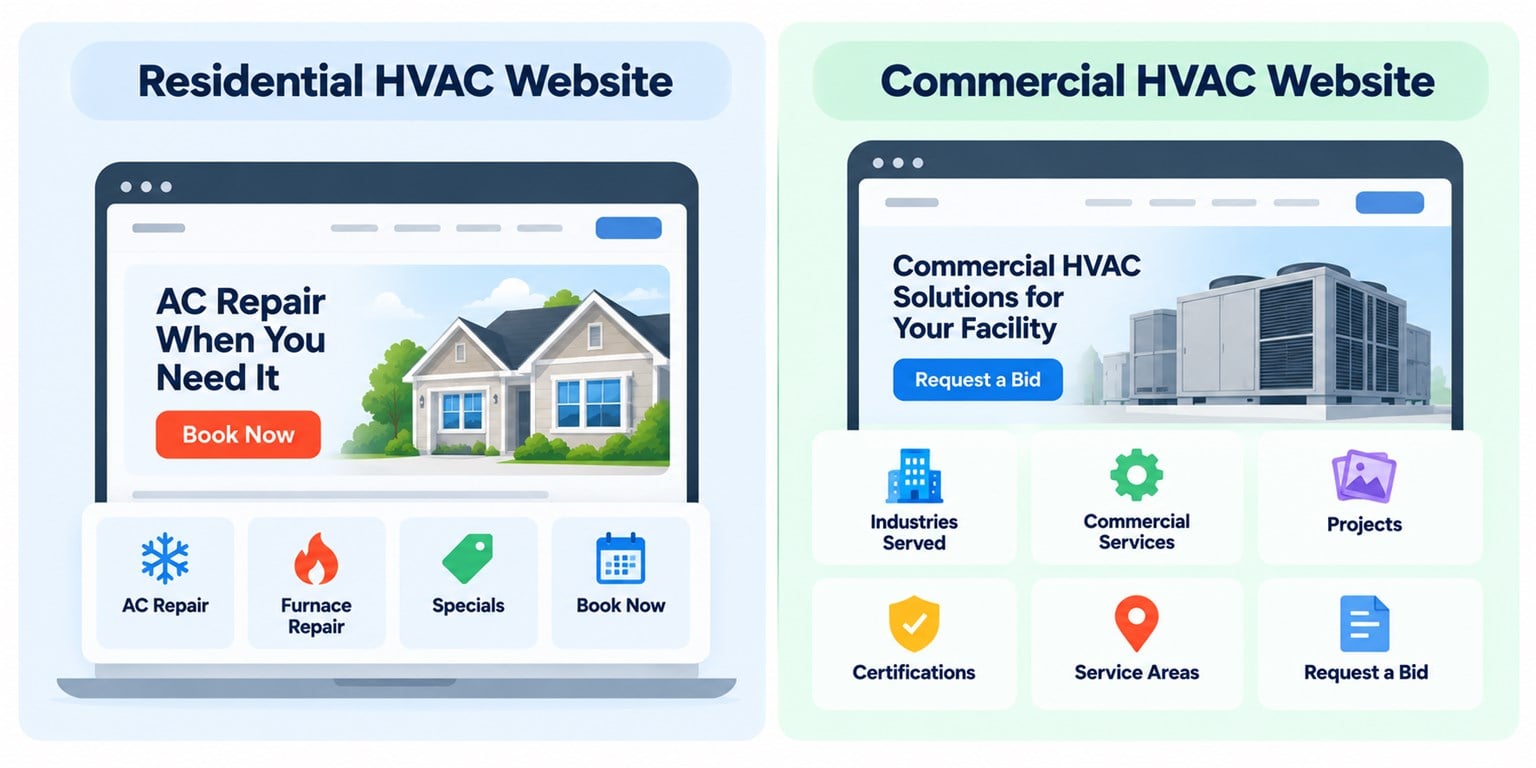
- A page for each kind of building. Separate pages for restaurants, offices, retail, and medical buildings match what a facility manager searches, and the commercial HVAC keywords for rooftop units and service agreements belong on them.
- Google Ads that filter out homeowners. Negative keywords tell Google which searches should never show your ad. Adding words like “home”, “house”, and “residential” keeps a commercial campaign from paying for homeowner clicks.
- Realistic expectations for Local Services Ads. Google lists HVAC as one home services category for Local Services Ads, so expect them to bring mostly homeowner jobs.
Once the accounts start coming, your website, search, and ads have to work as one system for a longer sales cycle, which is the job commercial HVAC marketing is built to do.
See How We Market Commercial HVAC Contractors
Should a Residential HVAC Company Take On Commercial Work Yet?
Commercial work can steady a residential schedule, and it can also stretch a shop that is not ready for it. Check these four things before you chase the first account.
Do Your Technicians Have Experience With Commercial Equipment?
Rooftop units, the packaged systems that sit on top of many small commercial buildings, and larger commercial equipment take experience a newer residential technician may not have yet. A first commercial job that runs long or needs a second visit is the one a property manager remembers. Send your most experienced technician on the first few commercial calls, and let newer technicians ride along to learn the equipment.
Does Your HVAC License and Insurance Cover Commercial Buildings?
Some states license commercial HVAC work separately from residential work, or limit the equipment size a license covers. Confirm with your state licensing board that your license covers the buildings and equipment you plan to service. Then ask your insurance agent whether your general liability and workers’ comp limits meet what property managers ask for, since vendor lists often set minimum limits before they add a contractor.
Can Your Cash Flow Carry 30 to 60 Days Between Invoice and Payment?
Homeowners usually pay when the job is done. Commercial customers often pay on invoice terms, such as 30 or 60 days after you bill them, so you pay your technicians and your parts supplier weeks before their check arrives. Before you take on a large account, work out whether you can carry up to two months of payroll and parts for that work.
Can Your Phones Meet a Property Manager’s Response Time?
A property manager expects an answer during business hours and a clear response time after hours, because every hour a building sits hot costs their tenants money. A homeowner who reaches voicemail may try again, while a property manager calls the next contractor on the vendor list. Decide who answers commercial calls after hours before you sign the first account, because one missed call can cost you the whole building.
If two of these are shaky, start with light commercial maintenance for business owners you already serve, and grow from there.
Want a Checklist to Track Every Commercial Lead Source?
The Commercial HVAC Lead Source Checklist covers the paperwork to gather, the seven places to look, and a 90-day plan for your first accounts.
Download the Commercial HVAC Lead Source Checklist
So Where Should a Residential HVAC Company Start With Commercial Leads?
Commercial accounts go to the contractors already on the list when something breaks, and getting on the list takes paperwork, a few handshakes, and one good first job.
Start with these three:
- Gather your paperwork this week. Get a COI from your insurance agent, a signed W-9, and your license number in one folder, ready to send the same day a buyer asks.
- Pull every business owner from your customer list. Offer each one a light commercial maintenance visit before the season turns.
- Visit five property managers in your service area. Bring your COI and a one-page maintenance offer, and ask to be their backup contractor.
Commercial work in your area is handed out from those vendor lists every week, and these three steps put your company’s name on them.