

Changing your ad schedule can stop the charges for hours when nobody covers the phones. The rest of the charges stop only when someone picks up within 20 seconds.
In this blog, we cover how LSA missed call charges work, where HVAC companies miss calls, and how to answer every one. Follow the steps, and every lead fee you pay buys a conversation.
When Does Google Charge for Missed Local Service Ads Calls?
Google charges for a missed Local Service Ads call when it rings during your business hours, and the caller stays on the line for more than 20 seconds. With Local Service Ads moving into Google Ads, where you manage your account changed this year, and this rule changes what you pay for.
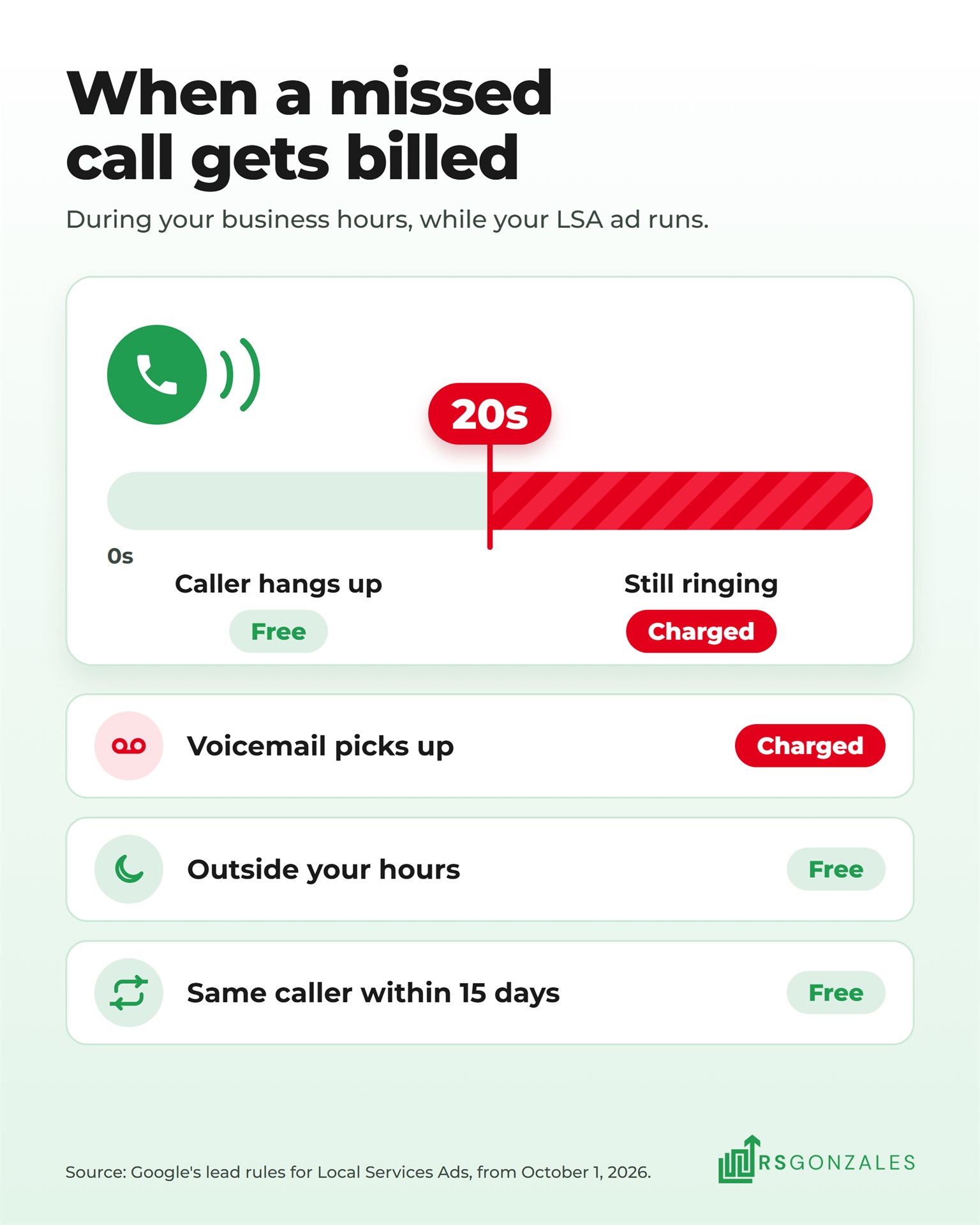
Unlike Google pay-per-click ads, which charge for each click, Local Service Ads charge for each lead. Google’s lead rules for Local Service Ads now count a missed call as a lead, and they treat each kind of call differently:
| What happens to the call | Does Google charge for it? | What it means for your shop |
|---|---|---|
| Someone answers, even after 20 seconds of ringing | It is judged as an answered call, on the conversation | Picking up late still beats not picking up |
| Nobody answers and the caller hangs up within 20 seconds | No | A short ring that ends costs nothing |
| Nobody answers and the caller stays on for more than 20 seconds during business hours | Yes, as a full lead | You pay for a call nobody took |
| The call reaches voicemail or a recorded greeting during business hours and the caller stays on for more than 20 seconds | Yes, whether or not they leave a message | Voicemail no longer protects you |
| Your phone menu asks the caller to press a key, and they hang up first | No | The homeowner is still gone |
| The caller presses a key in your phone menu | The 20 seconds start at the first key press | A long menu after that key press counts against you |
| The call comes in outside your business hours or your ad schedule | No, the missed-call rule needs both to be active | Misses outside those hours are not billed |
| The same homeowner calls or messages again within 15 days | Not charged again once their first contact is a lead | Calling them back costs nothing extra |
Two settings decide what counts as your business hours. Google uses the hours on your Google Business Profile, the free listing that shows your company on Google Maps. It bills a missed call only while your LSA ad schedule is running too. The ad schedule in Local Service Ads can run all day, only during your business hours, or on custom hours you choose.
Google has not published how it will handle spam calls and robocalls under this rule, beyond saying its systems filter invalid activity. It has not described a way to contest a single missed-call charge either. Start dates have also varied between accounts, so check the notice email your account received.
Three Ways HVAC Missed Calls Cost You More Since October
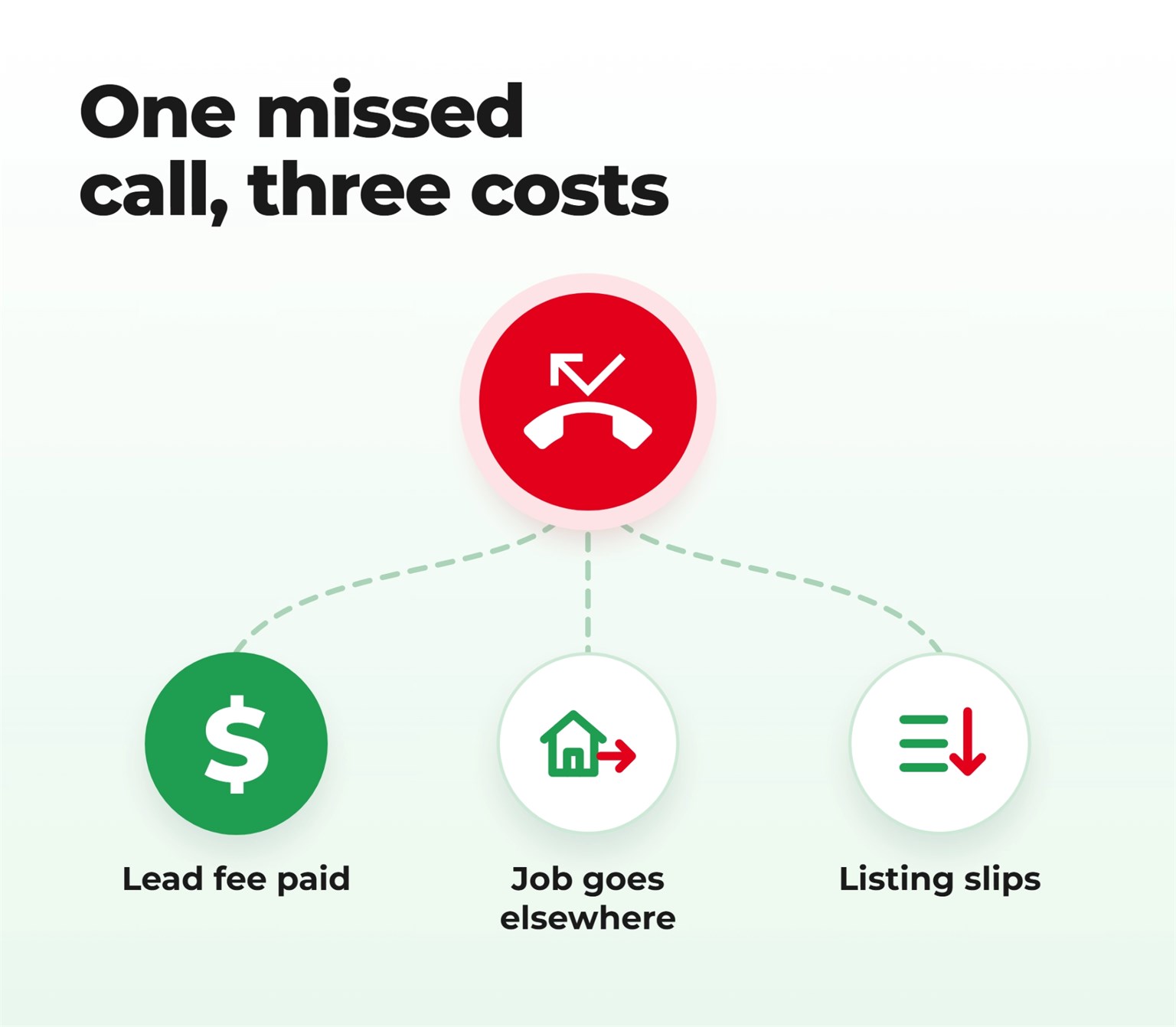
A missed call used to cost you the job. Since October, a missed call on your Local Service Ads can cost you three things at once.
You Pay the Full LSA Lead Fee for a Call Nobody Answered
Google bills the missed call at the same price as a lead you spoke to, on top of what HVAC ads already cost to run. That fee changes by market and season, and the HVAC cost per lead benchmarks for 2026 show how far it moves.
Paying for leads that never turn into jobs is one of the things HVAC owners hate most about advertising, and this rule adds a new way to do it.
The billable window is also wide. In ServiceTitan’s data from the 30 days before September 4, 2026, 65.9% of abandoned LSA calls lasted at least 20 seconds without being answered. Most calls an HVAC company misses already fall inside the rule.
The Homeowner Calls the Next HVAC Company on the List
In a 2022 Service Direct survey of 559 US homeowners, almost 40% said they rarely or never work with a contractor that didn’t answer their first call. A furnace that won’t light does not wait for a callback.
The lead fee is the smaller loss. The job that went to a competitor is the larger one.
Missed Calls Can Push Your LSA Listing Behind Competitors
Google’s ad ranking rules for Local Service Ads count your responsiveness when deciding which listings show higher, and Google says missed calls may count against it. A lower spot means fewer homeowners see your listing, so this week’s missed calls can mean fewer calls to answer in the weeks after.
Where HVAC Companies Miss Local Service Ads Calls
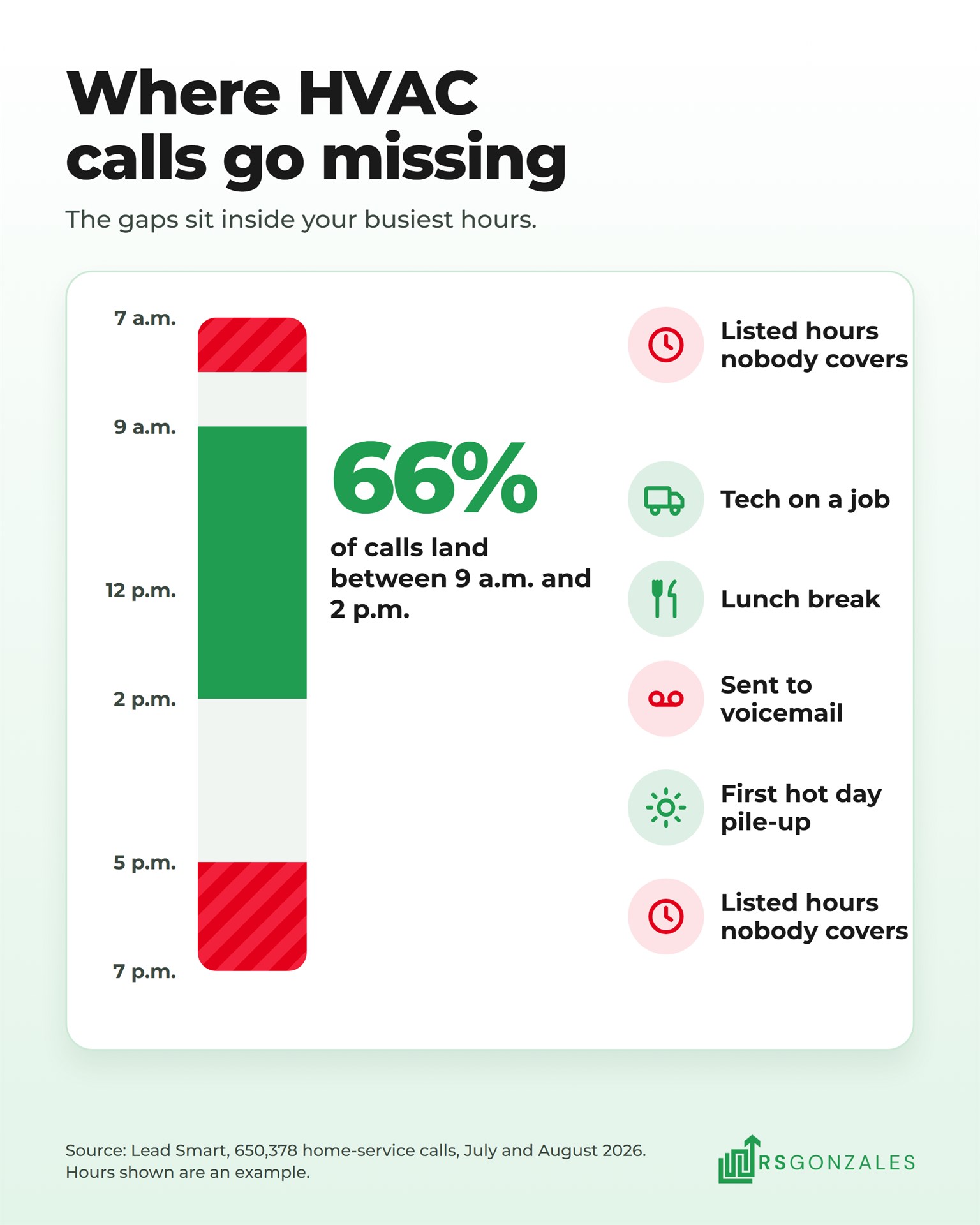
Most missed LSA calls in an HVAC shop happen at predictable moments, when the person who should answer is busy with another job. Each of these gaps now shows up on your Google invoice.
1. Technicians Answering From the Truck
Many smaller shops forward the business line to the owner’s or a lead technician’s cell phone. A technician in an attic or under a condenser can’t answer with gloves on, so the call rings past 20 seconds and Google bills it. If the call rolls to that cell phone’s voicemail, Google bills it as well, and the homeowner hears a personal greeting instead of your company.
2. The Lunch-Hour and Dispatch Gap
The busiest calling hours are the hours your office is stretched thinnest. Lead Smart tracked 650,378 home-service calls in July and August 2026, and 66% of them came in between 9 a.m. and 2 p.m. That window holds lunch breaks, and it is when your dispatcher, the person who assigns jobs to technicians, is already on another line, moving the day’s schedule around.
3. Business Hours Set Wider Than Your Phone Coverage
If your Google Business Profile says 7 a.m. to 7 p.m. but someone covers the phones from 8 to 5, every missed LSA call in those extra hours is billable. Saturday hours listed for an emergency crew work the same way when nobody sits at the phones. Many owners list wide hours so they show as open in Google Maps searches, which is a fair reason. The fix is to cover those hours or narrow the ad schedule, not to hide from homeowners.
4. Calls That Roll to Voicemail
Voicemail used to be the safety net for a busy office. During business hours, Google now treats a call that reaches voicemail or a recorded greeting as connected. It bills that call after 20 seconds, whether or not the homeowner leaves a message. Invoca’s call data shows fewer than 3% of callers sent to voicemail leave a message, so most of those charges buy you nothing at all.
5. Peak-Season Overflow on the First Hot or Cold Day
On the first heat wave or cold snap of the season, calls arrive faster than one person can answer them. While your CSR, the customer service representative who answers the phone and books jobs, is on the first call, the next three ring through to voicemail. A shop that has set up its marketing to keep running when the schedule is slammed still needs a phone plan for that day. The ads keep sending calls whether anyone is free or not.
See How We Run Local Service Ads for HVAC Companies
How to Answer Every LSA Call Before Google Bills It
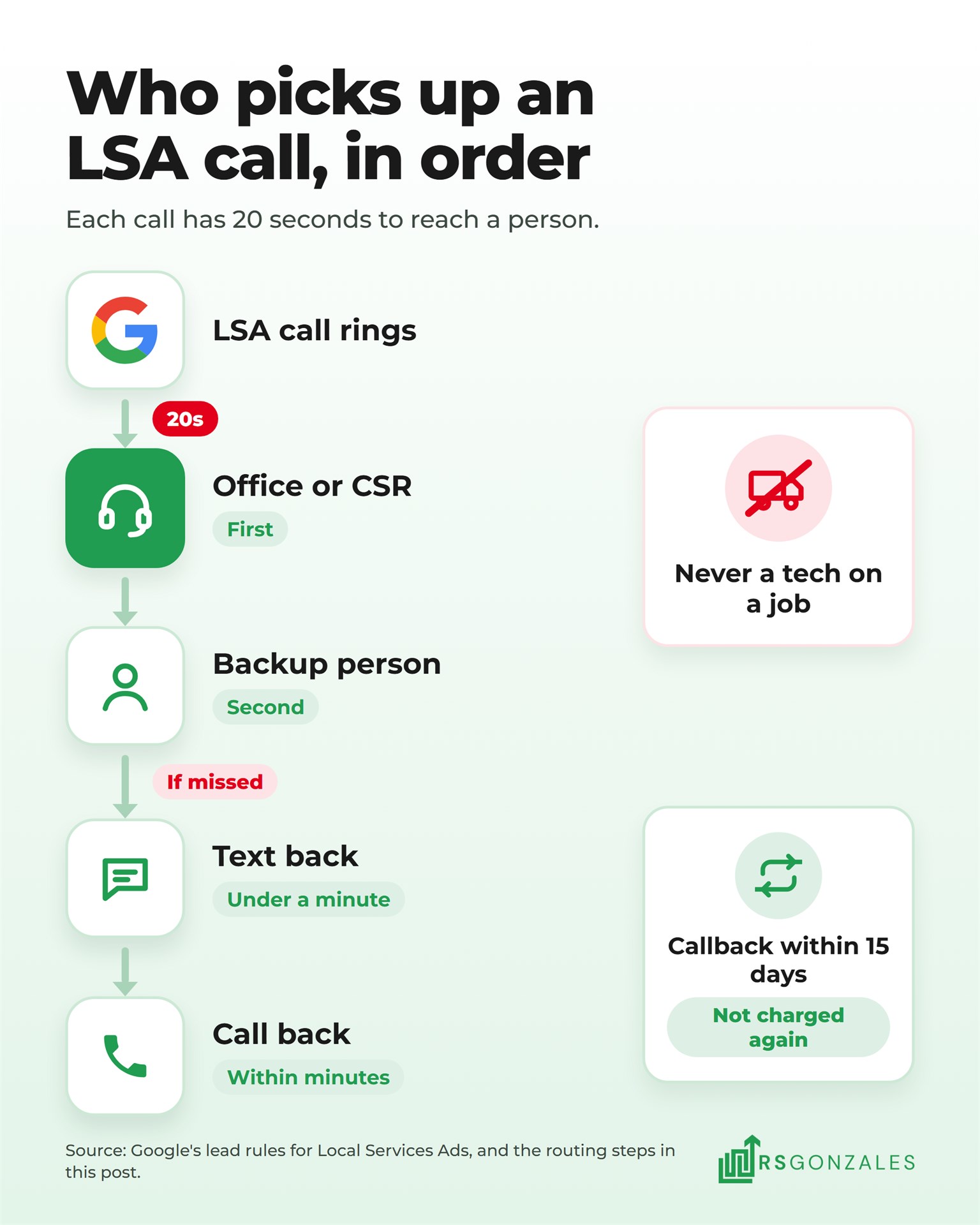
Answering every LSA call takes two things: someone free to pick up within 20 seconds, and a fast reply to the calls that still slip through. These steps cover both, in the order most HVAC shops can set them up.
1. Match Your LSA Ad Schedule to the Hours Someone Answers the Phone
In your Local Service Ads settings, choose custom hours that match your phone coverage, or cover the hours you want to keep. Keep the hours on your Google Business Profile accurate too, because Google uses them to decide what counts as business hours. Google Business Profile optimization keeps those hours, services, and service areas consistent across Google.
2. Send LSA Calls to the Person Whose Job Is the Phone
Set your call routing so Google’s forwarding number rings the office or your CSR first, then a backup person, and never a technician on a job. If you use a phone menu, keep it to one short choice. Google starts the 20 seconds at the first key press, and a caller who hangs up at the menu is still a lost job.
3. Turn On LSA Message Leads for Nights and Weekends
Message leads let a homeowner text or message you from your listing instead of calling. Google says they give customers another way to reach you, especially at night and on weekends when you can’t answer the phone. Turn them on in your Local Service Ads account, and send the message alerts to whoever covers nights, so a homeowner who writes at 9 p.m. gets a reply before trying someone else.
4. Text Back Every Missed HVAC Call in Under a Minute
A text-back does not cancel the charge, but it can save the job you already paid for. The HVAC CRM included in every RS Gonzales plan texts back missed calls in under a minute and syncs with ServiceTitan, Housecall Pro, Jobber, and FieldEdge.
5. Call Back Every Missed Homeowner Within Minutes
Google does not charge again when the same homeowner calls or messages within 15 days of their first contact, so the callback costs you nothing extra. It also catches the homeowner before they reach the next company on the list.
6. Give Your Other HVAC Marketing Channels Their Own Tracking Numbers
A call tracking number is a separate phone number that forwards to your office and records where each call came from. LSA calls already come through Google’s own forwarding number, so add one for your Google Business Profile and one for your website. Then a drop in calls from Google Maps shows up as a channel problem rather than a mystery.
HVAC Answering Service, AI Voice Agent, or In-House CSR: Which Fits Your Shop?
Most HVAC shops need a second line of answering behind the office for lunch, overflow, and after hours. The three common options differ most on cost, coverage, and whether they can book the job. The answering service and AI voice agent prices come from each provider’s own website, as of November 2026. The CSR wage comes from the US Bureau of Labor Statistics.
| Live answering service | AI voice agent | In-house CSR | |
|---|---|---|---|
| What it costs | Ruby: $395 a month for 100 minutes. Abby Connect: $329 a month for 100 minutes | ServiceTitan’s AI Voice Agent: from $2.75 a call. Sameday AI: from $449 a month for 500 minutes | $21.53 an hour, the median wage for customer service representatives in May 2025, before benefits and payroll taxes |
| What it does | A live person answers in your company’s name and follows your script | Software answers in a natural voice, asks your questions, and books or routes the call | A member of your team answers, books, and handles follow-up |
| Can it book the job? | Often takes a message or books into a calendar, and few name HVAC field-service software | Some book straight into ServiceTitan or similar software | Yes, into whatever software you run |
| What the homeowner hears | A trained stranger reading your script | A voice that sounds human but is not | Someone who knows your technicians, prices, and service area |
| Where it fits best | Lunch and overflow cover for a small shop | After hours and peak-day overflow | Shops with enough calls to fill a full-time seat |
Pick by when you miss calls. A shop missing a few calls at lunch can often cover that gap with an answering service’s smallest plan. A shop missing calls all through peak season needs more people on the phones, human or AI. An overflow plan sized for a normal day breaks on the first hot one.
RS Gonzales does not sell answering services, so we have no stake in which one you choose.
See How Our HVAC CRM Texts Back Every Missed Call
What to Check on Your Local Service Ads Leads Every Week
Once the fixes are in place, fifteen minutes a week in your LSA lead list shows whether they are working. Check these five things.
Which Charged LSA Leads Were Missed Calls
Every lead in your LSA lead list shows as Charged, Not charged, In review, or Credited. Count how many charged leads were missed calls, and compare the number week to week.
Call Recordings of Missed and Short LSA Calls
Google records calls that come through its forwarding number in the US and Canada. Listen to a few missed calls and short calls to hear how far each caller got before they hung up.
Spam Calls and Wrong Numbers Google Can Credit Back
Use Rate this lead on any charged call that was spam, a robocall, or a wrong number. Google can credit low-quality leads, and most credits reach your account within 30 days.
Review Requests From the Week’s Booked Jobs
Google weighs your rating and number of reviews when it ranks your listing, so every answered call that books should end with a review request. HVAC reputation management turns that request into a habit your team follows on every job.
Cost per Booked Job for Answered and Missed LSA Calls
Add up what you paid for charged leads, then divide it by the jobs those leads booked. Do the math once for answered calls and once for missed calls, and the gap between the two numbers shows what your phone coverage cost you that week.
What HVAC Owners Should Take Away About LSA Missed Call Charges
You stop paying for missed HVAC calls on LSA by answering them, not by hiding from them. Google now bills a business-hours call that rings or sits in voicemail past 20 seconds, so every gap in your phone coverage shows up on your invoice. Your ad schedule decides when you can be billed, and your people, routing, and text-back decide whether you are billed for nothing.
Missed calls also show where the rest of your HVAC lead generation leaks, because every channel ends at the same phone. Start with these three steps:
- Pull last month’s missed LSA calls by hour. The pattern tells you whether your gap is lunch, late afternoon, Saturdays, or peak days. Your LSA lead list shows the time of each call, so sort it and count the misses in each hour.
- Line up your ad schedule with your phone coverage this week. It stops the charges for hours nobody answers, and it takes a few minutes in your Local Service Ads settings. Then decide which of the uncovered hours are worth staffing, and add cover for those.
- Set a speed to lead target your team can hit. Speed to lead is the time between a homeowner reaching out and your team replying. Research reported in Harvard Business Review found that companies contacting an online lead within an hour were nearly seven times as likely to qualify it as companies that waited longer. Aim for a text in under a minute and a call back within the hour.
Google’s change does not make Local Service Ads a worse channel. It makes an unanswered phone more expensive. The shops that answer every call keep paying only for conversations, and they have more budget left for the jobs worth paying for across their HVAC advertising.