


That week, your marketing stops too. Nobody asks for reviews, nobody chases last week’s replacement estimates, and the tune-up reminder you meant to send in September never goes out. None of it looks like a problem until the weather turns mild and the phone goes quiet, right when you finally have time to answer it.
The fix is not working harder in July or January. It is a marketing system, meaning the parts of your marketing that start on their own when something happens, like a missed call or a finished job, instead of waiting for someone to remember. Picking your goals and channels is the work of an HVAC marketing strategy, and keeping those channels running when nobody has time for them is the work of a system.
In this blog, we cover why marketing stops in the busy season, six parts that should run without you, what still needs the owner, and when to set it all up.
Why Does HVAC Marketing Stop When the Busy Season Starts?
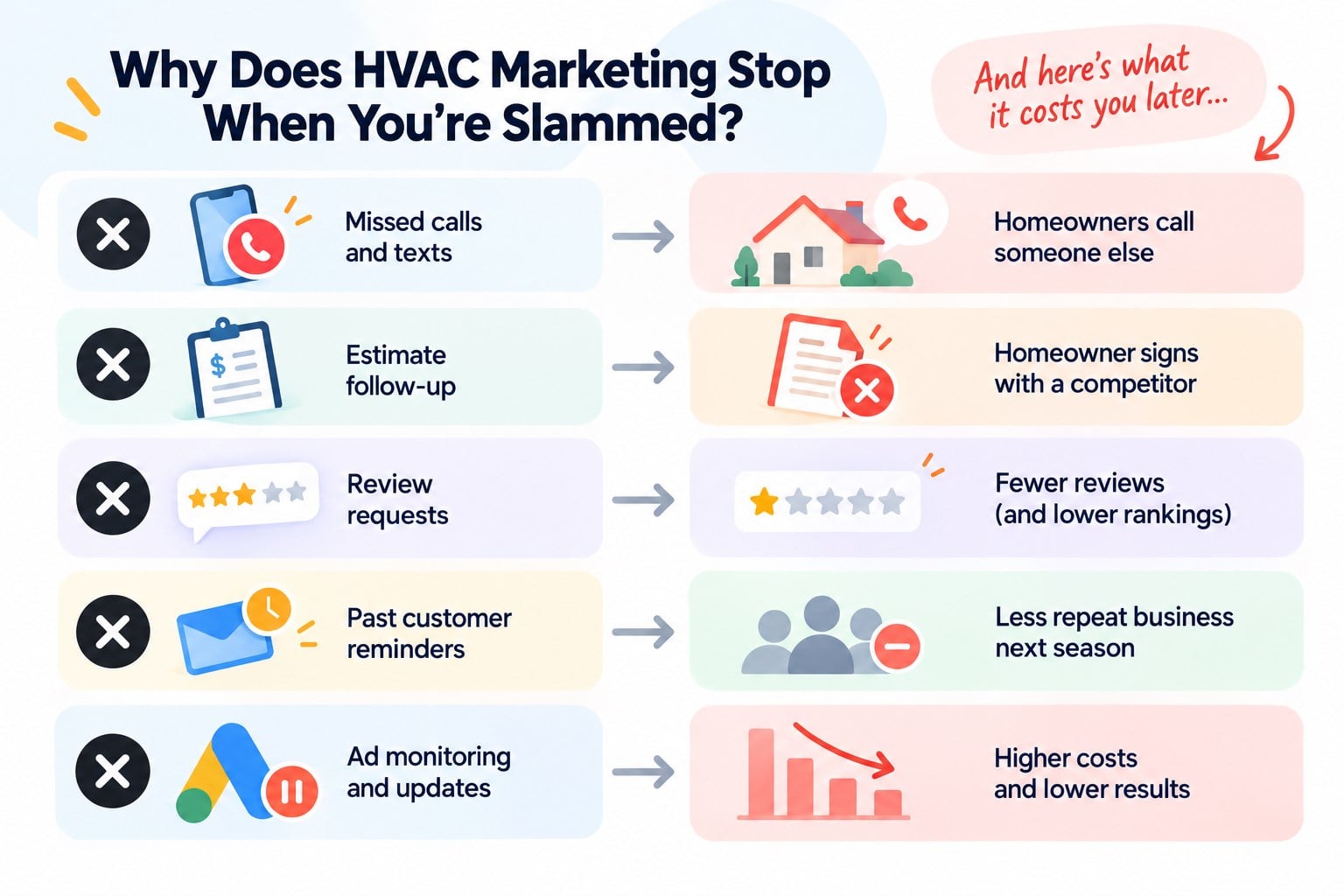
Most HVAC marketing stops in the busy season because one person does it by hand, and that person is now running calls. The owner, or an office manager who is also dispatching, handles callbacks, review requests, and follow-up between everything else. When the phone rings all day, those tasks go first, because none of them feels urgent that afternoon.
The cost shows up weeks later, in the slower season, when the work you skipped would have been filling the schedule.
| What gets dropped in a busy week | What it costs you later |
|---|---|
| Calling back missed calls within the hour | The homeowner books the next company on Google, often before you see the missed call. |
| Following up on replacement estimates | A quote for a new system sits unanswered, and the homeowner signs with whoever called back. |
| Asking for a review after each job | Your newest review gets older every week, while homeowners favor companies with recent reviews. |
| Reminding past customers about tune-ups | Maintenance customers drift to whoever reached them first, and your slow months have gaps. |
| Changing your ads when you are booked out | Ads keep buying calls you have to turn away, or get switched off and stay off for weeks. |
A marketing system closes each of those gaps with a rule instead of a reminder. When a set thing happens, a set message goes out, whether you are on a roof or asleep. The same rules run in July, in January, and in the slow weeks between, which is how a feast-and-famine year starts to even out.
Six Parts of HVAC Marketing That Should Keep Running While You’re on a Roof
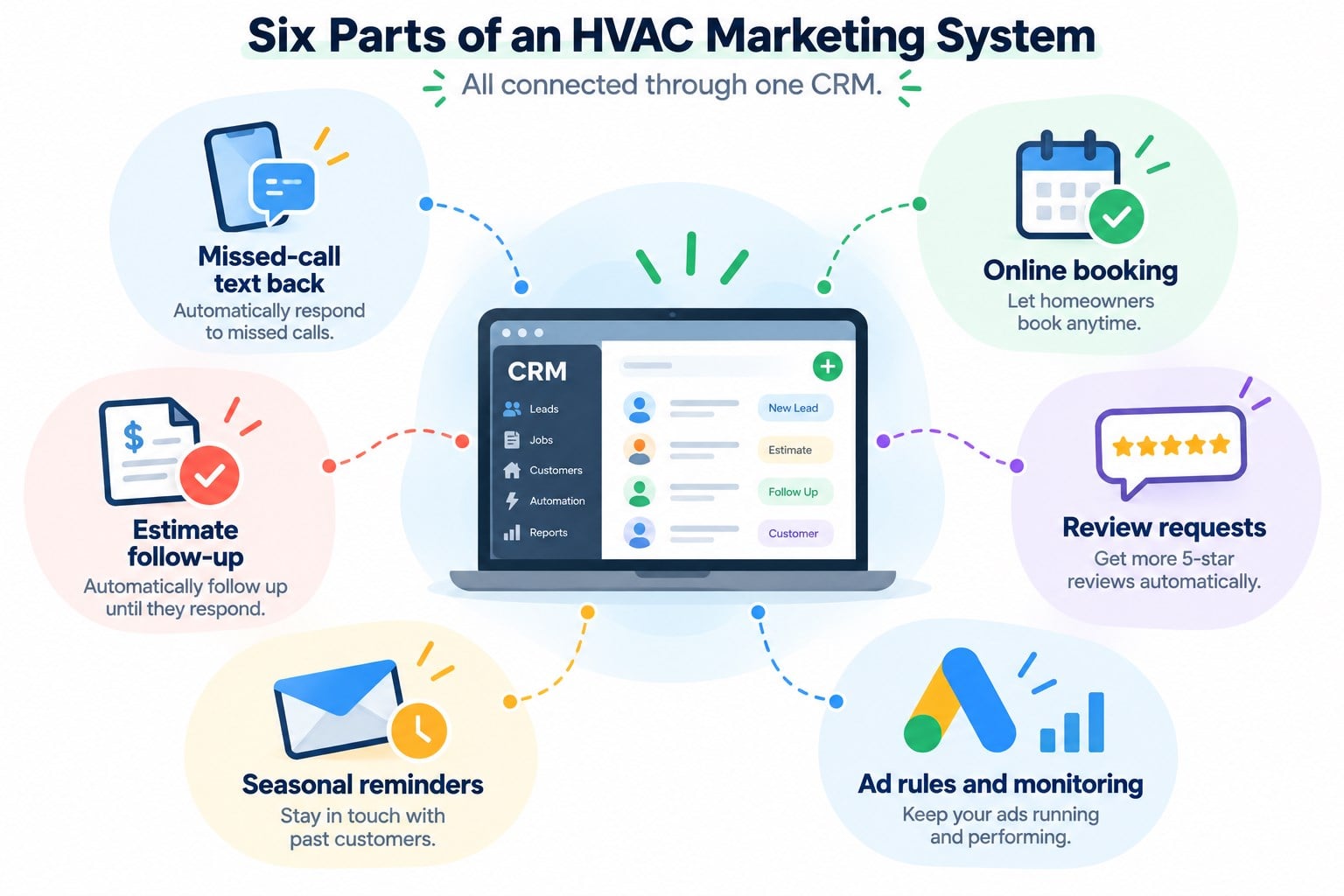
Each of these six parts replaces a task an owner usually does by hand, and each one starts on its own when something happens in your business. Most of them run inside a CRM, the software that keeps every lead, customer, and job in one place, so a call, a booking, and a review request all connect to the same homeowner.
1. Every Missed Call Gets a Text Back Within a Minute
You cannot answer the phone with your hands in a furnace, and many homeowners who reach voicemail hang up without leaving a message. They call the next company on the list instead. A missed-call text back sends the caller a message automatically, usually within a minute, such as “Sorry we missed you, we’re on a job. What’s going on with your system?” The call becomes a text conversation that you or your office can pick up between jobs.
It matters for your ads too. Local Services Ads are the listings at the top of Google with the green Google Guaranteed check, and they rank partly on how quickly you respond. Google’s own guidance says missed calls may count against your responsiveness, so every unanswered call can push those ads lower.
2. Homeowners Can Book a Time Without Calling You
Plenty of homeowners would rather pick a time slot than wait for a callback, especially at 9 p.m. once the house is quiet. An online booking calendar on your website and your Google Business Profile lets them choose an open slot and get a confirmation by text. Your schedule fills while you work, and every job booked this way saves a round of phone tag.
Set the calendar to show only the job types and hours you want to sell online. That way a homeowner can book a tune-up or a repair visit into a set window, and a full system replacement still starts with a conversation.
3. Every Replacement Estimate Gets a Follow-Up
A replacement estimate is the most expensive lead to lose to silence. A homeowner collecting three quotes for a new system tends to sign with the company that kept the conversation going. Following up by hand works in a slow month, and then the busy season starts and two-week-old estimates are the first thing to slide.
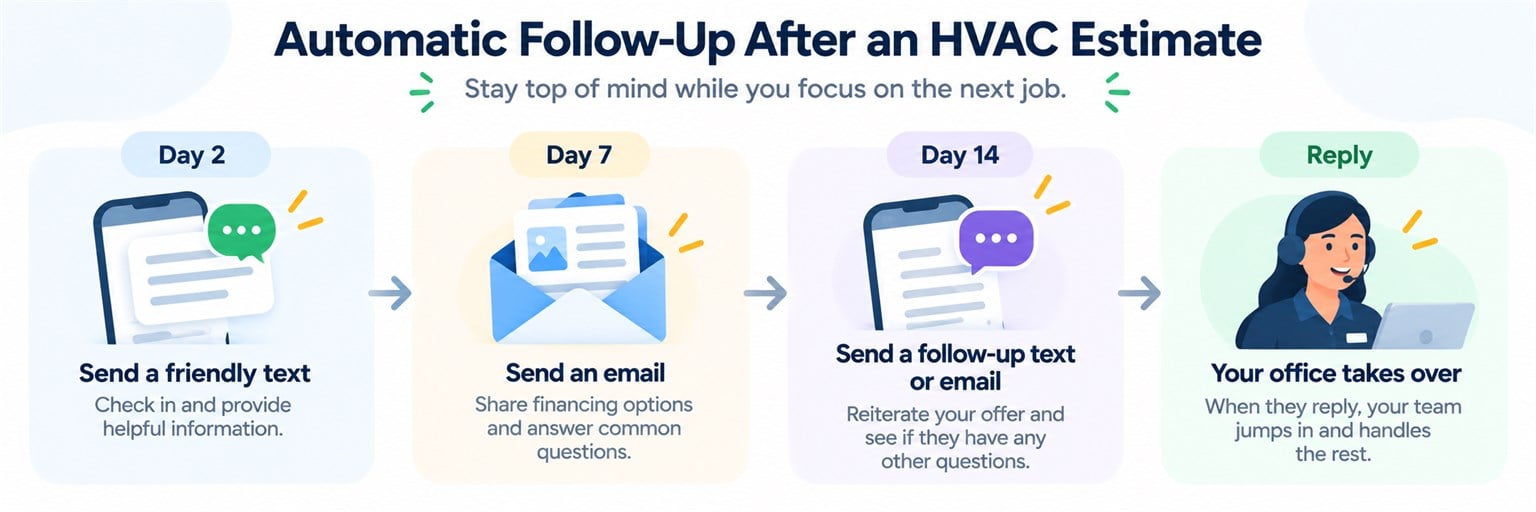
An automatic follow-up keeps that conversation going for you. Each message answers a question homeowners ask about a new system, and the sequence usually runs like this:
- A text two days after the estimate. A short check-in asking whether they have questions, sent while your visit is still fresh in their mind.
- An email after one week. Your financing options, for the homeowner who liked the system and is now weighing the cost.
- A text or email after two weeks. The warranty and how long the install takes, so the homeowner knows what happens once they say yes.
- A handoff to a person when they reply. The moment the homeowner answers, the automatic messages stop and someone from your office takes over the conversation.
4. Every Finished Job Sends a Review Request
When a technician marks a job complete, a text goes to the homeowner with a direct link to your Google review page. It arrives while the repair is still fresh, which is when a homeowner is most willing to write a few lines, and it does not depend on anyone remembering at 6 p.m.
Recency is why this has to run every week of the year. BrightLocal’s 2026 consumer survey found that 74% of people look for reviews from the last three months, so a review count that stalls through a busy summer looks stale by fall. Tying the request to the job status, rather than to someone’s memory, is how HVAC review management keeps new reviews arriving in your busiest month.
5. Past Customers Hear From You Before Each Season Turns
Every household you have served is a homeowner you can reach without buying an ad. A system sends them a furnace tune-up reminder in early fall, an AC reminder in spring, and a renewal notice before their maintenance agreement runs out. Each one goes out on a date you set once, so it still sends in a month when you have no time to write anything.
These reminders do two jobs at once. They fill the slower weeks with tune-ups, and they keep your name in front of the homeowner, so they call you the next time their system breaks instead of searching Google. Seasonal email and text campaigns for HVAC customers can be written months ahead and loaded before the rush.
6. Your Ads Follow Rules You Set Before the Rush
Ads are the one part of marketing that can work too well in the busy season. When you are booked out for a week, every emergency call an ad brings in is a call you have to turn away. Many owners switch all their ads off, then forget to switch them back on until the phone has already gone quiet.
Set the rules before the rush instead:
- An ad schedule. Your ads run only during the hours your office can answer the phone.
- A daily budget. It sets the most you will spend in a day, so a heat wave cannot run up a bill your crew cannot work off.
- A plan for full weeks. When the schedule is full, move money toward tune-ups, maintenance agreements, and replacement estimates, which can be booked for next week. Splitting your ad budget by the kind of job each platform books makes that move a decision you make once.
See How We Set Up and Run Your HVAC CRM
What Still Needs an HVAC Owner, Even With a Marketing System?
A marketing system handles the tasks that repeat. It does not replace the owner, and four jobs still need a person. Each one takes less time once the repetitive work is off your plate.
Calling Back the Leads the Marketing System Catches
A missed-call text back keeps a homeowner from calling the next company for a little while, but it does not book the job. Someone still has to read the reply, price the work, and put it on the schedule the same day. Decide who checks new texts and when, such as at lunch and at the end of each day, so a lead the system caught does not go cold in the inbox.
Replying to Google Reviews in the Owner’s Own Words
The review request can go out on its own, and the reply should come from you. A reply signed by the owner that mentions the job or the technician tells the next homeowner a person runs the company. A copied template reply reads like a call center, which is the impression a local company works hardest to avoid.
Changing the Offer When the Weather Changes
A system sends what you loaded into it, and it cannot read the forecast. When a cold snap comes early or a heat wave runs long, someone has to update the offer, the seasonal reminder, and the ads. An early freeze might mean sending the furnace tune-up reminder two weeks sooner and pausing an AC offer that no longer fits.
Checking Your Marketing Numbers Once a Month
Thirty minutes a month with your booked jobs, missed calls, and cost per booked job tells you whether the system is working. Cost per booked job is what you spent on marketing divided by the jobs it booked, and it tells you more than cost per lead, because a cheap lead that never books is not cheap. If missed calls are climbing or estimates are going quiet, the numbers show you which part of the system to fix first.
The system does the remembering, and you still make the calls that need judgment.
A Week-by-Week Plan to Set Up Your HVAC Marketing System Before the Rush
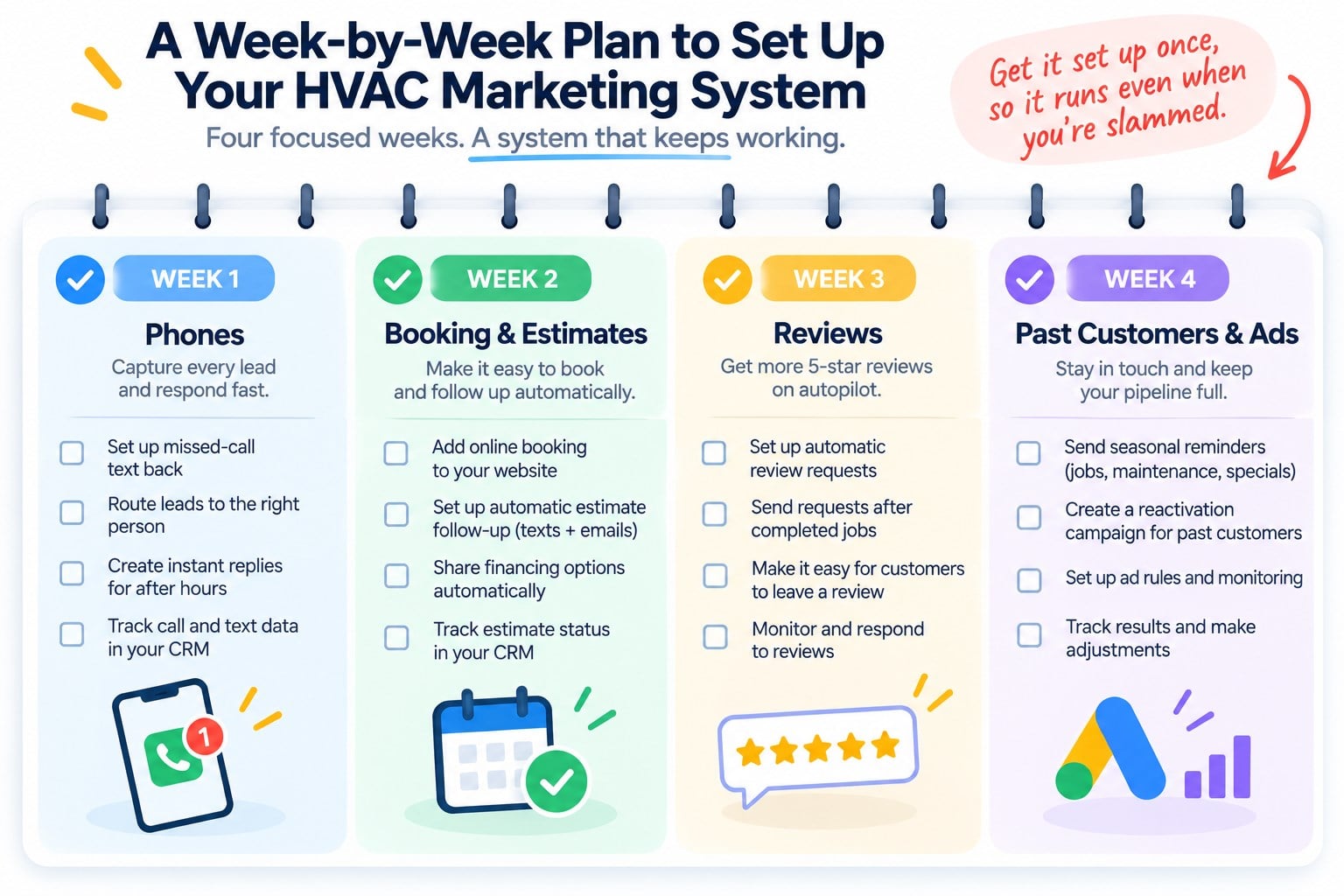
The best time to build a marketing system is the shoulder season, the slower weeks in spring and fall between the heating and cooling rushes. In October, there is still time before the first hard freeze fills your schedule. Setup needs a few weeks of decisions from you, and almost none of it gets done once the busy season starts.
Build it in this order, one week at a time, so the parts that save the most jobs go live first:
- Week 1: Phones. Turn on missed-call text back, decide who answers after hours, and call your own number at 7 p.m. to test both.
- Week 2: Booking and estimates. Add online booking to your website and Google Business Profile, and load the follow-up messages for replacement estimates.
- Week 3: Reviews. Tie the review request to the job-complete status, and agree on who replies to new reviews and how fast.
- Week 4: Past customers and ads. Load your customer list, schedule the next two seasonal reminders, and set your ad schedule and daily budget.
Each week’s work feeds the next one. A missed call that turns into a booked job sends a review request when the job is done, and that same homeowner gets a tune-up reminder next season. That chain, running without you, is what turns marketing from a list of chores into a system.
Want to See Which Parts of Your Marketing Stop When You Get Busy?
The HVAC Marketing System Map walks through all six parts, asks whether each one runs on its own or waits on a person, and turns the gaps into a four-week setup plan.
Download the HVAC Marketing System Map
So What Should an HVAC Owner Set Up Before the Next Busy Season?
Every busy season tests whether your marketing depends on you. If it does, it stops when you are busiest, and you pay for that in the quiet weeks after.
Start with these three:
- Call your own business number and let it ring out. If no text arrives within a few minutes, missed-call text back is your first fix.
- Pull every replacement estimate from the last 60 days. Count how many got a second follow-up, then set up the messages that do it for you.
- Schedule your next seasonal reminder to past customers today. Pick the date, write the message once, and let it send.
You can only be on one job at a time, and a marketing system keeps answering, following up, and asking for reviews on all the others.